
Opportunities You Need To Know Beyond the Museum Walls
Welcome to 2026! A brand-new year means fresh starts and reevaluating your personal goals. We hope that you make education, learning, and decolonizing your perspective part of your 2026 plan. The Ah-Tah-Thi-Ki Museum is a fantastic place to start. It is a vital resource and priceless repository of Seminole history, culture, and the Tribe’s future. But its impact reaches far beyond its walls! If you can’t make it to the Museum itself, there is a world of information available to you beyond the Ah-Tah-Thi-Ki campus. Today, join us to explore just some of these options available to you. Happy learning!
The Online Collection
The Ah-Tah-Thi-Ki Museum offers a world of information for visitors digitally, as well as in person. The Museum Online Collection is a robust online repository of many of their photographs, objects, newspaper clippings, and more. Almost all the images that you see on our blog from the Ah-Tah-Thi-Ki Museum can be found through the Online Collection. The Museum cares for more than 200,000 unique objects, ranging from military ephemera to dolls and patchwork.
The Online Collection shows a robust picture of the Museum’s diverse collections. While not every item is available online, many can be accessed. High quality pictures and scans are available for you to explore at your leisure. Each catalog entry also contains relevant background information, detailed identification information, and provenance of the items. Behind the scenes, the Museum also cares for and maintains a large reference and research library. You can learn more about how to interact with the Online Collection here in a previous blog post!
Online Resources
Beyond the Collection itself, the Museum has curated and created a number of online resources, educational frameworks, reading lists, and other educational materials that are available for free online. They offer curriculum plans in a variety of age ranges for some topics. One of these includes Egmont Key, which is explored more below. Others include previous exhibits, photography collections, and activities. These are a great resource for children of all ages, and there are multiple versions of each curriculum that adjusts with age. Reading lists allow you to explore more learning opportunities on your own time. Additional resources include coloring pages, paint by number sheets, and introductions to Museum research and how it is conducted.
An online archive of the Ah-Tah-Thi-Ki Museum blog is a great source of information on their inner workings, previous projects, and what it means to work for the Museum. A select few previous exhibits are also hosted online. Although they are not hosted in their entirety, these online exhibits are an incredible look into some of the greatest exhibits previously hosted by the Museum. Some of them, such as “It’s Not A Costume,” have been revisited multiple times for this blog, and are a wonderful educational resource! It is well worth your time to explore the Ah-Tah-Thi-Ki Museum website, and all it has to offer.
The Land is Your Classroom
The Ah-Tah-Thi-Ki Museum works very, very hard to make the Seminole story accessible and available to everyone. Outside of their many online resources, they have partnered with a number of other Museums, learning institutions, and parks in order to amplify Seminole voices. Outside of the Museum itself a great place to start visiting is places and spaces that are important to Seminole history, and maybe even feature Seminole voices and perspectives. We have featured a number of different places in our Seminole Spaces series.
Need a place to start? Below are three places that the Ah-Tah-Thi-Ki Museum and Seminole voices have helped create an honest narrative about Seminole history. You can also learn more about many of these places in the Ah-Tah-Thi-Ki Museum Online resources, on our blog, and from other Seminole Tribe of Florida departments!
Before visiting these places, we encourage you to do your research, and approach them with the appropriate mindset. Seminole history is one that is marked by violence, sacrifice, and loss. Please be respectful.
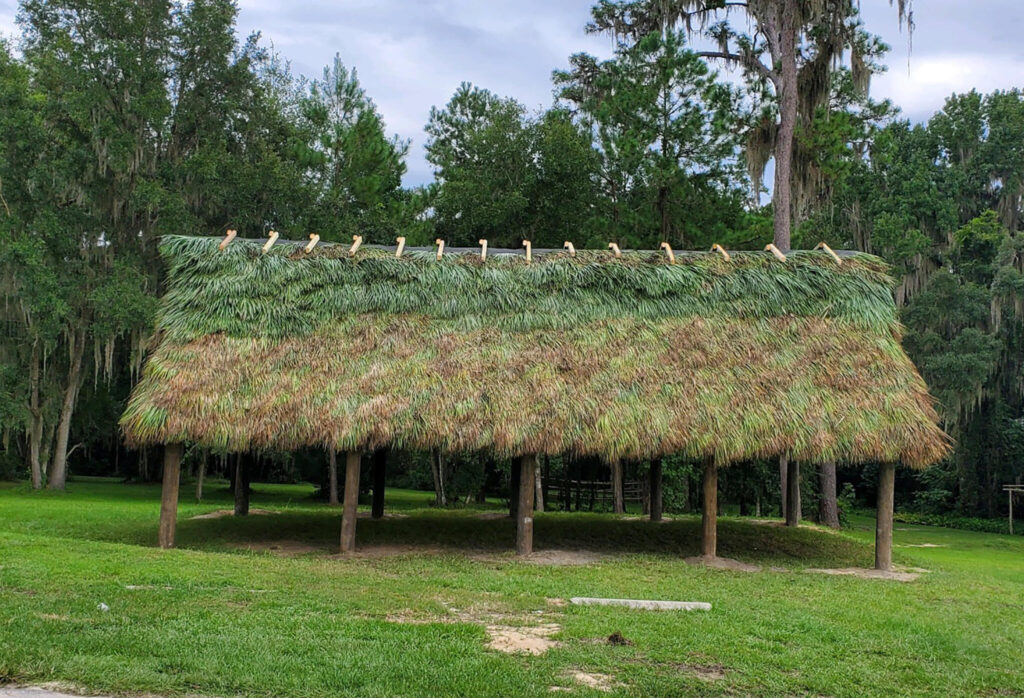
Chickee at Fort King National Historic Landmark
Fort King
Located outside Ocala, Fort King was a key fort for the United States during the Seminole War period. Named after U.S. Army Colonel William King, it played a pivotal role particularly during the second phase of the war period. It was originally constructed to place pressure on Seminoles, forcing them deeper into the Everglades, as well as protecting U.S. supply lines. It was also strategically constructed to monitor Seminole movements at Silver Springs. On Christmas Eve 1835, Osceola launched an attack on Fort King, culminating in the death of Indian Agent Wiley Thompson. This event was a major catalyst for the Second Seminole War.
Seminoles would burn Fort King down in 1836, nine years after its original construction. Although it was eventually rebuilt and later used as a courthouse, settlers would demolish it for supplies after it was abandoned for a second time. The Fort King National Historic Landmark is now located on the site. The military fort, with as much accuracy as possible, was reconstructed in 2017 with support from the Fort King Heritage Foundation.
In 2021 the Seminole Tribe of Florida constructed a chickee on site as part of a planned expansion of the complex. “The tribe has been instrumental working with us in the way their story is told; it shouldn’t be our interpretation but their interpretation of their history,” said Bill Rodriguez, head of Ocala’s parks division in a Seminole Tribune article. “We have a very strong relationship with the tribe. We are the first group to come to them before anything was actually done to get their input and participation in the project. It’s extremely important to have all parties involved in the telling of the story.”
They also annually host the Fort King Festival, a two-day event that features living historians, crafts, games, workshops, activities, vendors, food, and reenactments each December.
Okeechobee Battlefield State Park
Lake Okeechobee and the surrounding area have a long history of Seminole and Seminole ancestor occupation. The water from the lake fed vital waterways that supported hunting and canoeing areas. It would also play a significant role in the Seminole War.
Located on the northernmost tip of Lake Okeechobee, the Okeechobee Battlefield State Park was the site of one of the most impactful battles of the Seminole War period. It is located on a portion of the original historic battlefield.
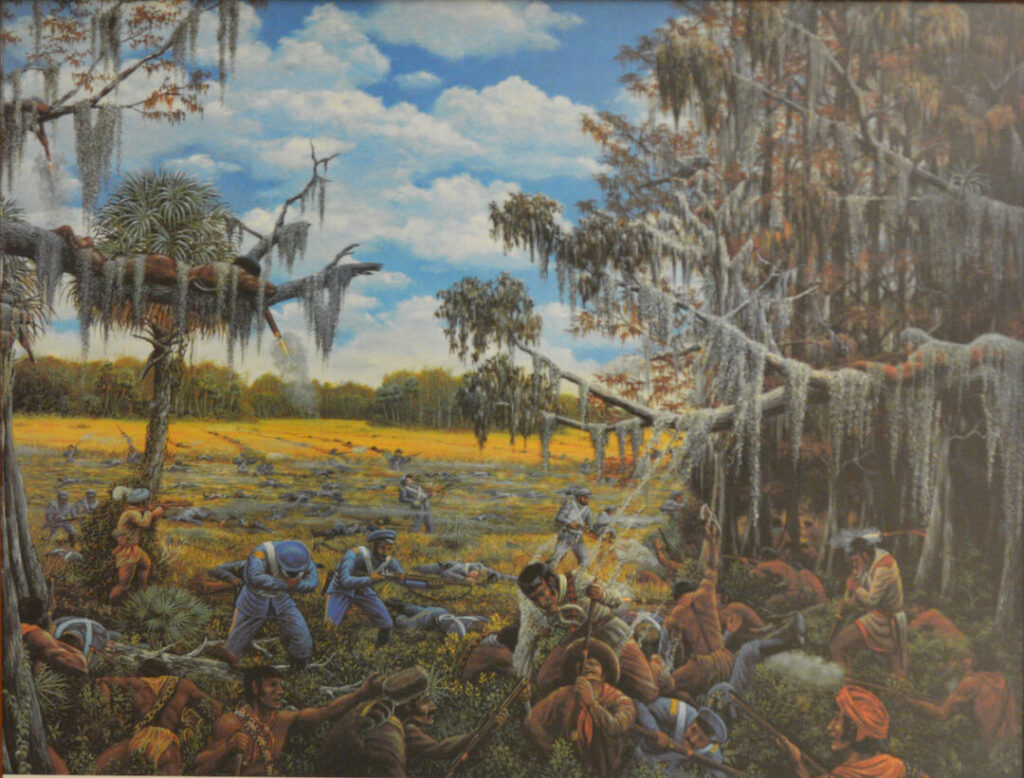
Fought on Christmas Day 1837, a group of Seminole warriors would go up against a contingent of U.S. Army soldiers led by Colonel Zachary Taylor. They were outnumbered 2:1. Seminole leaders Alligator, Billy Bowlegs, Abiaka (Sam Jones) and the recently escaped Coacoochee comprised the Seminole side. At the end of the battle, the Seminole resistors were able to escape and continue the fight against Indian Removal. They suffered the loss of 11 warriors, with 14 injured. Above, you can see an oil painting titled “Battle of Okeechobee” by famed Florida painter Guy LaBree.
Today, the park is open for visitors and also includes a chickee on site maintained by Seminole builders. Annually there is a historic reenactment of the Battle of Okeechobee. The reenactment features a number of Seminole actors. This year’s event is being held February 28th through March 1st.
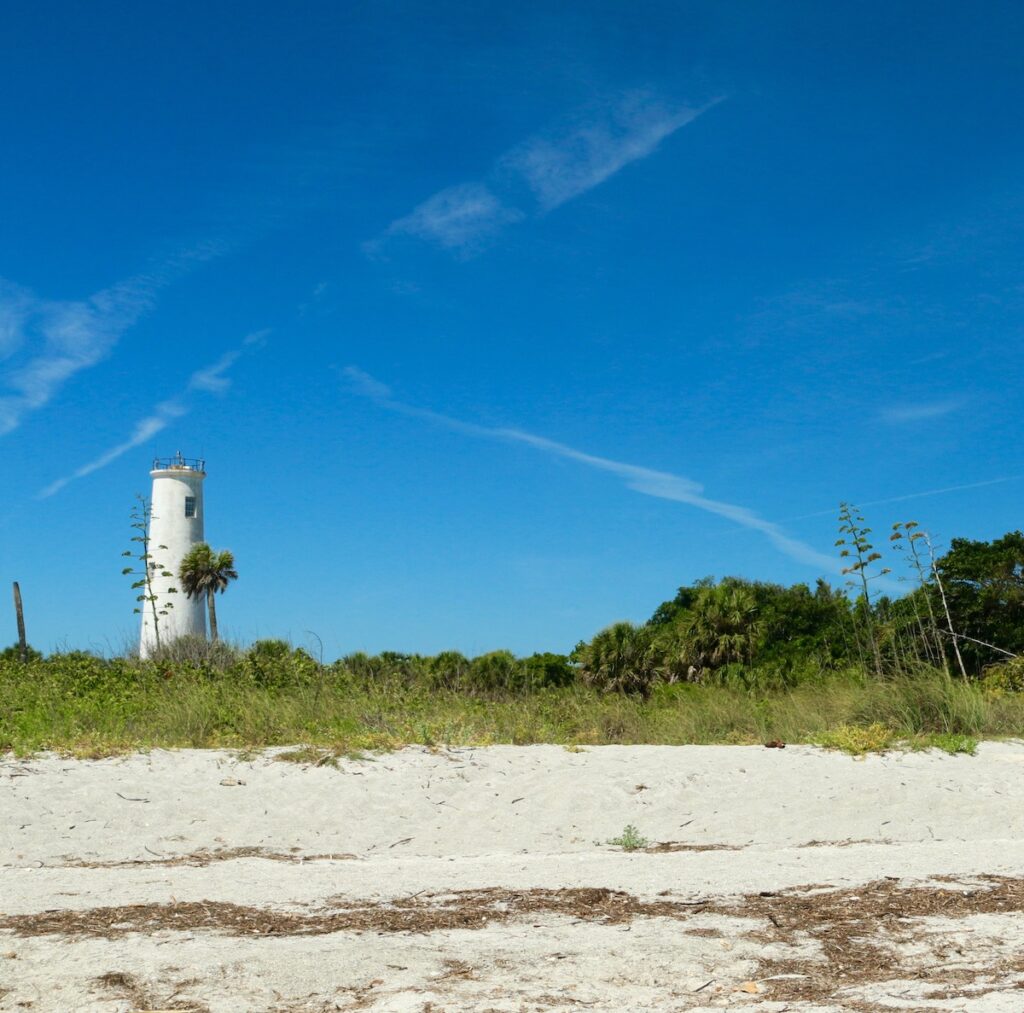
Egmont Key
Egmont Key is a small island located in Tampa Bay. Today, it is known as Egmont Key State Park and Wildlife Refuge. But, it holds a dark history. Only accessible by boat, the key was at one time an internment camp for Seminole prisoners as they were transported north. The United States Army would select the key as a strategic prison camp in the 1850s.
Hundreds of Seminoles were imprisoned at Egmont Key before being transported north to the Creek Reservation in present-day Oklahoma. Captured or surrendered Seminoles were first removed from South Florida and held at Fort Myers. From there, they were placed aboard the steamer Grey Cloud and taken to Egmont Key. After their imprisonment, the captives were transferred to St. Marks and then transported farther north through New Orleans to Fort Gibson.
For many Seminoles, Fort Gibson marked the final stop on the Trail of Tears before they were forced on to federal reservations. Seminoles have described it as “The Dark Place,” “Our Alcatraz,” and a concentration camp. Polly Parker is one of the only Seminoles we know who definitively escaped this Seminole Trail of Tears. She would escape at St. Marks and walk over 150 miles home to Okeechobee. Today, her descendants make up an important part of the Seminole Tribe of Florida. Seminoles like Parker, who resisted removal, escaped, or fled U.S. Army efforts would go on to build the Seminole Tribe we know today.
Egmont Key is open for visitors, although we caution you to be respectful and take care when visiting. It is accessible by tour boat only. A few years ago the STOF Tribal Historic Preservation Office, in conjunction with a number of other departments (including the Ah-Tah-Thi-Ki Museum) and Tribal members, released “Egmont Key: A Seminole Story.” This book not only goes into the Seminole history of the key, but also the continued impact and Seminole perspective. We encourage you to read the publication, which is available as a pdf at the link above.
Bonus! Okalee Seminole Indian Village
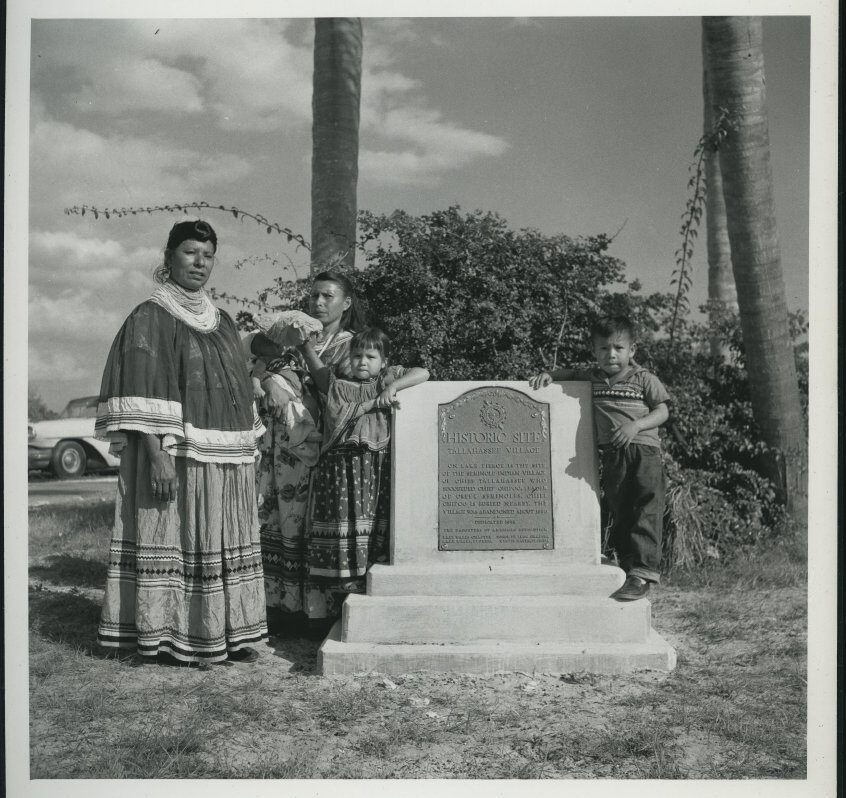
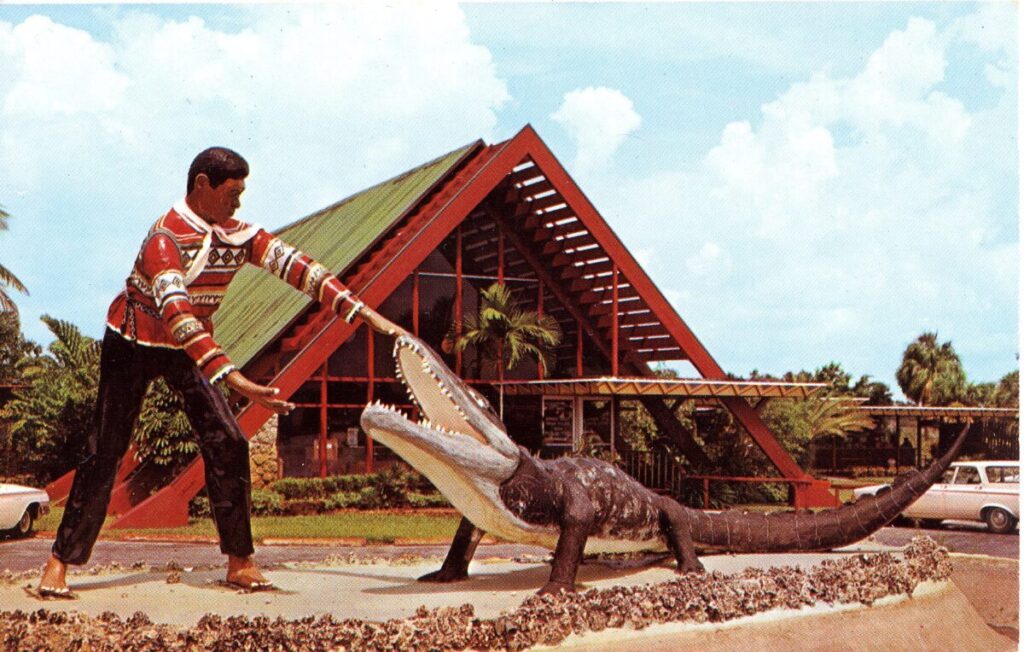
Did you know that the Ah-Tah-Thi-Ki Museum has a second location? The Okalee Indian Village opened originally in the 1950s, with the Okalee Arts & Crafts Center opened officially in 1960. It was the first official business venture of the Seminole Tribe of Florida. The original center (above) featured a statue of Jack Willie (of Pointing-Man-Sign fame!) alligator wrestling.
The Tribe built Okalee primarily as a tourist attraction. They built numerous chickees, where men and women would demonstrate arts, crafts, and various parts of daily life on the reservations. Additionally, they included a small zoo on the property, complete with alligator wrestling pits. In many ways it was a “classic” Seminole tourist attraction, focused on alligator wrestling and arts and crafts. It represented a huge step forward for Seminole agency, where for the first time they were completely in control.
It also became an iconic part of Seminole history, with the striking A-frame roof of the center and statue in front of the doors being forever linked with Seminole history. The original Arts and Crafts center sowed the seeds of what would become the Ah-Tah-Thi-Ki Museum. Although the original structure is no longer there, the Seminole Tribe of Florida rebuilt the grounds. Today, Okalee is still used as a museum space for events, exhibits, and gatherings. We encourage you to stay up to date on the Ah-Tah-Thi-Ki Museum and Okalee Indian Village’s social media! Check back in in April for Okalee’s “Earth Day the Native Way” event.
Events
Looking to learn more about the Seminole story and culture? There is a great lineup of events with the Seminole Tribe of Florida and the Ah-Tah-Thi-Ki Museum for 2026. We encourage you to come out, bring friends and family, and have a great time with the Seminole Tribe!
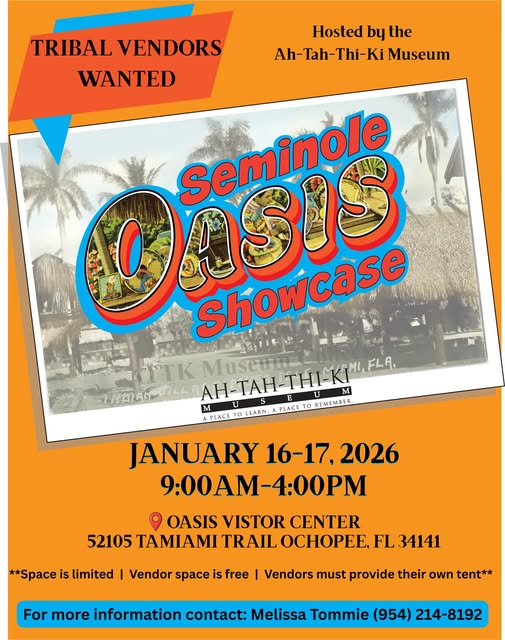
Oasis Seminole Showcase
Join the Ah-Tah-Thi-Ki Museum at the Oasis Visitors Center January 16-17th for the Oasis Seminole Showcase. Featuring Seminole vendors of all kinds, this unique showcase of Seminole culture is located at the visitor center in Big Cypress National Preserve.

Seminole Tribal Fair & Powwow
Kicking off festival season with one of the biggest events of the year, the Seminole Tribal Fair and Pow Wow is January 30-February 1, 2026 at the Seminole Hard Rock Hotel & Casino Hollywood. Featuring a dazzling lineup of pow wow exhibition dancing, drum competitions, arts and crafts, food, and music. Open to all, this is an incredible cultural celebration in the heart of South Florida with over 55 years of tradition. Check back later this month for an in depth blog post all about this event!
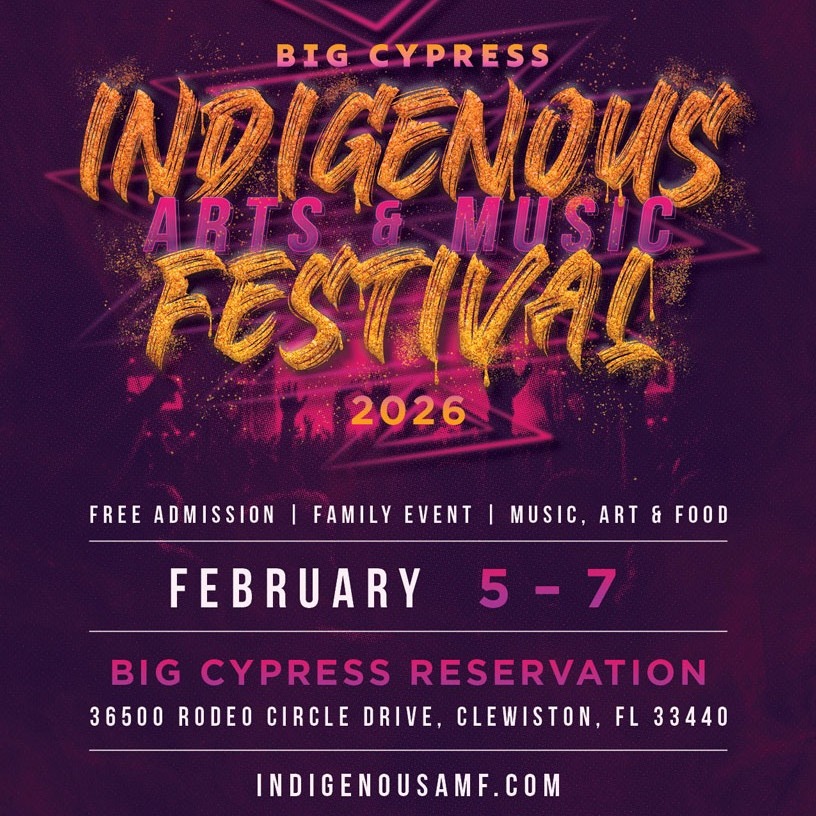
The Indigenous Arts and Music Festival
Back for the 4th annual celebration, the Big Cypress Indigenous Arts and Music Festival is February 5-7th at the Junior Cypress Entertainment Complex. Located just down the road from the Ah-Tah-Thi-Ki Museum, this festival is a fantastic mix of Indigenous music, art, and culture. With everything from rap to country, the festival pulls from the best Indigenous artists to create a one-of-a-kind cultural experience

Brighton Field Day Festival
This year’s Brighton Field Day Festival is February 19-22, 2026 on the Brighton Seminole Indian Reservation. Featuring a full PRCA Rodeo, Xtreme Bulls, alligator wrestling, carnival rides, authentic Native arts and crafts, food, and music, this event is one you won’t forget. Headliner Tucker Wetmore performs with Dasha on February 21st. Tickets are available now at TicketWeb.
Exhibits
There are also a number of current exhibits that feature Seminole art and artists, with some also developed in collaboration with the Ah-Tah-Thi-Ki Museum. Wherever you are in the Sunshine State, you are sure to find something to visit and enjoy.
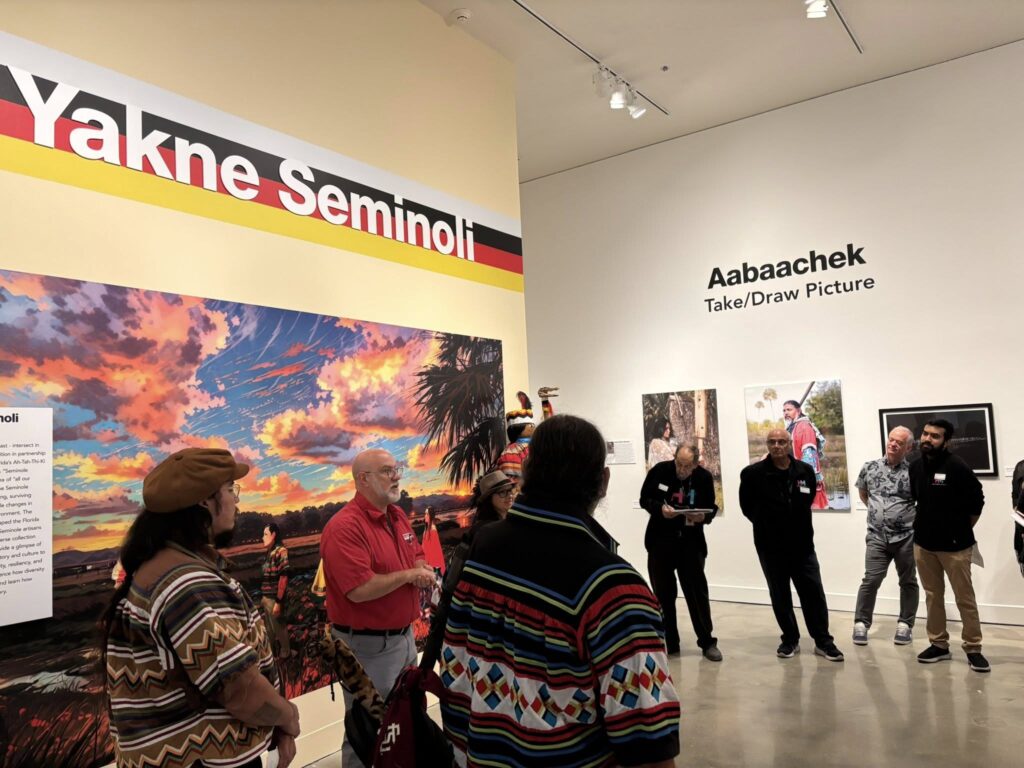
Yakne Seminoli at History Miami
Opened November 1st, 2025 this exhibit is a collaboration with the Ah-Tah-Thi-Ki Museum and the HistoryMiami Museum. Yakne Seminoli, which roughly translates to “Seminole World,” showcases over 25 Seminole artists, including: Jimmy John Osceola, Brian Zepeda, Erica Deitz, Wilson Bowers, Elgin Jumper, Virginia Osceola, Gordon Oliver Wareham, Jojo Osceola, and Bobby Henry.
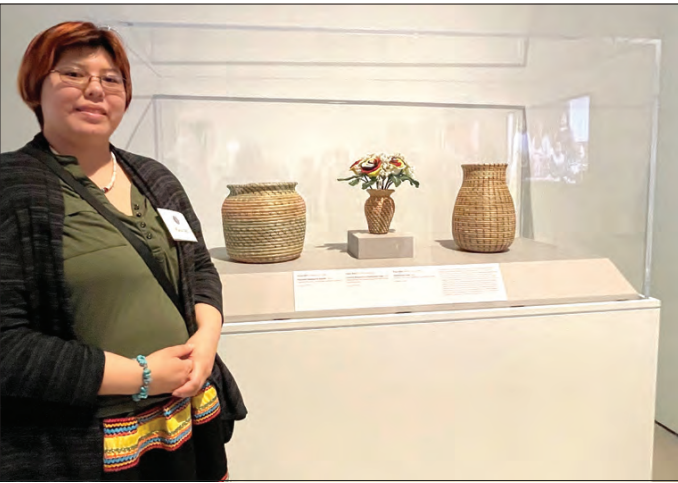
Ancestral Edge: Abstraction and Symbolism in the Works of Nine Native American Women Artists
Running until April 12, 2026 at the John and Mabel Ringling Museum of Art in Sarasota, this exhibition brings together works by nine contemporary Native American artists making significant contributions to the field of abstraction. These artists include Teresa Baker (Mandan/Hidatsa), Natalie Ball (Klamath/Modoc), Kiana Bell (Seminole, pictured above), Elisa Harkins (Cherokee/Muscogee [Creek]), Erica Lord (Iñupiaq/Athabascan), Sarah Sense (Chitimacha/Choctaw), Sara Siestreem (Hanis Coos), Marie Watt (Seneca/German-Scot) and Dyani White Hawk (Sičáŋǧu Lakota).
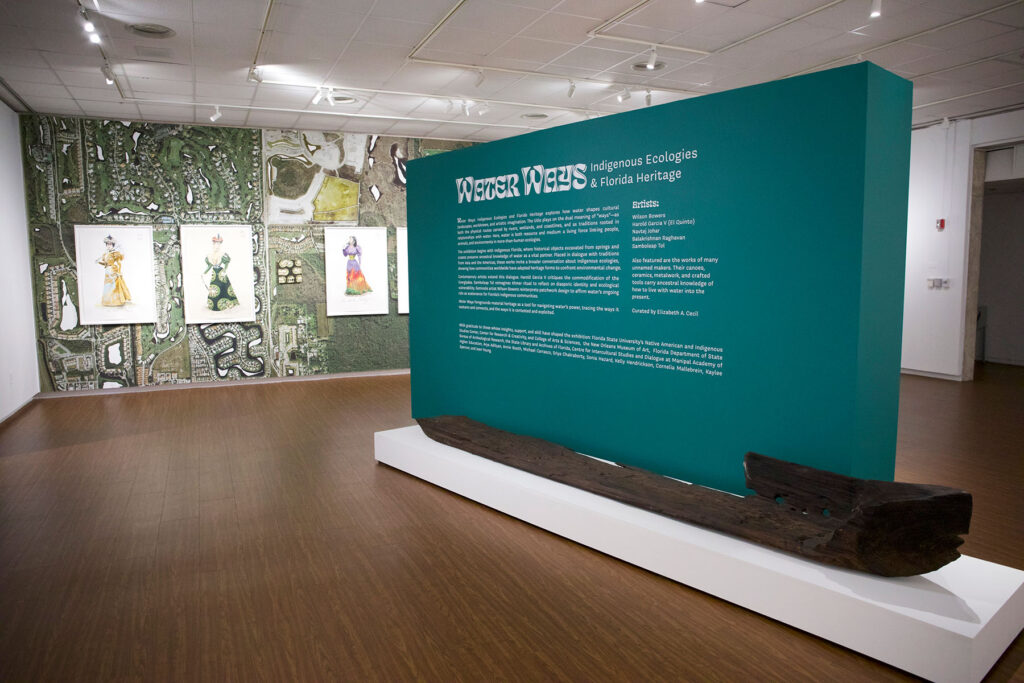
Photo by Jamie Rager via the Florida State University News
Water Ways at FSU’s MOFA Gallery
Exhibiting now through March 14, 2026 is “Water Ways: Indigenous Ecologies and Florida Heritage” at FSU’s MOFA Gallery. One of the featured artists is Seminole Tribe of Florida member Wilson Bowers, who “reimagines tribal patchwork designs across varied media, like murals and skateboards, to sustain Indigenous heritage.” Bowers is joined by two other featured artists Harold García V (El Quinto) and Samboleap Tol.
Above, you can see an installation view of “Water Ways: Indigenous Ecologies and Florida Heritage,” on display at the Florida State University Museum of Fine Arts through March 14, 2026.