
What Actually Happened: Powerful Propaganda in a Battlefield Letter
Seminole history has been told from a colonialist point of view for hundreds of years. Only recently have there been concerted efforts made to highlight the Seminole voice in that history. Today, the Seminole Tribe of Florida works hard to elevate and highlight their history from their own words and perspective. Join us for the second installment of our blog series: Correcting the Record. In this series, we try to uncover and correct misconceptions, mistruths, and obfuscations around Seminole history and culture. This week, we are collaborating with the Ah-Tah-Thi-Ki Museum to look at a single object. Then, we are using it as a lens to look at the long-reaching ripples of the propaganda, mistruths, and misconceptions surrounding Seminoles and Seminole history.
Following the Battle of Okeechobee on December 25, 1837 Zachary Taylor would write a letter detailing the battle. It presented a certain facet of the truth as gospel. This letter would have long term impacts for Seminoles, Taylor himself, and the entire United States. But what was the reality? Today, we will be focusing on Taylor’s letter from a micro to macro viewpoint. Join us as we peel away the motivations and mechanisms behind its penning and the larger implications. You can look at Taylor’s full letter in the Ah-Tah-Thi-Ki Museum Online Collection (2002.5.1, ATTK).
This blog post has been written in collaboration with the Ah-Tah-Thi-Ki Museum’s Research Coordinator Joseph Gilbert. Keep on the lookout in the coming months for more collaborations with the Museum!
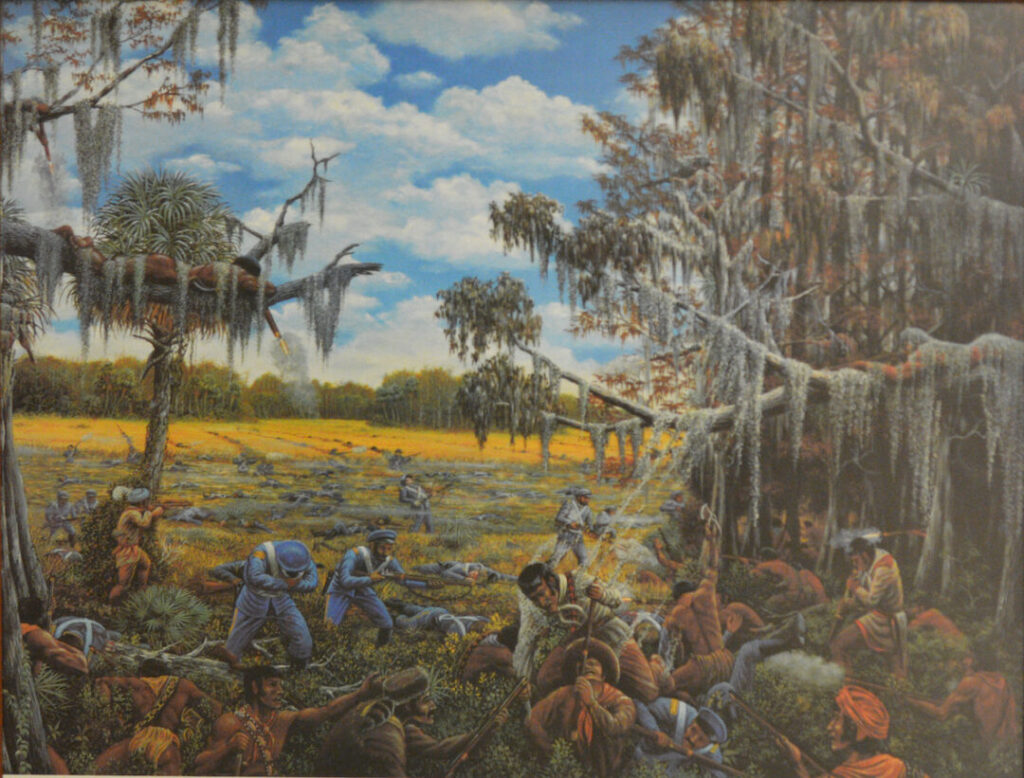
1994.4.2, ATTK Museum. Oil painting titled “Battle of Okeechobee” by famed Florida painter Guy LaBree
The Battle of Okeechobee
On December 25, 1837, a group of around 400 Seminole warriors would go up against 800 US Army soldiers plus volunteer militia led by then-Colonel Zachary Taylor. Outnumbered 2:1, the Seminole resistors managed to hold their own. They lost only 11 warriors and had 14 wounded before escaping. Seminole leaders Halpatter Tustenuggee (Alligator), Holata Micco (Billy Bowlegs), Abiaka (Sam Jones) and the recently escaped Coacoochee (Wild Cat) commanded a group of fierce guerilla fighters for the Seminole side, against Colonel Zachary Taylor’s rigid military command.
Colonel Taylor would choose to employ a frontal assault against the Seminole forces. This choice would cost the United States side dearly. It would also later play into Taylor’s narrative around the battle. At the end of the day, the Seminoles would escape the battlefield and continue their efforts of resistance against Indian removal. Zachary Taylor would go on to claim victory for the United States. But what did victory mean for Taylor, and by extension, the United States? Today, we will tease apart the many motivations, political machinations, and long-reaching effects swirling around the Battle and Taylor’s subsequent account.
Why did Taylor need a victory?
By Christmas 1837 the United States, and Taylor himself, was desperate for a victory against the Seminoles. The United States had sunk an incredible amount of money into the Seminole Wars. Although they were successful in increasing pressure on the Seminole people, they were not successful in eradicating them from the state.
The Second Seminole War, which began two years prior in 1835, was the bloodiest and costliest of the three wartime periods. It resulted in both the most casualties and the most expensive campaigns. The United States was also recovering financially from the economic depression caused by the Panic of 1837. In effect, the public was tired of the continued political and financial strain focused on Florida.
Public opinion was also shifting towards sympathy for the Seminoles. Many felt that Seminoles deserved to be able to remain in their homelands. Earning his nickname “Old Rough and Ready” during the Seminole Wars, Taylor’s image was also in a precarious spot. Although by the Battle of Okeechobee he had not yet reached national prominence, following the battle he would leverage the win to build his reputation. Victories such as this were one building block towards his greater reputation. He utlized this battlefield prowess to outweigh the less palatable tactics he employed throughout the war.
A later example of this would be Taylor’s use of bloodhounds. Taylor activated bloodhounds to root out Seminole forces starting around 1840, something that was deemed inhumane by public opinion. A political cartoon from 1848 is one example of the critical reception these bloodthirsty tactics received.
In it, Taylor is shown to say “Hurra! Captain, we’ve got them at last, the dogs are at them—now forward with the Rifle and Bayonet and ‘give them Hell Brave Boys,’…. Show no mercy-, exterminate them, -this day we’ll close the Florida War, and write its history in the blood of the Seminole—but remember Captn., as I have written to our Government to say that the dogs are intended to ferret out the Indians, (not to worry them) for the sake of consistency and the appearance of Humanity, you will appear not to notice the devastation they commit.”
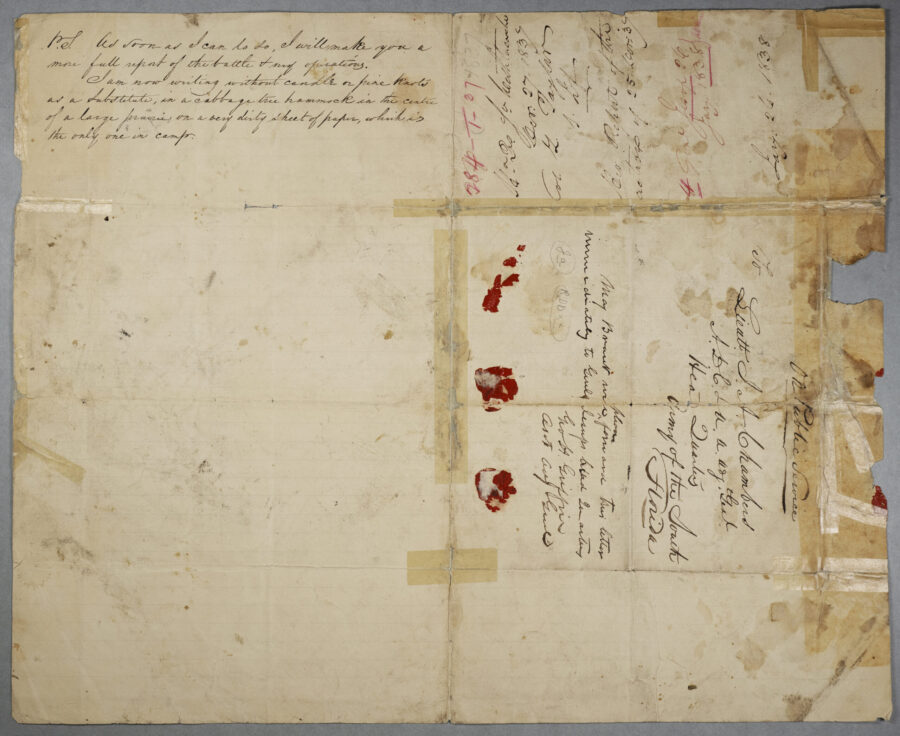
It was at this point in the war, and Taylor’s career, that a battle victory was required for the continuation of his campaign. The framing around the Battle of Okeechobee was thus a convenient and timely opportunity for Taylor, who would use it to his utmost advantage. You can see Taylor’s original letter, dated December 17, 1837, below. See our featured image for the back!
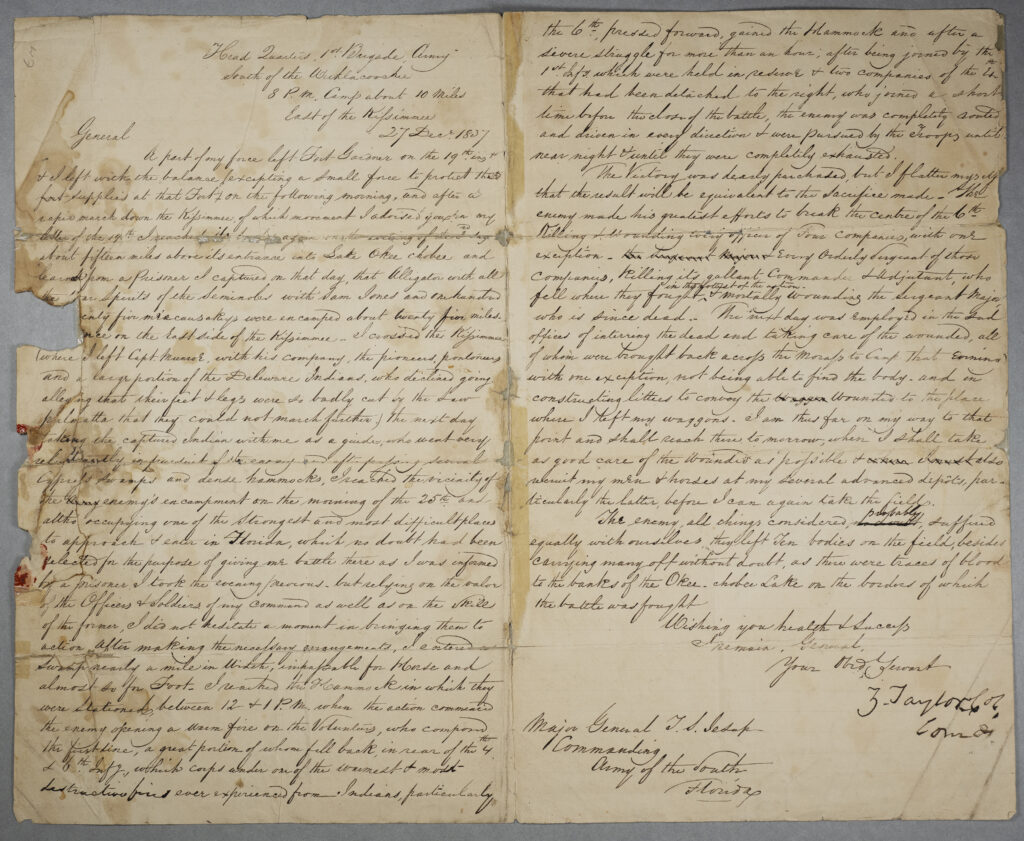
2002.5.2, ATTK Museum. Front
Taylor’s Letter
If you ask most people in the United States who Zachary Taylor was, they probably would be able to name him as a former President of the United States. Some may even get the number – the 12th. But, not many would know that his presidency, his reputation, and his legacy began with the Seminole Wars.
Immediately following the battle, Taylor seized the narrative around its outcome. He wrote a letter to his commanding officer only two days after the battle ceased. The letter was then disseminated to dozens of newspapers. They printed, reprinted, and spread Taylor’s narrative around the battle, effectively enshrining his words as the truth.
It is an incredible piece of propaganda, one that Taylor very effectively wielded to further his own goals. Repeatedly, Taylor uses language that frames the narrative. He calls his own troops “gallant,” and the Seminoles “hostiles” and the “enemy.” He describes it in such a way that the Seminoles are placed as the aggressors, even though they were being pursued quite explicitly by Taylor and his forces. It is also missing from Taylor’s narrative that the Seminole side was overwhelmingly outnumbered 2:1.
He describes instead the US side at the disadvantage. He states that the Seminoles were at their “strongest position” and repeatedly underlines the harsh environment and hardships the US soldiers endured in their pursuit of the Seminoles. Taking Taylor’s account at face value, then, the average reader would draw from his words that the US side not only won the battle but did so at a thorough disadvantage. In describing his own losses and wounded, Taylor espouses their heroics, saying “there lay one hundred and twelve wounded officers and soldiers, who had [accompanied] me on hundred and forty five miles most of the way through unexplored wilderness, without guides, who had so gallantly beat the enemy, under my orders, in his strongest position, and who had conveyed back through the swamps and hammocks, from whence we sat out without any apparent means of doing so.” But, as we peel away the layers of Taylor’s words, we can see more political motivation than just declaring victory.
The “Problem” of the Missouri Volunteer Militia
The Battle of Okeechobee as portrayed by Zachory Talyor was a hunting mission where he searched the wilderness. His troops entered every clearing “disposed of in order of battle, but we found no enemy to oppose us.” Eventually, they would capture a Seminole scout, who led them to the Seminole encampment. They began the battle with the Missouri Volunteers at the front who then “[fell] back, in the rear” of the career soldiers after the first rounds of fire. The following account proceeds to disparage the character and courage of the Volunteers, propping up the regular army. But, looking at the battle strategy, this held more political implications than it sounds on paper. Taylor chose to push the Missouri Volunteer Militia to the front of the assault, something that Richard Gentry of the Missouri Volunteers objected to. Gentry suggested instead to flank the Seminoles, which Taylor denied. The results were disastrous, effectively sacrificing the Missouri Volunteers to the Seminole forces. Almost 30% of the US forces who perished were Missouri Volunteers, 40 out of 132 militia men. Gentry himself was among the dead.
The first report of the battle Taylor wrote from the campsite on December 27th, 1837, describes what comes next as the “warmest & destructive fire ever experienced” subjected to the regular troops. For nearly three hours the “Regulars” advanced on the tree line while under the sustained fire of the Seminole before they were “completely routed and driven in every direction.” Taylor in this first report noted that nearly every officer (except himself) was wounded or killed during the battle and that the major losses would be commiserate to the “Sacrifice made.”
The report celebrated the role that the career soldiers played in the battle, minimizing mentions of the volunteer groups under his command, while claiming a great victory despite massive losses. Reading Zachary Taylor’s first report and the subsequent more detailed ones paints a picture of volunteers who were broken by enemy fire, only to be followed by “gallant” soldiers who triumphed under extreme condition to scatter the Seminole forces. This played directly into Taylor’s political motivations and is exactly what he wanted his superiors and public to think.
After the Battle
Understanding the implications of this report requires understanding two truths of the time. One, that political power and monetary gain were directly tied to your position in the army. And two, that the United States was in a heated debate on whether or not the federal government should have a standing army or should they rely on the volunteer troops of the states. Taylor was placing the Battle of Okeechobee and himself at the center of that debate. By blaming his losses on the volunteers, he was able to gain political support from those in Washington who had a vested interest in the creation of a standing army.
His reports do nothing to explain the situation of the battle, nor try to understand the objectives of Seminole forces who were able to fight them to a standstill for nearly three hours. Instead, he heaps shame on the volunteer soldiers, glorifies his own troops, and demonizes the Seminole who were fighting to protect their families and their lives.
Thankfully, Taylor’s tarring of the Missouri Volunteer’s reputation resulted in an extensive investigation by the Missouri Legislature. They found that Taylor knowingly went into a pre-prepared battlefield by the Seminoles, refused to consider any other angle of attack other than approaching from the front, and then he pressured the Volunteers to take the front knowing he was walking into an ambush. They even testified that while they were being attacked in the front by the Seminole, they were also being shot from behind by the regular soldiers. Despite their testimony when the Missouri Legislature sent a request to the House of Representatives for an official military inquiry, their request was ignored in favor of Taylor’s version.
Looking back at Taylor’s first report, the reader can see how he is already framing the Battle of Okeechobee to get as much benefit for himself as possible from the battle. His command, directly leading his men into an ambush where over 100 were wounded, led to a great victory. The Missouri Volunteers, who were being shot by the Seminole and their own allies, broke formation and fled to the backlines. The “Regular” soldiers, whose officers were nearly all wounded or killed, accomplished a great victory. A victory where less than a dozen Seminole bodies were found, no one was taken prisoners, and hundreds of fighters and civilians were able to escape into the Everglades to continue the fight.
To the Victor Goes the Spoils
While we have established that Taylor, and by extension the United States, needed a win against the Seminoles, we haven’t yet defined what that win would mean on a larger scale. By examining the letter itself, we can gain insight into how Taylor defined the victory and follow that definition back to his goals surrounding the narrative. Forgetting Taylor’s letter and relying entirely on facts, the Battle of Okeechobee is, at best, a draw. Both sides took heavy losses, with Taylor’s forces losing 26 men and leaving 112 wounded. Taylor did not capture anyone. Despite losses on the Seminole side, he also did not gain much at the end of the Battle.
For the Seminole, the battle was a diversion of sorts. There was no winning, only survival. It allowed the non-fighting camp members, women, and children to flee to safety. Once their families and vulnerable were safe, the Seminole warriors abandoned the pitch and escaped to safety themselves. Their goals in the battle were vastly different, and they had no interest in crushing the opposing force.
One major goal of Taylor’s letter thus was, despite suffering major losses with very little gained, to frame the battle as one that was won against all odds. Espousing the heroics of his regular army, the way Taylor talks about the battle goes even further. In effect, it places his regular army forces as the ‘only ones’ who could have won in such a scenario. The volunteer militia, who Taylor belittles throughout the letter, could not hold a candle to his regular army.
Taylor’s Political Capital
The second major goal of Taylor was to center himself as the architect of that victory. He would then gain prestige, political power, and clout for himself. Towards the end of the letter, Taylor writes that “The Victory was dearly purchased, but I flatter myself that the result will be equivalent to the Sacrifice made.” This might be the most honest line he wrote, and it seems apparent that to Taylor, it was worth it. By propping up the regular army, which he himself was a part of, Taylor made major political alliances in Washington. Those would later be a massive boon to his political career and bring him to national prominence.
The “Victory’ also cemented his reputation. Following the Battle of Okeechobee, Taylor was promoted to brigadier general. He would replace Major General Thomas S. Jesup as commander of the forces in Florida in May 1838. He would command these forces for a couple of years, leaving to start building his political career. By 1844, Taylor would again leverage his reputation to choose his role in the Mexican American War. His role during the Mexican-American War would then directly lead to his later presidential nomination and subsequent win in 1849.
Interested in deeper dives into Seminole history? Check back with us later for more collaborations with the Museum!
Resources
Baillie, J. S. (1848) Hunting Indians in Florida with blood hounds. United States Florida, 1848. N.Y.: Published by James Baillie. Retrieved from the Library of Congress, https://www.loc.gov/item/2008661482/.
Mahon, J. K. (1991). Missouri Volunteers at the Battle of Okeechobee: Christmas Day 1837. The Florida Historical Quarterly, 70(2), 166–176. http://www.jstor.org/stable/30140548
Tucker, Phillip Thomas (1991) “A Forgotten Sacrifice: Richard Gentry, Missouri Volunteers, and the Battle of Okeechobee,” Florida Historical Quarterly: Vol. 70: No. 2, Article 4.
Available at: https://stars.library.ucf.edu/fhq/vol70/iss2/4
United States War Department & Taylor, Z. (1838) Report from the secretary of war, in compliance with a resolution of the Senate of the 14th instant, transmitting the official report of the action of the 25th December, with the Seminole Indians. Retrieved from the Library of Congress, https://www.loc.gov/item/08033590/.