
Back in 1973: A Fascinating Moment in Time
Welcome back to the latest in our “Seminole Snapshots” series! In this series, we look at the impact of photography in preserving and sharing the Seminole story. This week, we are looking at the work of John J. Lopinot, who visited the Seminole Tribe of Florida two times, once in June 1973 and again in September 1987. Lopinot’s work captured the edges of a pivotal time for the Seminole Tribe of Florida. Pre-1973, Seminoles were learning to adjust to struggles of a diminishing tourist economy, and what that meant for their livelihoods. By 1987, the Seminole casinos were in full boom, propelling the Seminole Tribe forward in just 15 years.
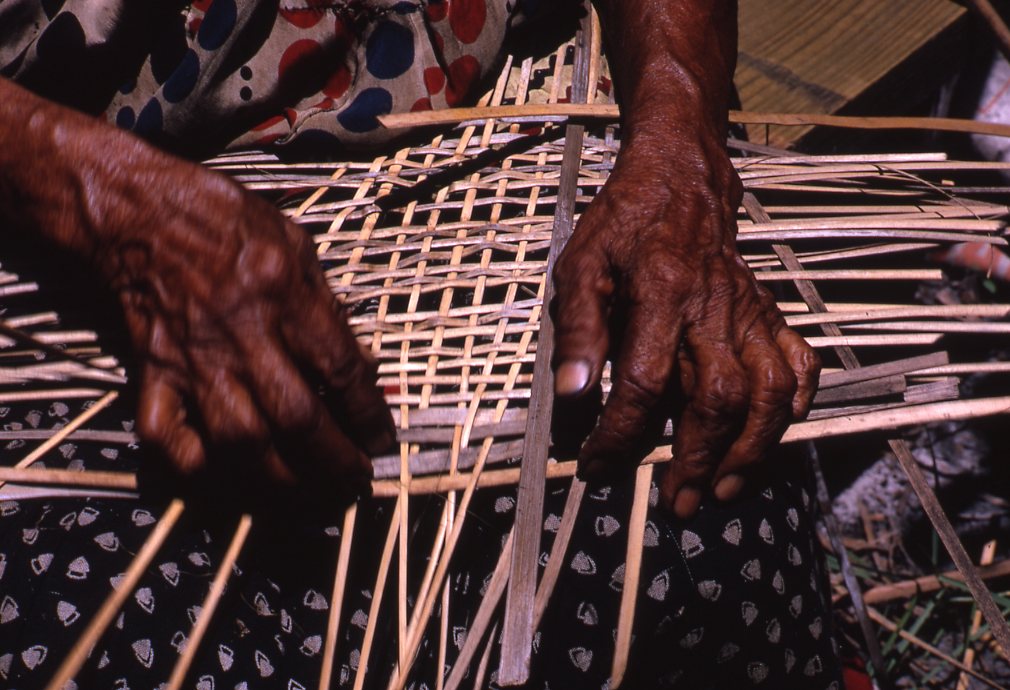
In our featured image, you can see Martha Buster’s hands weaving a basket on the Brighton Reservation, June 1973 (2021.24.118). Please note that every image included in this blog post was taken by John J. Lopinot and is held by the Ah-Tah-Thi-Ki Museum.
1973 in Economic Context
In many ways, 1973 for the Seminole Tribe of Florida was a time of rebuilding and economic survival. The Tribe had seized federal recognition only 16 years before, in 1957. The Seminole tourist era, which had dominated so much of their economic agency from the previous decades, was dwindling. The United States was smack dab in the middle of a deep recession, one that effectively put an end to the post-war expansion that had defined the United States after World War II. Precipitated by a massive oil crisis, the 1973 recession would be more severe than any of the five previous recessions, plunging the United States into an era of uncertainty and unemployment.
For the Tribe, who had often walked a thin line of survival dependent on tourism, trade, and agriculture, this time period was incredibly difficult and lean. The unemployment rate for Native Americans was 10x the national average in 1970, with 40% living below the poverty line. That same year, life expectancy for Native Americans was 44 years old, a third less than that of an average American. Reservations throughout Indian Country were ravaged by disease, depression, and poverty.
But, through the harshness, the Tribe would set the stage for the massive casino and gaming boom realized in the 1980s and 1990s. The 1970s would, through an incredible amount of work, be the beginning of the Seminole Tribe of Florida we know today. You may recall that the Tribe opened its first tax free smoke shop in 1977, and its first bingo hall in 1979. This focus on bingo, gambling, and economic diversification would pull the Tribe back from the edge. What followed was more than economic survival, but the realization of a multi-generational dream. The Seminole Tribe of Florida would become an economic powerhouse, to the degree that it would, and could, take care of its people for generations to come.
1973 in Cultural Context
Along with the economic upheaval that came with stagflation, recession, and uncertainty, there was a significant amount of cultural upheaval during the 1970s, particularly for Indigenous people. The early 1970s focused on Indigenous rights, particularly through the “Red Power Movement” that swept through Indian Country. This movement came directly on the heels of intense pressure from the United States for Indigenous people to assimilate, and particularly in response to Indian Termination and relocation. The movement worked to empower Indigenous people and communities, and advocated for the rights, cultural identity, and tribal sovereignty of those people. It also saw the rise of movements such as the American Indian Movement (AIM), founded in 1968, and the National Indian Youth Council (NIYC).
Through public resistance, civil disobedience, and grassroots organization, these movements worked to change the lives of Indigenous people throughout the United States and Canada. However, they were not without moments of intense conflict. Increased tensions between demonstrators and the United States would erupt a number of times, particularly in moments like the Trail of Broken Treaties (1972) and the Occupation of Wounded Knee (1973). To further contextualize the cultural feelings of the era, it is important to remember that the United States was also still wrapped up in the Vietnam War, the drawn-out conflict impacting the political, social, and cultural climate of the entire country.
Throughout all of this, there was also a refocusing for Indigenous people on their cultures and traditions. The “Red Power Movement” worked to empower a sense of pride, and thus spurred a refocusing on many traditional crafts, cultural traditions, language revitalization, and more. You will be able to see this throughout the photo series, which highlights traditional crafting techniques, things of cultural importance, and more.
The Photographer, John J. Lopinot
John J. Lopinot would travel for his first assignment with the Seminole Tribe of Florida in June 1973. A young intern with National Geographic, his images were a snapshot in time that captured so many of the cultural and economic threads that defined the early 1970s. Lopinot would go on to work for the Palm Beach Post. He was employed at the Palm Beach post for 33 years, retiring in 2008 as the Director of Photography. His later career focused almost entirely on the environment, highlighting local flora and fauna throughout Florida. In a 2006 interview series, he shared his mission; “I want to show people another world through my pictures.” (Palm Beach Post)
Elders and History through Images
Lopinot’s first assignment in June 1973 would bring him to the Brighton and Big Cypress communities. Both were, and continue to be, some of the more rural communities. It would have been even more so in 1973. It is also important to note that Lopinot’s images also show a number of significant Tribal Elders, many of whom you may recognize by name. Join us to explore this incredible photo collection.
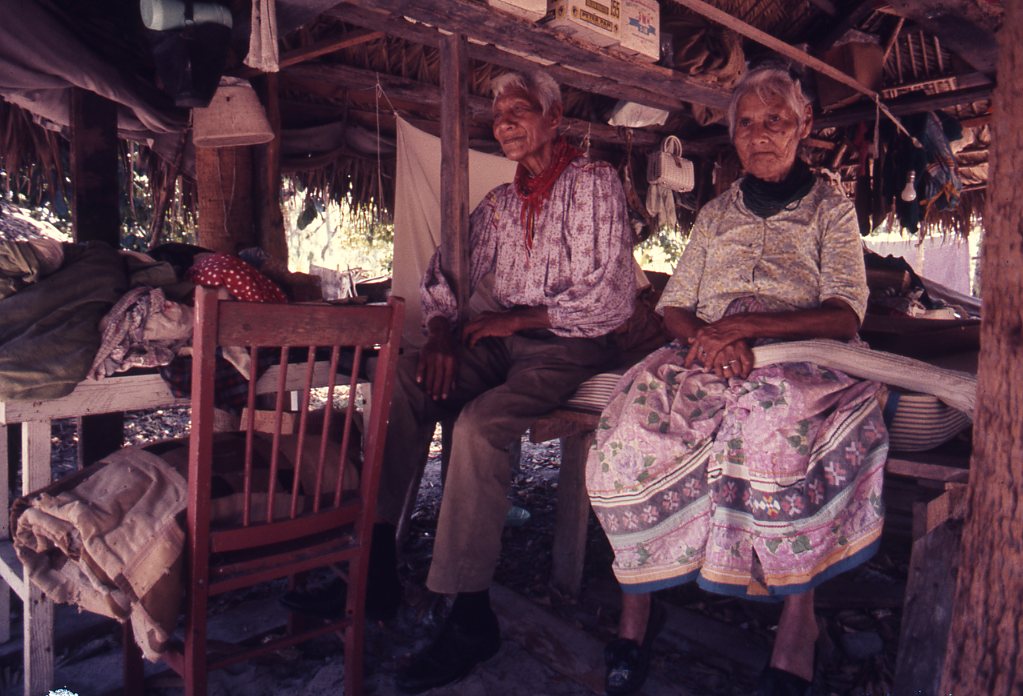
2021.24.100
Lena and Eli Morgan, June 1973, Brighton Reservation. They are sitting on a platform under a chickee, most likely in their camp. There are various boxes and articles of clothing around them. Lena would have been 88 years old and Eli 96 years old when this image was taken.
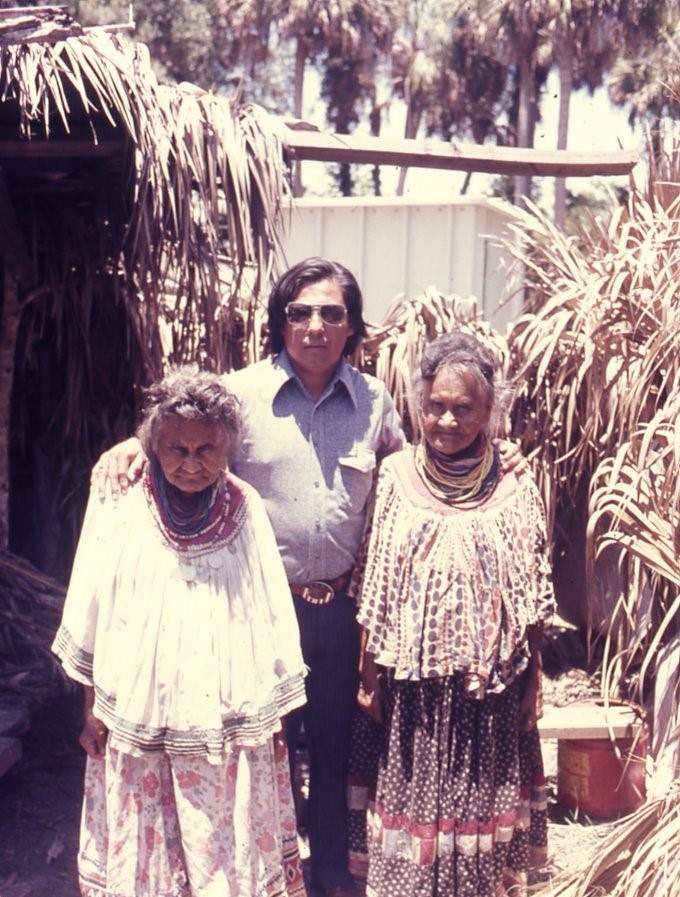
2021.24.103
Mary and Martha Buster with Joe Dan Osceola, June 1973, Brighton Reservation. Mary and Martha were twins who were 88 years old when this photo was taken. The three of them are standing in front of a chickee; both Mary and Martha are wearing patchwork skirts, capes, and beaded necklaces.
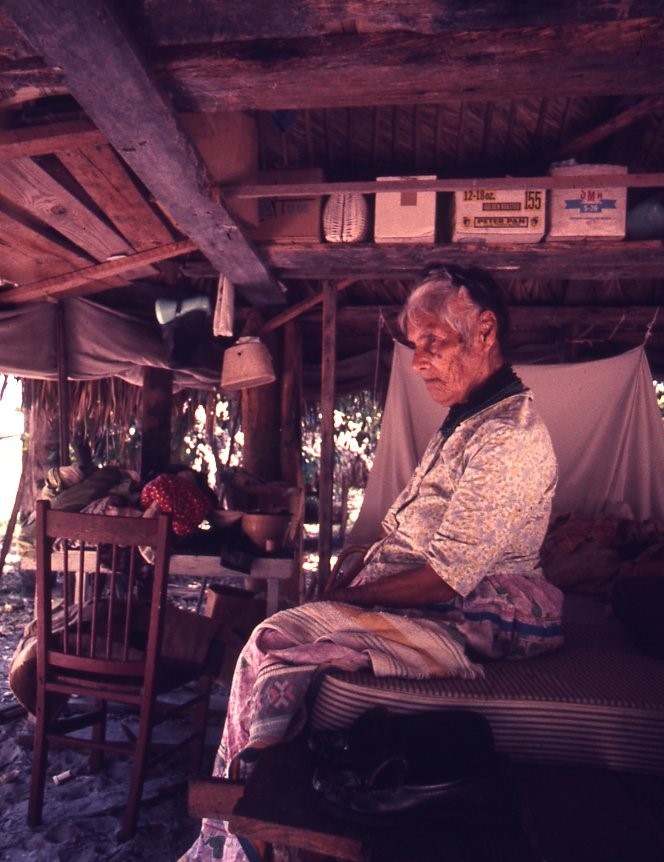
2021.24.111
Lena Morgan sitting under a chickee, June 1973, Brighton Reservation. Lena is wearing a purple floral skirt and blouse, along with multiple strands of dark beads around her neck. She is seated on a platform with her hands in her lap, and the shot is taken profile. Various boxes can be seen in the rafters of the chickee.
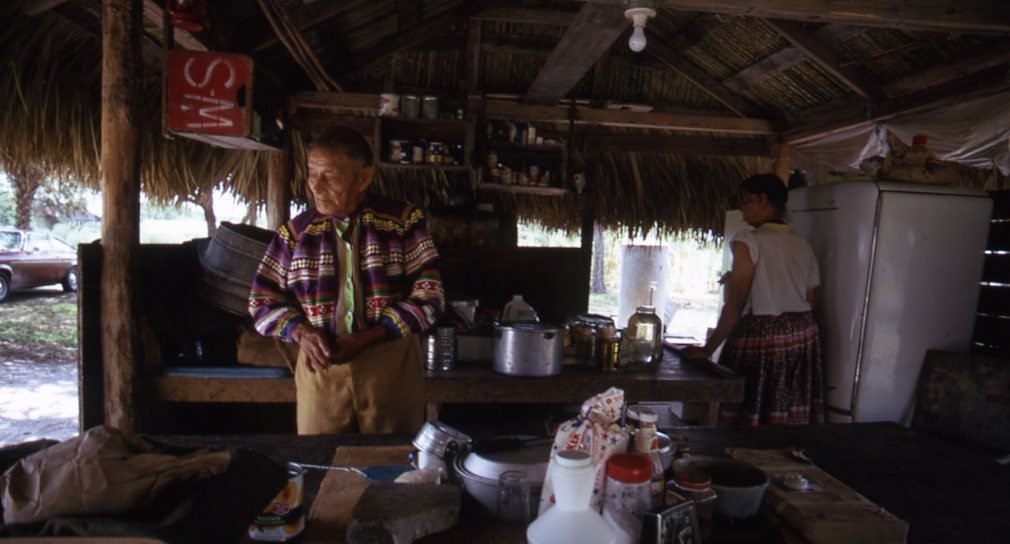
2021.24.116
Ingram Billie and a woman, possibly his wife, cooking under a chickee, June 1973, Big Cypress Reservation. There are pots set on the two tables, as well as bread, fruit, and various containers. There are also two refrigerators and canned goods on shelves in the background.
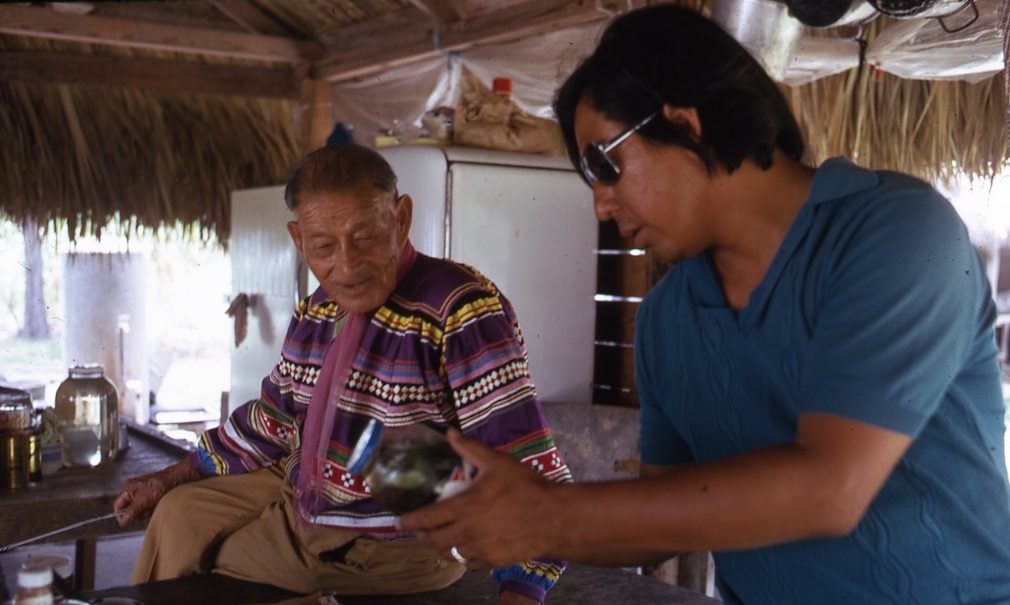
2021.24.127
Ingram Billie and Joe Dan Osceola, June 1973, Big Cypress Reservation. They are under a chickee, most likely in Ingram’s camp. Ingram is wearing a purple patchwork shirt, and he is sitting on a table. Joe Dan is holding a jar of food and showing it to Ingram.
Crafting
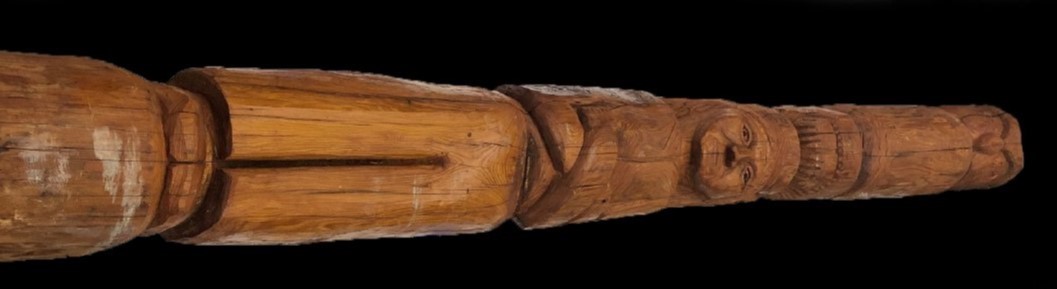
Lopinot’s photo series also shows a number of different traditional crafts, both complete and in progress. Beyond the popular dolls and keychains, you can see full-size dugout canoes, totem poles, turbans, baskets, and beadwork.
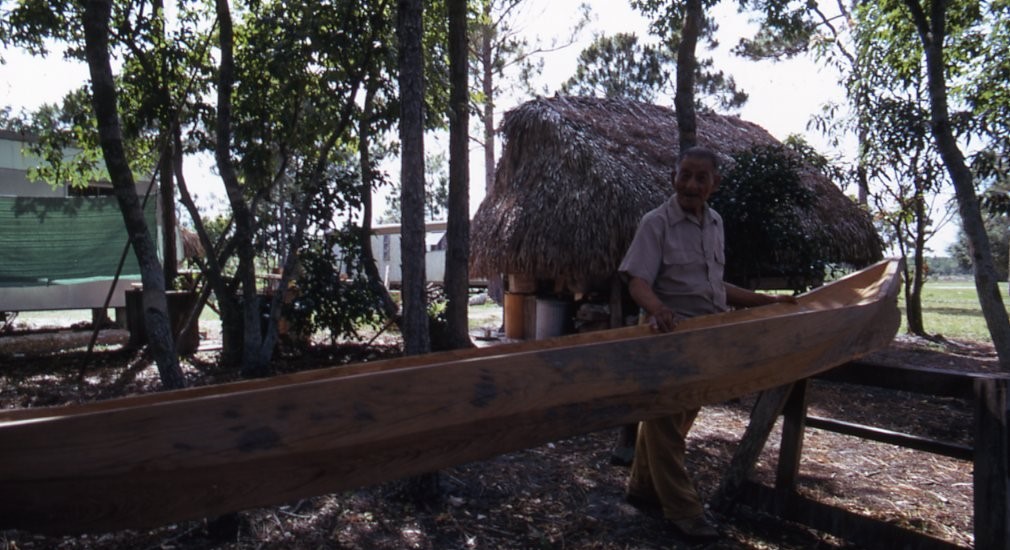
2021.24.113
Ingram Billie with a dugout canoe he carved, June 1973, Big Cypress Reservation. There is a chickee and a mobile home in the background, most likely part of Ingram’s camp.
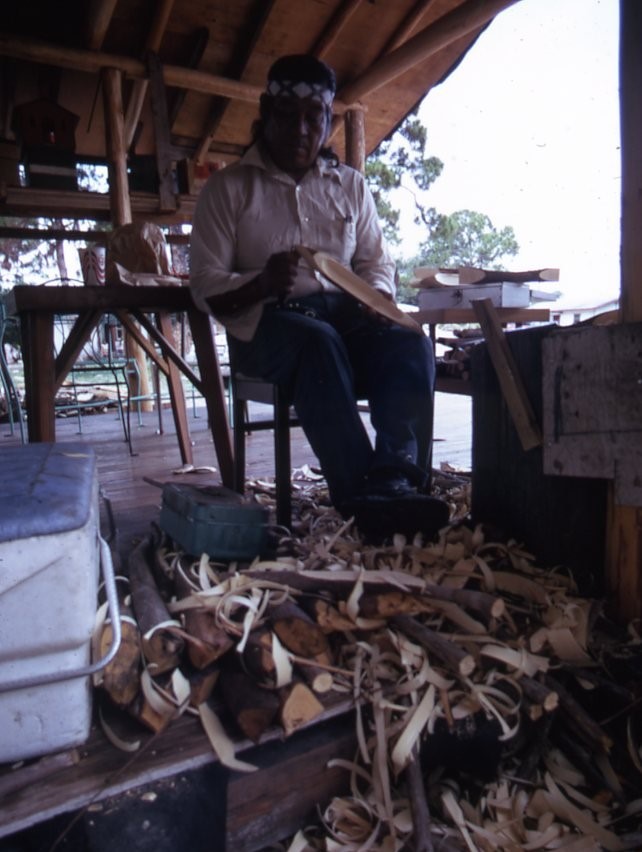
2021.24.115
Charlie Billie Boy carving a small canoe, June 1973, Big Cypress Reservation. He is wearing blue pants, a white shirt, and a beaded headband. Charlie Billie Boy is sitting under a chickee, and there are branches and wood shavings at his feet.
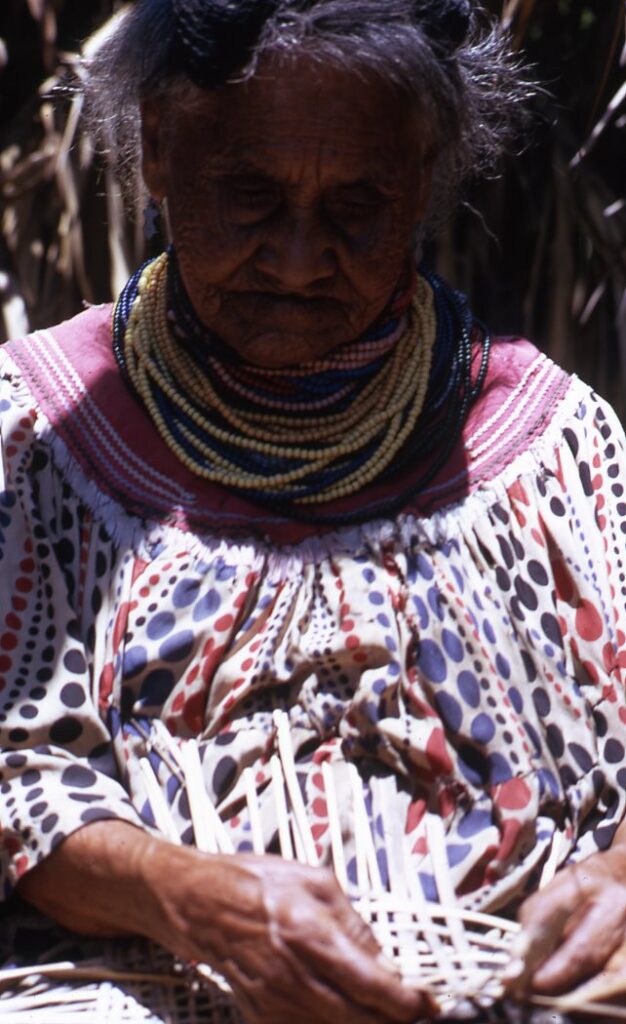
2021.24.122
Martha Buster weaving a basket, June 1973, Brighton Reservation. Martha is wearing a blue and white patterned skirt and a white blouse with blue and red circles. The fronds she is weaving are resting in her lap.
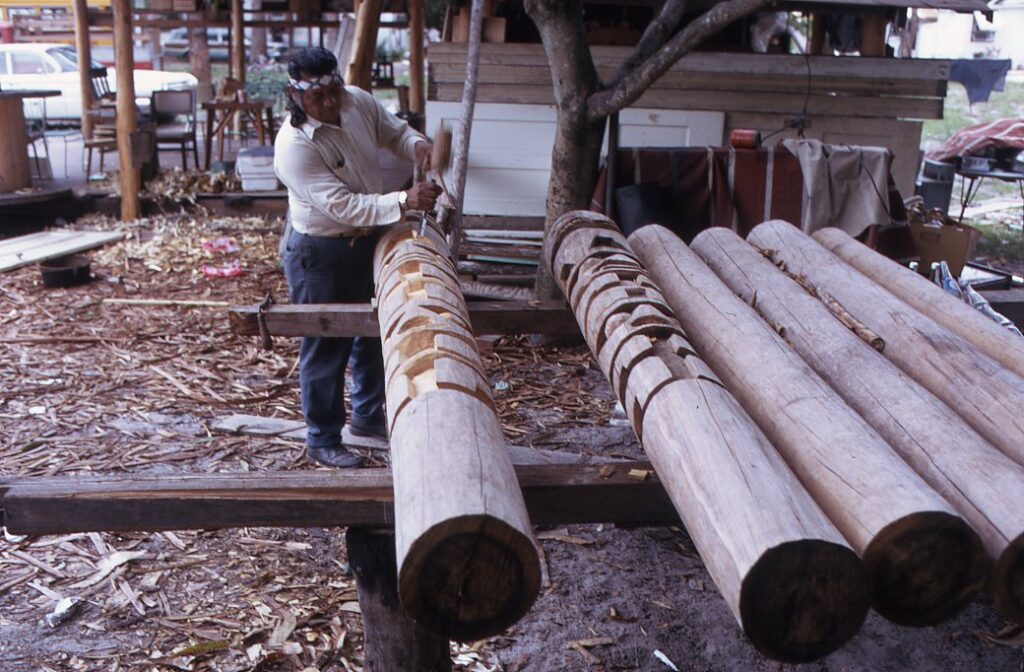
2021.24.148
Charlie Billie Boy carving totem poles, June 1973, Big Cypress Reservation. Charlie is wearing blue pants, a white shirt, and a beaded headband. He has six poles resting on supports; he is carving one and another pole has been carved.
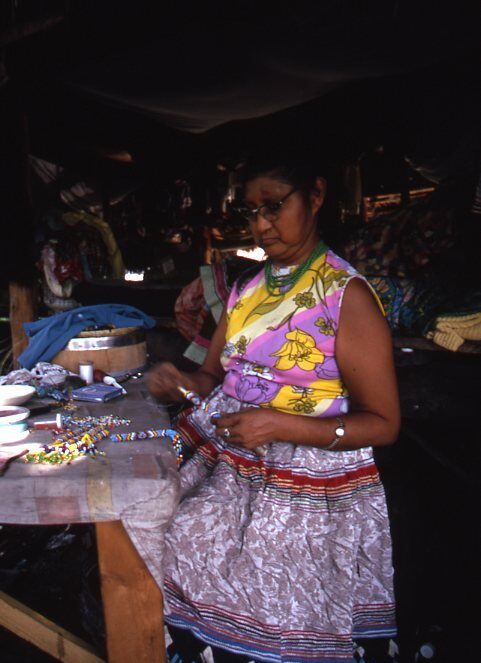
2021.24.199
A woman makes keychains under a chickee, June 1973, Big Cypress Reservation. There are several sheets hanging around her. The woman is wearing a pink and yellow patterned shirt with strands of green beads, as well as glasses.
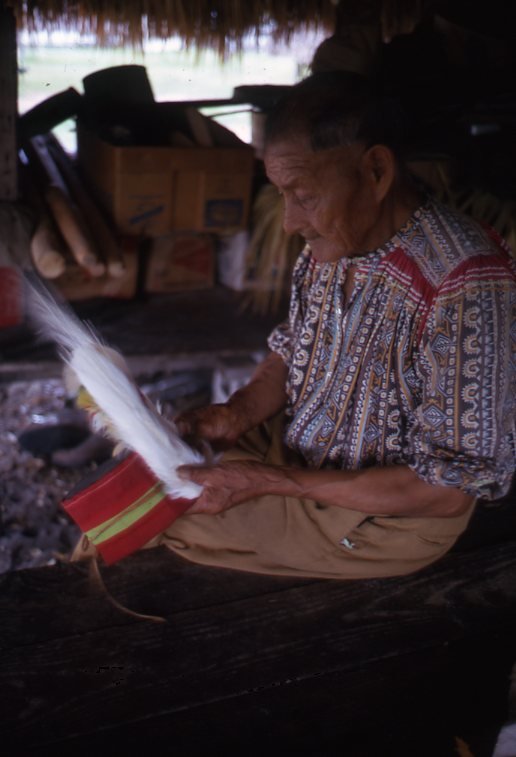
2021.54.152
Ingram Billie making a turban, June 1973, Big Cypress Reservation. Ingram is placing white Egret feathers on the turban, which is red with a green band. He is sitting under a chickee, and there is a table with crates and boxes in the background. You may remember that traditionally, Seminoles included items like egret feathers in their turbans. But, in the late 19th and early 20th centuries Western fashion hyper focused on these snowy white bird feathers. According to the Smithsonian Magazine, it was “calculated that in a single nine-month period the London market had consumed feathers from nearly 130,000 egrets.” The Plume Wars would devastate the wading bird population and make traditional use of egret feathers difficult.
Slice of Life
The images we see throughout this series all show day-to-day camp life. During this time, many people lived blending modern and traditional life. You can see that shown here.
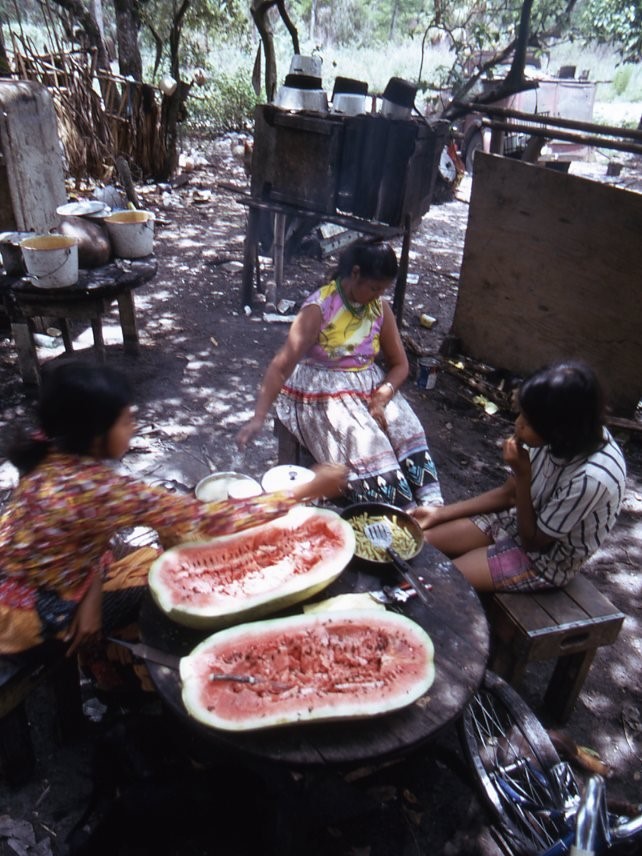
2021.24.105
Three women, most likely a mother and daughters, cooking in a camp, June 1973, Big Cypress Reservation. There are two large watermelon halves, as well as a bowl of beans and various pots. The women are sitting around a fire, and a refrigerator and tables can be seen in the background.
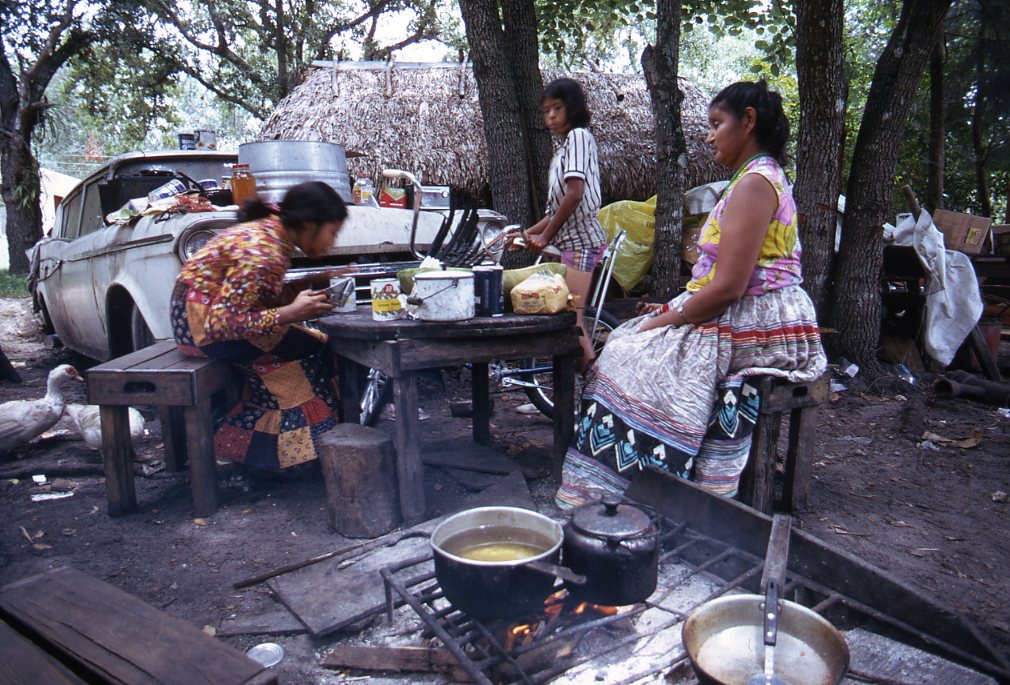
2021.24.109
A woman cooking over a fire with her daughters, June 1973, Big Cypress Reservation. There is a fire with several pots over it, and the three women are sitting at a table behind a pickup truck. Various buckets and cans are spread around the camp, and several ducks are wandering beside the table. A blue bicycle is also resting between the truck and the table.
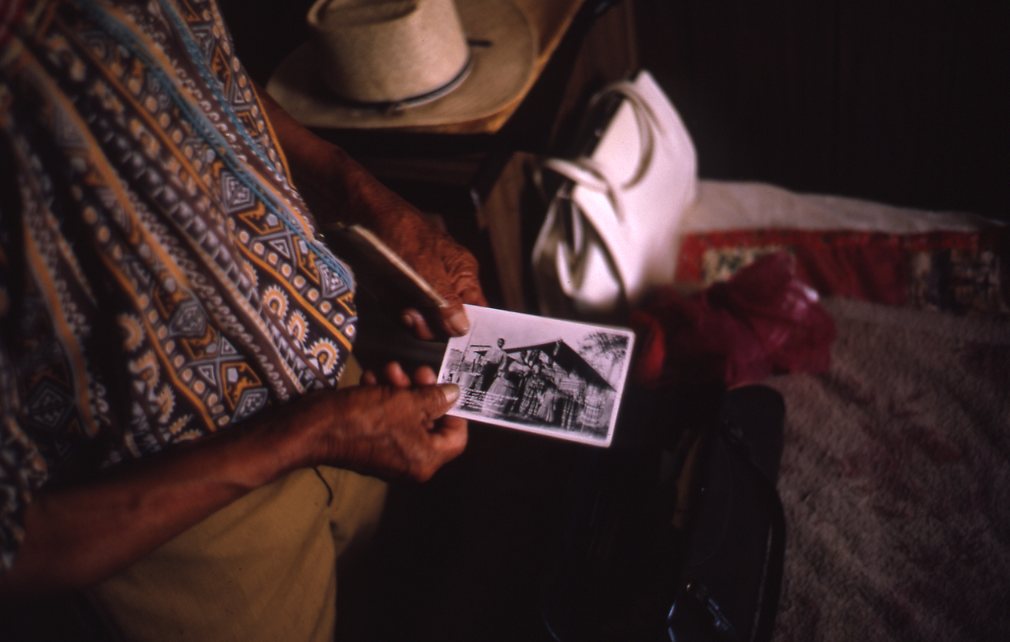
2021.24.129
Ingram Billie holding a black and white photograph, June 1973, Big Cypress Reservation. He is wearing a patterned shirt and khaki pats. There appears to be a bed or sofa in the background, and there are two purses lying on it. There is also a small table with a straw cowboy hat beside the bed.
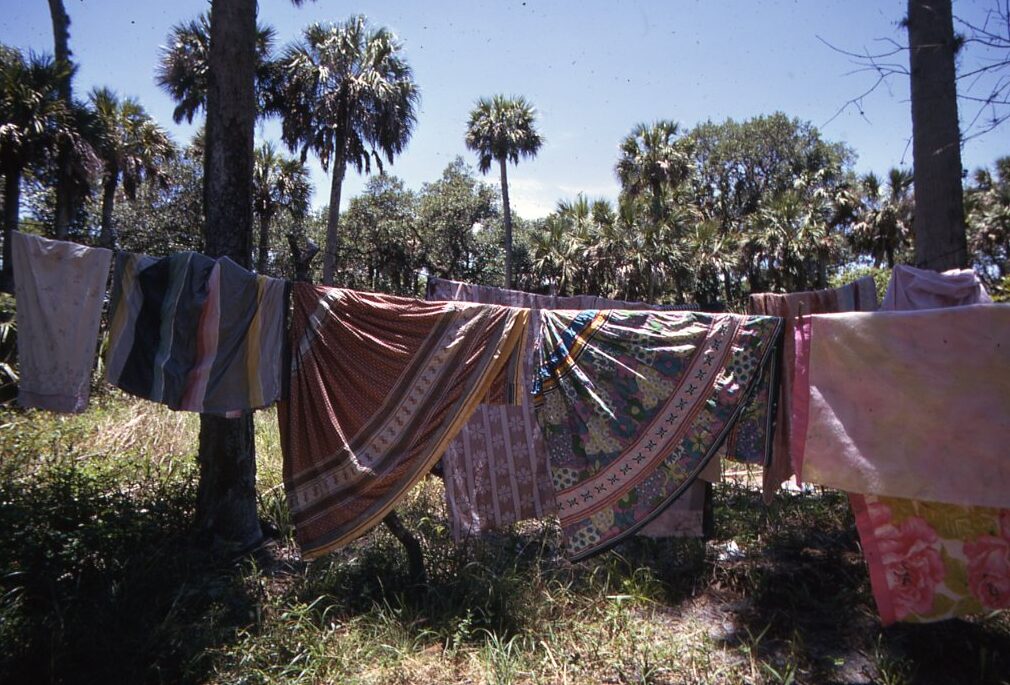
2021.24.131
Clothes hanging on a line at the Morgan Camp, June 1973, Brighton Reservation.
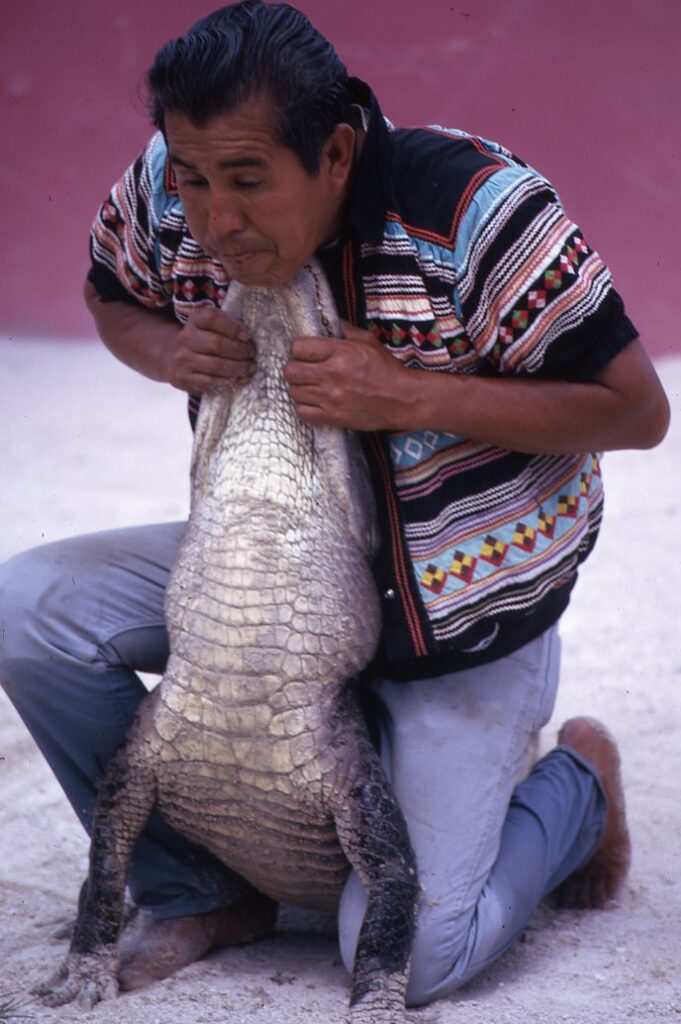
2021.24.136
Bobby Tiger wrestling an alligator. Bobby is pinning the alligator’s mouth with his chin, and he is kneeling in a sand pit. This photo was most likely taken at the Miccosukee Indian Village in June 1973.
Lopinot’s Return
John Lopinot would return to the Seminole Tribe of Florida one additional time in 1987, following a 15-year hiatus. This trip would highlight the sharp contrast between the Seminole experience in 1973 and in 1987. You can see a shift in modern conveniences and fashion.
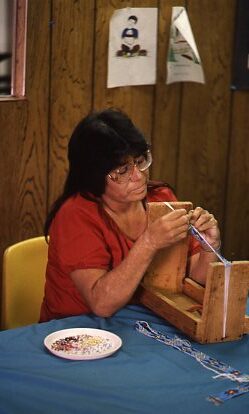
2021.24.222
A woman makes jewelry on a beading loom, September 1987. She is sitting at a table in a room with wood-paneled walls.
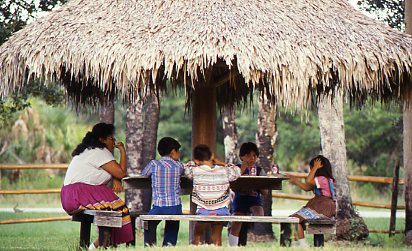
2021.24.355
A group of individuals sitting at a picnic table under a chickee.
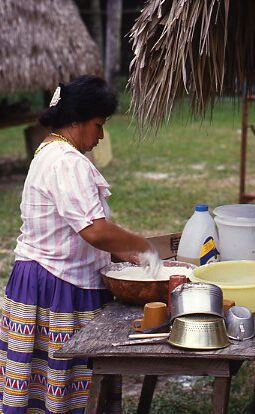
2021.24.291
A woman mixing a bowl of flour with her hands, possibly for frybread. She is standing beside a table with pots and bowls on it, and the corners of two chickees can be seen.
For the Seminole Tribe of Florida, the importance of these images is not only in the actual pictures, but what they represent: a moment of ‘before.’ Before the casinos, before economic security, and before the security found in legal power. The photos show tribal elders sharing traditional crafts and everyday camp life, not from a century ago but just a few decades past. Yet through all of them, you can see the threads that carry their story forward from 1973, to 1987, to today