
The Politics of Peace Medals
One of the most interesting ways to experience history is to look at the ephemera left behind. Often, if we look closer, we can gain a better understanding by examining the things people placed value in, and why they were important. You might remember a few weeks ago in our post about Micanopy, we mentioned that in Inman’s famous copy, Micanopy is wearing a peace medal around his neck. Why would a peace medal be important enough to include in a portrait like that?
This week, for our latest collaboration with the Ah-Tah-Thi-Ki Museum, we are diving deep into peace medals, why they were worn, and their evolving meaning both for the giver and the receivers. Like last time, we will focus on peace medals as objects, before zooming out and discussing their greater sociopolitical implications. We will also use the Ah-Tah-Thi-Ki Museum Collection to focus on examples of Seminoles wearing peace medals.
This blog post has been written in collaboration with the Ah-Tah-Thi-Ki Museum’s Research Coordinator Joseph Gilbert. Keep on the lookout in the coming months for more collaborations with the Museum!
Early European Medals
Early peace medals were ceremonial medals given to leaders of tribes as symbols of peace, diplomacy, and a symbol of allyship to political powers. England, Spain, and France all utilized peace medals during their struggle over the Americas, with the earliest dating to around the 17th century. In fact, the Museum collection contains two European peace medals. The first is a George III peace medal, probably circa 1814 based on the style. This large, silver medal would have been given to warriors or leaders alike, although the provenance of the medal in the Museum collection is unknown. It is important to remember that Native Americans were being recruited by British powers for support during this time, particularly during, and in the aftermath of, the War of 1812. They would have been given as a symbol of allyship to British powers.
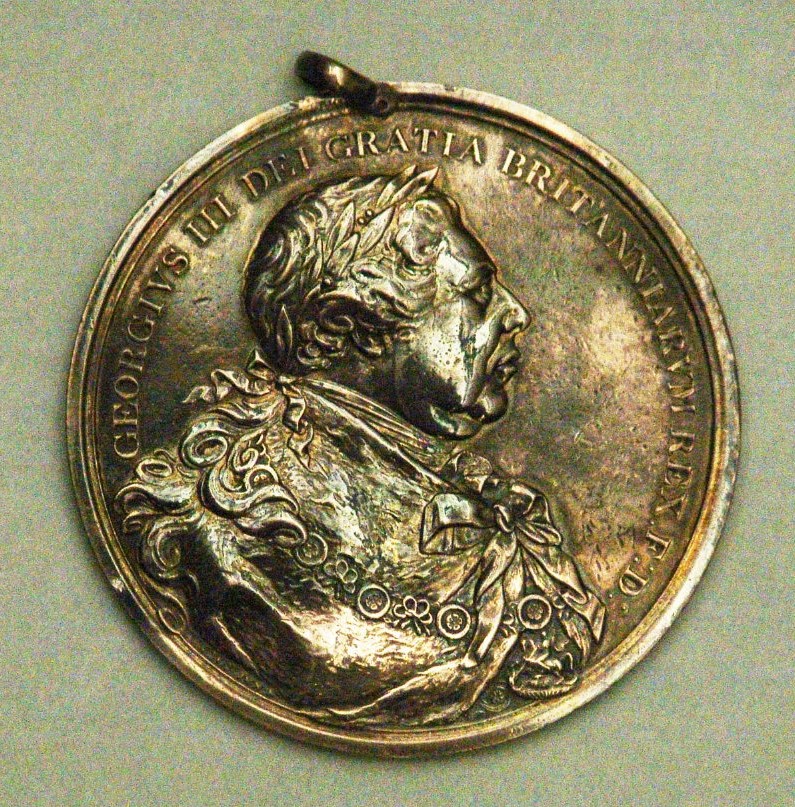
2001.109.2, ATTK Museum
The other European peace medal in the collection is incredibly unique: a silver Charles II portrait medal. Although not definitively gifted as a peace medal, former Tribal Archaeologist Willard Steele stated in 2011 to a colleague that “The Charles II Medal is the most important one we may have. It dates to the year the English founded the Carolina colony (1670) and is generally accepted to be the likely first peace medal given by the English to the Creeks. The first English peace medal in the southeast.”
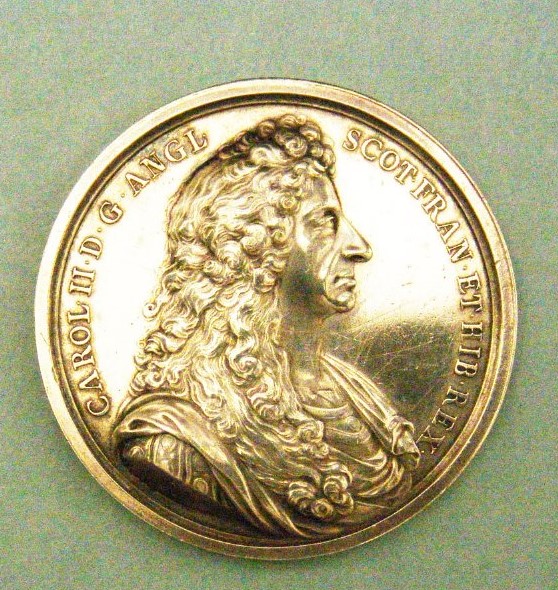
2001.111.1, ATTK Museum
Especially during those burgeoning moments of outward European expansion into the Americas, medals like this could strengthen trade partnerships, symbolize peace and diplomacy, or even mark an agreement of some kind. During conflicts between the new United States and the British, they even acted as symbols of allegiance or diplomacy.
Early United States Medals
The new United States of America would follow in the example set by previous European powers. They would give peace medals in a similar way, signs of peace and a recognition of sovereignty. George Washington was the first president to give out peace medals, continuing the tradition from the very beginning of the United States. In 1790, Washington gave peace medals to a delegation of Miccosukee leaders, with the treaty mentioning medals intended for the “Chiefs of the Miccosukee.” These were intended as a sign of peace and goodwill, and there are additional records of Governor Duval, the first civilian Governor of Florida (1822-1834 term) requesting some for Seminole allies at a few different points.
Washington peace medals from the time featured symbols of tribal leaders dropping tomahawks and receiving a peace pipe from the Roman goddess Minerva, meant to represent the young United States. The reverse showed an eagle with outstretched wings, and then thirteen stars to represent the original thirteen states. Only a few years later the symbology would change to Washington himself sharing a peace pipe, symbolically placing himself on the same level as these tribal leaders. Curiously, some medals from this era also show Washington with a sword outstretched, although the tribal leader has dropped his tomahawk. These oval, silver medals would have been given to tribal leaders, and to those who were ostensibly on the same level leadership-wise. They also acknowledged, in a very basic way, the inherent sovereignty of these tribal nations.
Early peace medals such as these were, in effect, nation-to-nation symbols of goodwill, with more important ones such as those depicting Washington given during a treaty negotiation. They were incredibly prized possessions, and leaders were often buried with them or passed them down. It is another reason they were often depicted in art, as they would have been a prominent symbol. Another painting by Charles Bird King, who painted the Micanopy original portrait, the Portrait of Sagoyewatha (known as Red Jacket, Albright-Knox Art Gallery, Buffalo, New York), shows the Seneca chief “dressed in European-style clothes with a remarkably similar [to the Washington peace medal] medal tied high at his throat.” (Excerpted from Jonathan L. Fairbanks.)
Seminoles with Peace Medals
As time wore on, and in particular the Indian Wars became more fraught, the driving factors behind why the United States was giving peace medals began to change. Thus, the political meaning of peace medals began to shift along with them. Instead of gestures of genuine goodwill and a promise of peace, they began to be given for more mundane reasons, even being given to those who the United States found easier to work with. On the flip side, those with peace medals could argue they gave them authority to speak and negotiate with the United States, effectively morphing the medals into a status symbol that communicated power they could leverage.
There are a couple of examples of Seminoles with peace medals represented artistically. Although this is by no means a comprehensive list of all Seminole leaders who would have received a peace medal, these artistic representations are particularly telling when we consider the broader sociopolitical implications of them as symbols, and how as time wore on these symbols could be interpreted. In 1790 when Washington was giving out his peace medals, they were a mark of nation-to-nation diplomacy. By around 1825 when Micanopy would have received his, it was an acknowledgement of sovereignty, and a promise in some respects to uphold peace, but trending towards forcing assimilation through political pressure. But, by the time Holata Micco (Billy Bowlegs) would have been wearing his, the political implications were greatly devalued, where the United States was using peace medals as political mechanisms to divide communities, and prop up those who were “friendly” to their interests.
Micanopy
Below, you can see Henry Inman’s copy of the original Charles Bird King Portrait we talked about a few weeks ago. In it, he is shown wearing a peace medal around his neck. Additionally, there are several prints depicting Micanopy with all of them showing a peace medal around his neck. The medal around Micanopy’s neck, although not clear in the painting, is most likely a John Quincy Adams commemorative medal, with only 231 made in its original striking. It features the bust of Adams on one side, and two hands shaking below a crossed tomahawk and peace pipe on the reverse, with the words “Peace and Friendship.”
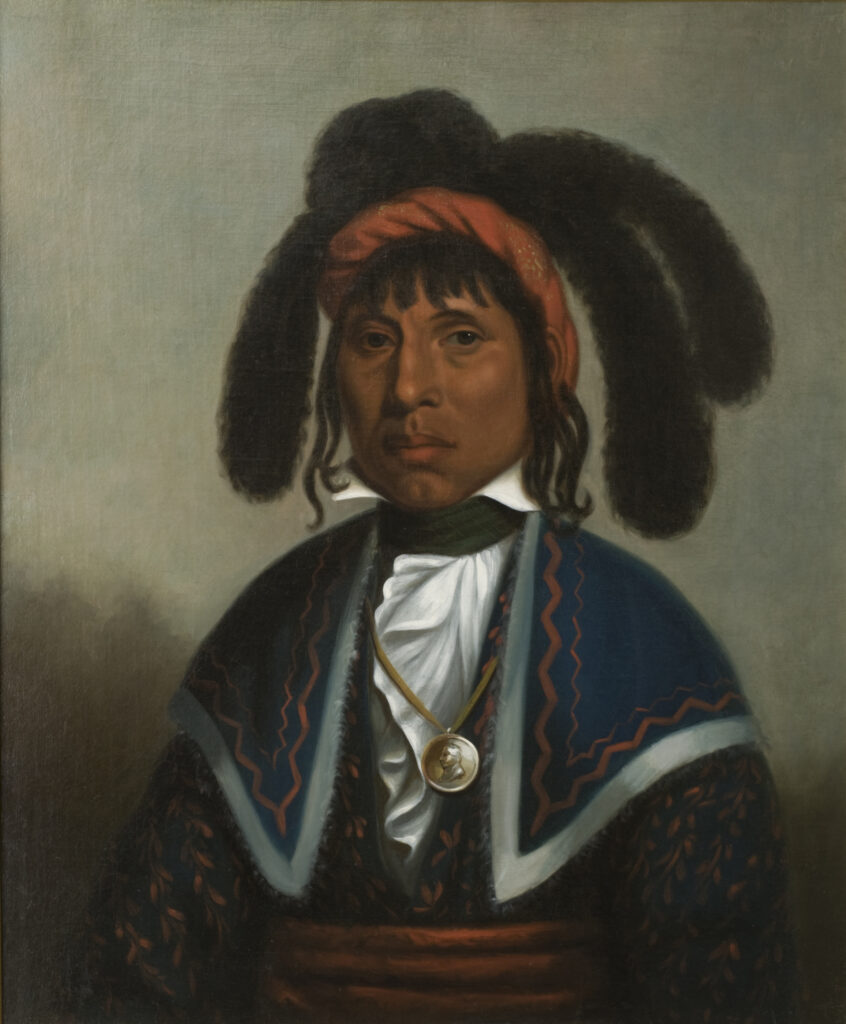
2006.48.1, ATTK Museum
This commemorative coin was produced under Thomas L. McKenney, who was appointed the Superintendent of Indian Affairs from 1824-1830. McKenney, who was a proponent of the “Indian civilization program” sought to assimilate Native Americans to Western values and ultimately thought if they did not move westward of the Mississippi they would be doomed. He was eventually removed from his position by Andrew Jackson, for “not being in sufficient harmony with [his] Indian policy.” In essence, “McKenney hoped that the relocation of the Indians could be achieved by persuasion, Jackson preferred force.”
McKenney was instrumental in the creation of the Charles Bird King paintings, and later the hand-colored lithographs of the originals. They were copied from the original King painting before it was destroyed in a fire in 1865. Below, you can see a copy of the lithograph made from Micanopy’s portrait, which can be found in the History of the Indian Tribes of North America, by Thomas McKenney and James Hall. Notably, many of the Charles Bird King paintings that remain or were copied show peace medals prominently displayed on necklaces of tribal leaders.
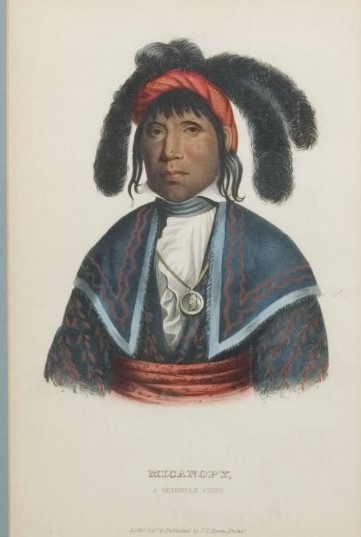
2002.166.9, ATTK Museum
When Micanopy received his peace medal, it would have been a recognition of indigenous sovereignty. He most likely received the medal on a trip to Washington D.C., where Micanopy had been part of a peace delegation of Native American leaders in 1825 to meet President Adams. It was organized by McKenney, who “invited all the prominent Indian dignitaries within the continental U.S. and its territories to visit the president in Washington and negotiate terms on behalf of their people.” At the time, although McKenney was arguing for assimilation and removal to the west, he also still attempted to uphold treaties and their diplomatic relations on a nation-to-nation basis. These medals were still a sign of that respect and thus were a prized part of the diplomatic process. But, the shift towards assimilation was marching ever closer to eradication, and peace medals were a tool that the United States would deftly utilize to further their own interests.
Holata Micco (Billy Bowlegs)
Below, you can see an image of Holata Micco (Billy Bowlegs) taken from a June 12, 1858 edition of Harper’s Weekly: A Journey of Civilization. The author of the article tracked him down in New Orleans during his final removal to Indian Territory, and lithographs of him and his family were included in the article. It should be impressed upon the reader that the article, while an important piece of history, was predatory and propagandizing in nature, coloring the Seminole War period heavily in favor of the United States. The author also hunted down Holata Micco and his people during their journey of forcible coercion from their homelands, which he had fought to stay in for the previous fifty years. While we could denote an entire blog post to unpacking this article, for the purposes of this post we are instead just focusing on the included lithograph.
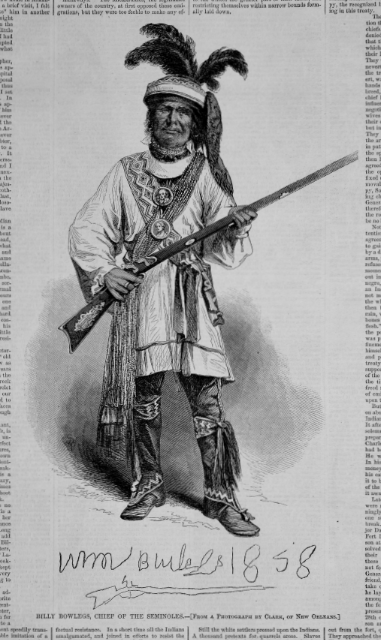
Selection from 1995.17.1, ATTK Museum
Although the lithograph does not clearly show what peace medals Holata Micco was wearing, the article mentions that they depict Martin Van Buren and Millard Fillmore. Other images/paintings, including a colorized copy of a well-known historic photograph do show him with two medals, but we can’t see who they depict (2002.166.210, ATTK Museum).
Holata Micco operated at a time in which he, and other leaders, were playing a dangerous political game. He spent a significant amount of time trying to avoid war outright, promising to relocate, then refusing several times. Pressures during the Seminole War era were horrific, and peace medals had become a political mechanism wielded by the United States to divide tribes and communities. Those who held medals were given the illusion of power. At this point, the United States was well aware that tribes were not governed by one person or entity. Instead, they distributed medals in such a way as to fracture communities, creating boundaries that would make them easier to overwhelm. It is interesting, then, that Holata Micco wore two medals, seemingly leveraging their political meaning for him and his community even post-removal.
Through his repeated actions, it is clear that Holata Micco was trying to buy Seminoles time by playing the United States’ own game of politics. He would survive for a very long time, past the deaths of Osceola and Micanopy, until finally surrendering to removal in 1858. Although worn down by war, he would be instrumental in arguing for Seminoles to have their own land and reservation in Oklahoma.
Holata Micco’s Medals
Although peace medals had been given out in different sizes before, there began to be a shift in how the medals were distributed, in effect cementing a particular type of hierarchy as denoted by the medals themselves. Previously, those given for diplomatic reasons had almost always been struck in silver. As time moved on, especially beginning with the Jefferson presidency, there began to be different sizes of medals awarded, with larger medals going to those with more “importance.” There was also a sharp increase in coin collecting within the United States, encouraging the US Mint to reactivate old dies and restrike them in bronze for collectors.
Medals began to be mass produced and given out with less discretion than had been previously afforded. Famously, Thomas Jefferson peace medals were carried by Lewis and Clark on their Corps of Discovery journey to the west. Along their journey they carried 89 Jefferson medals in three different sizes, in addition to 55 “Seasonal” Washington medals. The Jefferson medals were “were struck in three sizes and distributed according to tribal leadership status.”
The oldest medal Holata Micco is wearing, the Martin Van Buren silver peace medal, was struck in 1837 at the beginning of his term as president. In many ways, the Van Buren medal conforms to many of the accepted symbols of the past medals. It included a bust of Van Buren on one side, with the date of his inauguration as 1837. The reverse, like many of the previous presidential peace medals, included clasped hands, with a crossed pipe and tomahawk and the words “Peace and Friendship.”
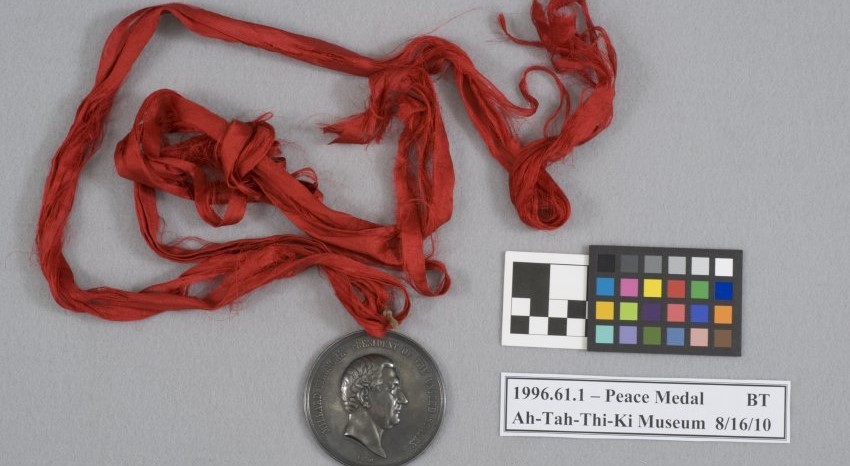
The second medal that Holata Micco is wearing is that of Millard Fillmore. This one is particularly telling, as Millard Fillmore was the first president to move away from the symbology of the “clasped hands” which had dominated so many of the previous presidential peace medals. You can see the reverse of a Millard Fillmore peace medal from the Ah-Tah-Thi-Ki Collection below. The front side can be seen in our featured image.
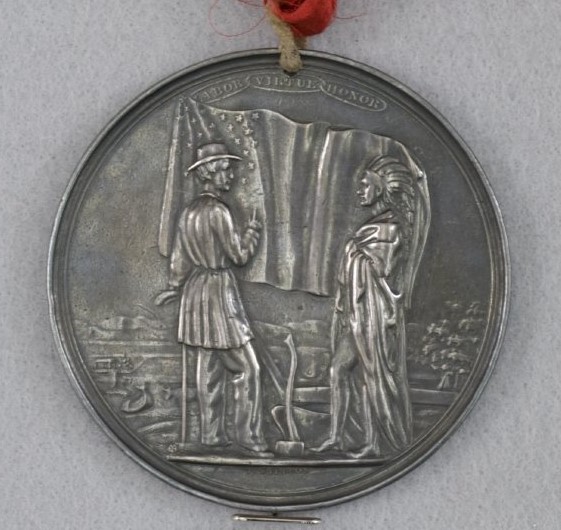
1996.61.1, ATTK Museum
Here, we can see a Native American in a headdress and blanket next to a white man in Western clothes. They stand in front of an American flag, and between them there is an axe and plow. At the top of the medal there are “three links of chain with the words ‘LABOR’, ‘VIRTUE,’ and ‘HONOR’ inside them.”
Thus, Peace Medal “imagery shifted in the mid-19th century to reflect U.S. policies of assimilation.” No longer were they even pretending to meet as two negotiating nations. Instead, there was an inherent expectation that those who wore the medals would take part in the making of America (through labor, virtue, and honor) that the Western powers deemed appropriate. This eradicated the Indigenous ways of life, and by extension upheld the vision of America that was currently being pushed by Manifest Destiny. These images would be taken even further in later presidential peace medals, with some presidents such as Buchanan and Lincoln placing a violent “savage” imagery of a traditional Native American on one side, and an “assimilated” Native American plowing a farm in front of a church on the other.
As the time of peace medals wound down to an end, final designs “mirrored the broader U.S. policies of the era, which pushed Tribal Nations from sovereignty and self-determination toward displacement and life on reservations.”
Looking back at these physical pieces of history, we have the luxury of piecing the symbols together and looking at the shifts in temperaments and diplomatic attitudes over decades and even centuries. But, at the heart of these broader shifts, there were people like Micanopy and Holata Micco who were fighting for their sovereignty, for their lives, and for their fundamental right to exist. They held these peace medals in their hands and became disillusioned. Micanopy, who would have received his with the highest of hopes in 1826, would be captured under a flag of truce by the United States in 1838 by General Jesup. He was removed to Indian Territory, where he died at Fort Gibson in 1849. Holata Micco, who wore two during his removal to Indian Territory, had lived in relative peace for over a decade before being goaded back to war by the United States. He would die in 1859, less than a year after his coerced relocation.
Additional Resources
Excerpted from Jonathan L. Fairbanks. Becoming a Nation: Americana from the Diplomatic Reception Rooms, U.S. Department of State. New York: Rizzoli, 2003.