
At a Glance: The Remarkable Coo Taun Cho Bee Collection Revisited
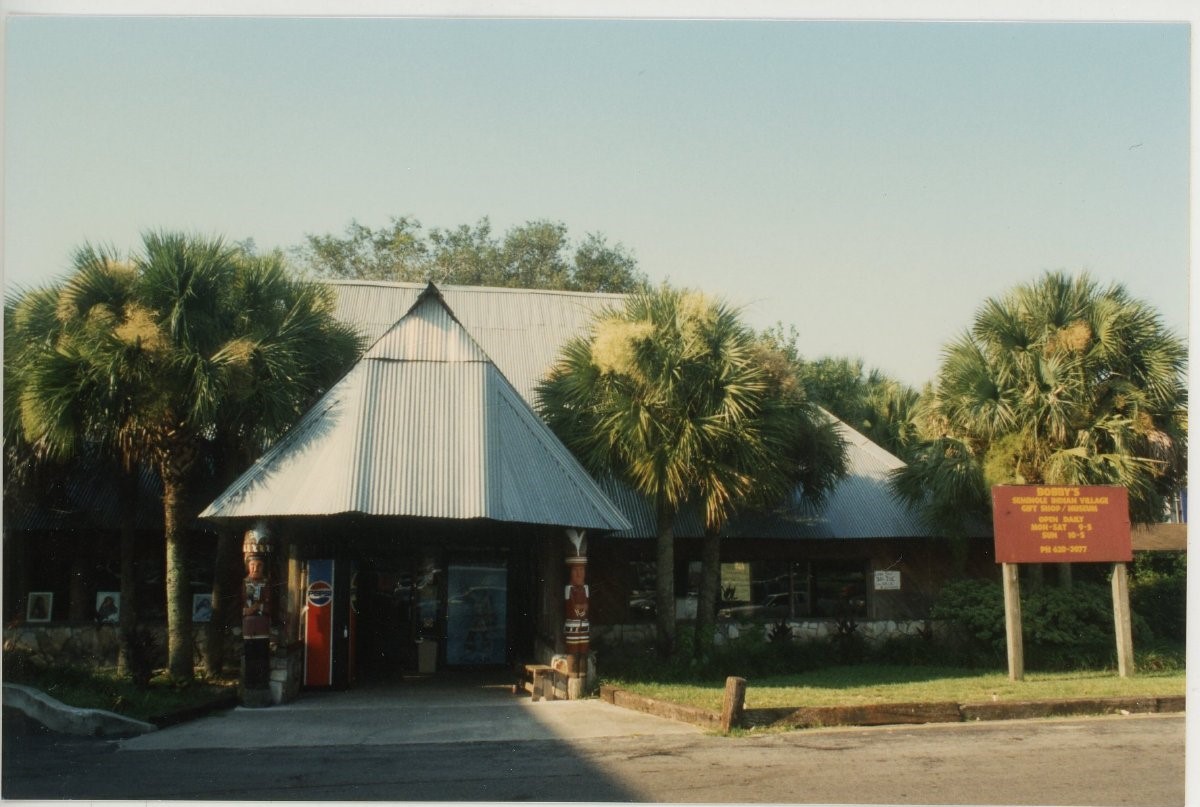
Welcome back to the second part of our two-part series about the Coo Taun Cho Bee Museum! Last week we looked at the roots of the Museum itself and its caretaker Bobby Henry. This week, join us as we feature parts of the collection, which now has a home with the Ah-Tah-Thi-Ki Museum. It is important to remember that the handful of items we are highlighting are only a very small part of the total collection. We encourage you to explore the Coo Taun Cho Bee Collection yourself through the Ah-Tah-Thi-Ki Museum Online Collection.
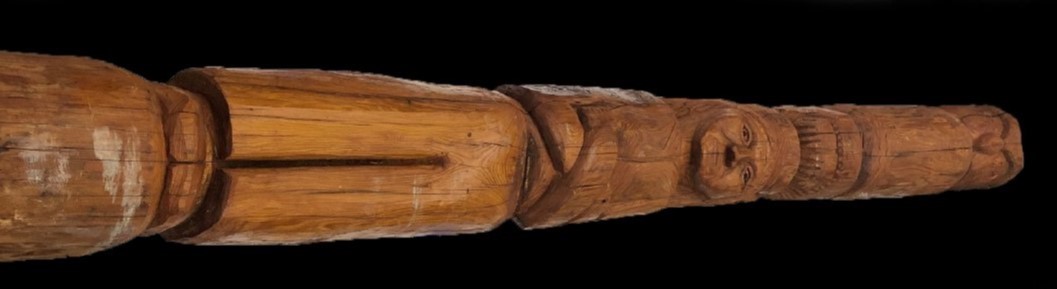
In our featured image, you can see a totem pole carved by Bobby Henry. He carved it for the first powwow at his Seminole Village. It was also on display at the Coo Taun Cho Bee Museum for a number of years. Henry is well known for his wood carvings, which range from sofkee spoons to totem poles. You can learn more about Seminole totem poles in a previous blog post. This pole is unpainted and depicts human and owl figures.
The story of the totem pole was pieced back together by Bobby Henry and its original winner. The story was detailed in a Seminole Tribune article from July 26, 2013. Henry Battiest Jr. won the totem pole in a raffle at Coo Taun Cho Bee Village in 1993. He offered wanted to sell it to the Museum since it was so large and difficult to take care of. Battiest said “It definitely wouldn’t fit in the Ford Taurus I had driven to the festival.”
The article continued that “Both men were happy to see the old totem pole remained in good shape. The men reminded the Museum of its job: to share pieces of the past with people in the present in special ways.”
The Collection
The Coo Taun Cho Bee Collection still exists today at the Ah-Tah-Thi-Ki Museum. The Coo Taun Cho Bee Museum was in many ways a precursor to the Museum of today, a tentative stepping-out of sorts into telling the Seminole story from a Seminole perspective. The items in the Museum thus reflected that desire; they highlighted the Seminole perspective, culture, prominent Tribal members, traditions, and items that were important to Seminole people. Although today this may seem like a natural concept (a Seminole museum designed around what Seminole people value), it is one that shoves against centuries of academic and traditional museum dogma.
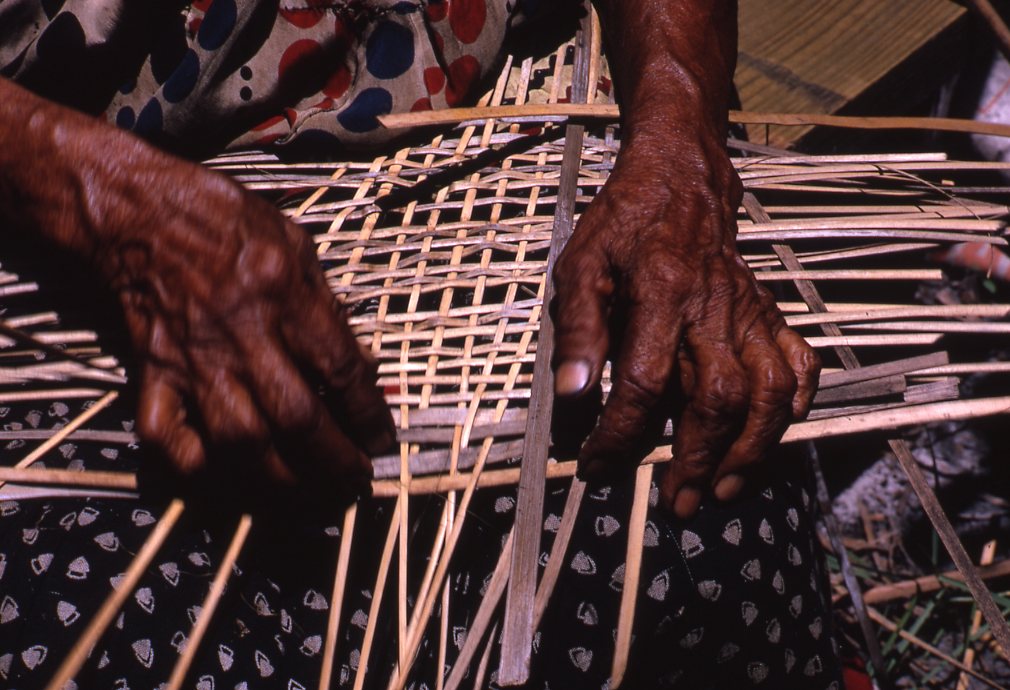
Included in this Collection is a vast array of items, ranging from prehistoric to contemporary. Alongside a prehistoric point collection there were biographies of Tribal leaders, dolls, trade beads, hides, wood carvings, patchwork clothing items and samplers, baskets, photographs, and even an explanation and example of a Seminole game using a cow knee bone (below).
Much like the Ah-Tah-Thi-Ki Museum today, the Coo Taun Cho Bee Museum was also an actively growing entity. That is, to say, that people were constantly adding to the Collection with contemporary items and creations to further the Seminole story. Bobby Henry was one of those people, who “created many Seminole crafts in the 1980s and 1990s in Tampa for the Coo-Taun Cho-Bee Museum.” (Seminole Tribune, July 26, 2013) His, and others, art remains a valued part of the Collection, and to this day works to add to the Seminole story. Below, join us to take just a tiny peek into this collection and look back at the Coo Taun Cho Bee Museum together.
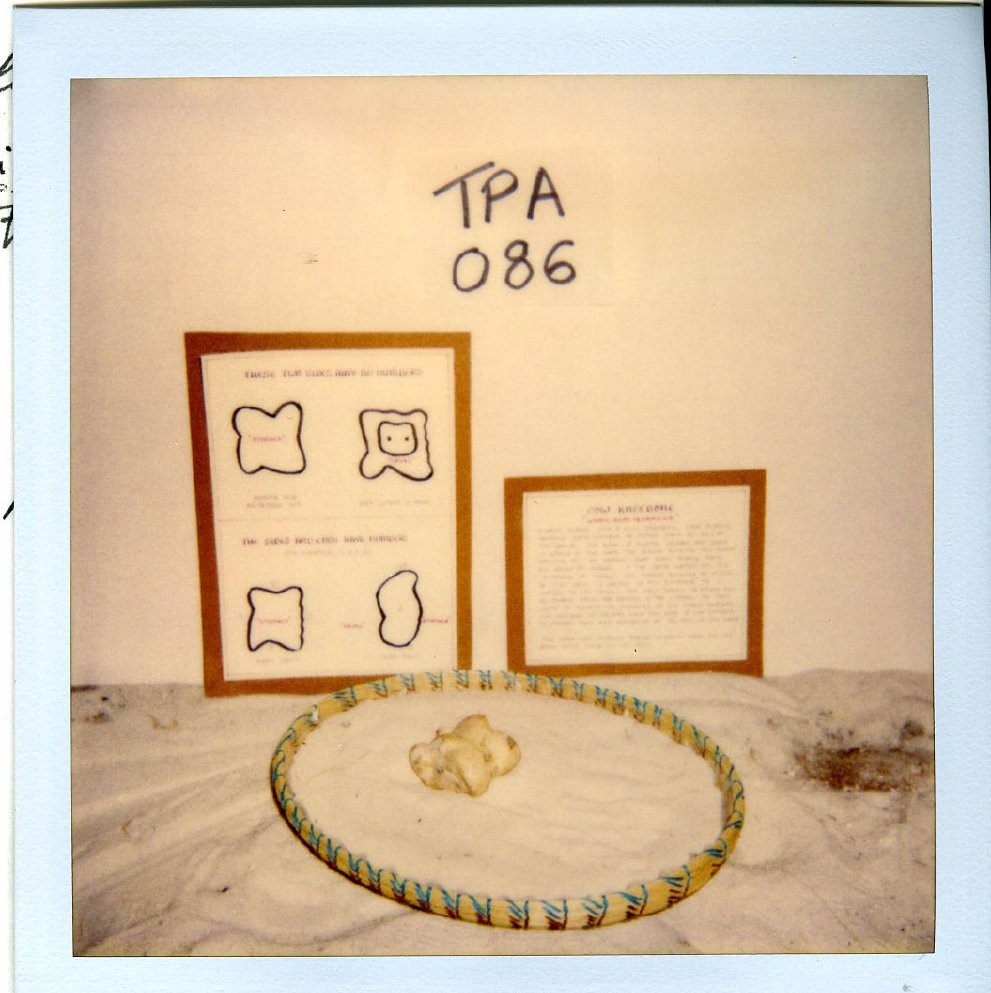
2002.166.46, Cow Knee Bone Game
Highlighting Prominent Tribal Members
A small portion of the Coo Taun Cho Bee Collection highlighted impactful and important Tribal Members. Although not an exhaustive history, many of the members depicted along the walls would have a significant impact on the trajectory of the Seminole Tribe of Florida in the modern era. You might even recognize some faces in the paintings below!
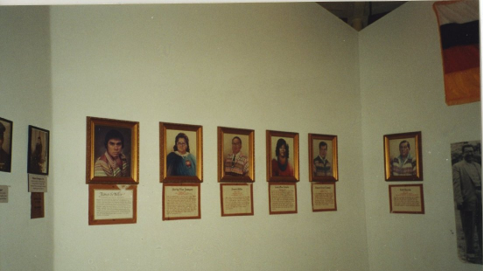
2002.166.136
Today, these biographies continue to be very useful. They trace the history of the Seminole Tribe of Florida and recognizing the individual contributions of Tribal Leaders. Below, you can see the biography of Dorothy Oceola, which hung below her portrait. The handwritten biography not only gives a snapshot into her life of service, but also her legacy through her family and children.
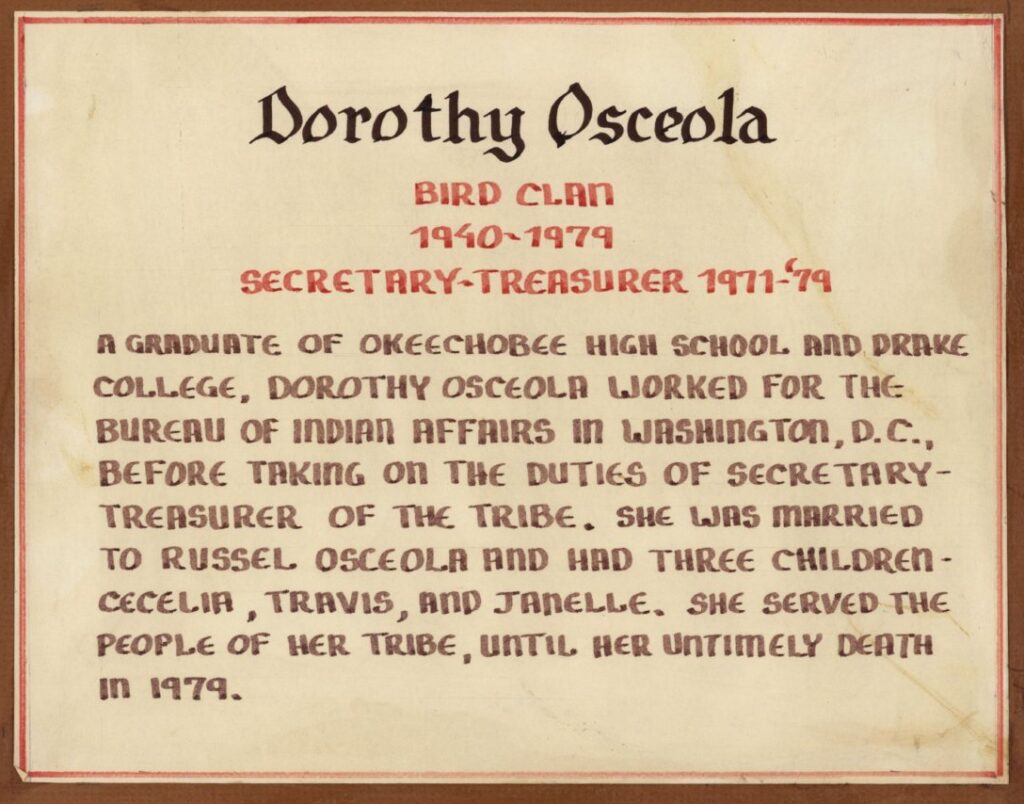
2002.166.471
Bobby Henry’s Wood Carvings
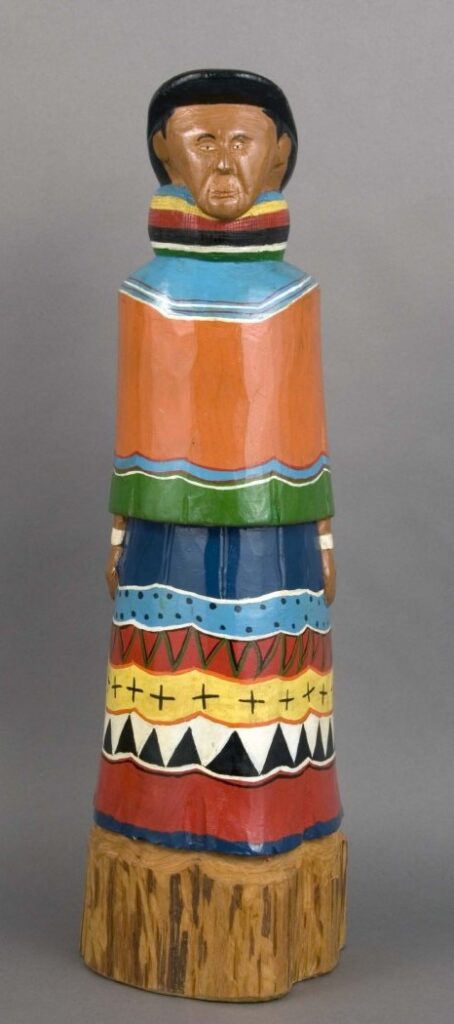
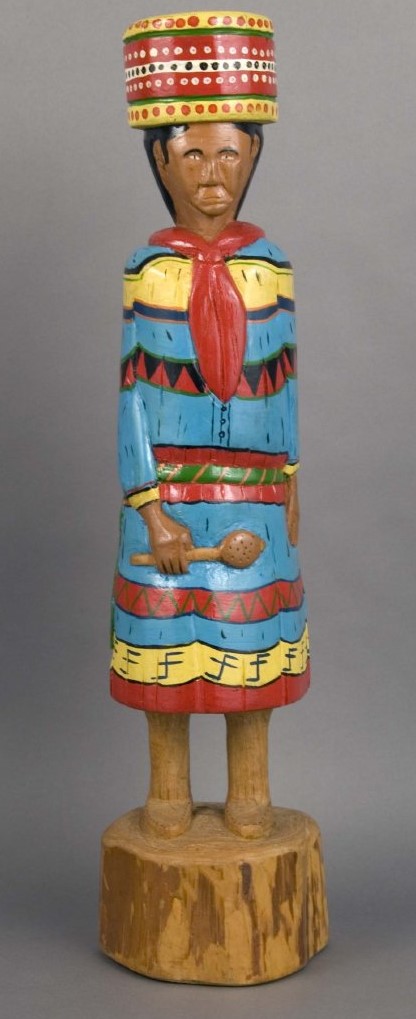
Interspersed within the collection are Bobby Henry’s own wood carvings. They range from smaller figurines to the larger scale totem pole mentioned above and even canoes. Henry was a prolific and incredible wood carver. He learned traditional canoe carving from his father at a young age in the Everglades. Although Henry’s carvings were not the only carvings included in the Collection, they are a cornerstone of it.
Below, you can see two 20” wood carvings: a Seminole man and a Seminole woman. The matched pair were made by Bobby Henry. On the Ah-Tah-Thi-Ki Museum record, it adds that “When [Bobby’s] wife, Annie Henry, visited the museum in 2010, she said it was meant to represent her, and the accompanying male doll was meant to represent her husband. The seriousness of this claim is unknown.” (2002.166.73-74, ATTK Museum)
In the 2013 Seminole Tribune article referenced earlier about the totem pole, Henry also views his dolls on that same visit to the Museum. The article shares that “the dolls are unique because unlike most Seminole dolls made out of palmetto fiber with patchwork clothing that mirror the style of the decade in which they were created, Henry’s have painted clothes. The other wooden dolls at the Museum date to the turn of the century, and they do not have painted clothes. So, Henry’s large, brightly painted dolls stand out.” In essence, this pair of dolls blends different eras of Seminole artistry.
Photographs
Many of the photographs included in the Collection date to the early to mid-20th century. They detail Seminole life, and include snapshots of sewing, canoeing, sitting around the fire, interacting at trading posts, and so much more. Collections like this are an invaluable look into Seminole life.
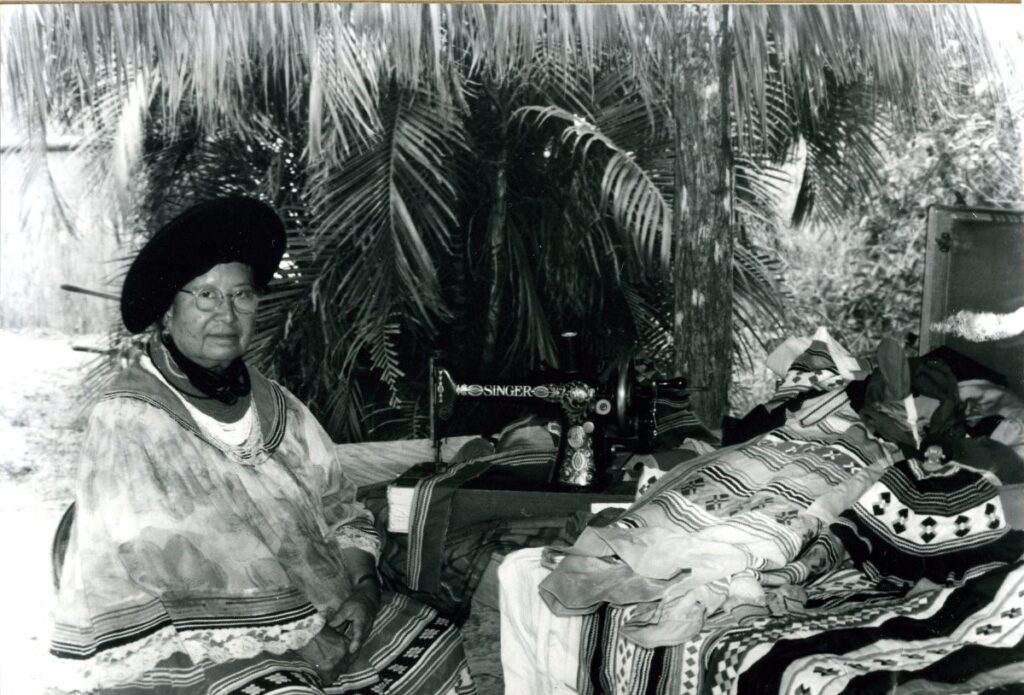
2002.166.181
Here, you can see a Seminole woman posing for a photograph. She is sitting next to a sewing machine with patchwork and a doll on a table. The image dates to the mid-20th century, judging by clothing and hairstyle. You also might notice that her sewing machine sits prominently in the shot. Singer machines like she is using were very important to Seminole women, and they had a massive impact on the development of Seminole patchwork.
Singer was the first company to offer installment sales of their machines. Individuals or families who could not afford the full purchase price could pay in installments and still take their new machine home. Seminole women thus finally had access to sewing machines in their own homes. This made creating the iconic patchwork possible on a larger scale. Paired with the rise of the tourism era after the 1910s, the importance of tabletop sewing machines like the one above can’t be understated. They were the vehicle with which Seminole women developed these iconic styles, as well as produced the incredibly complex and varied clothing we know of today.
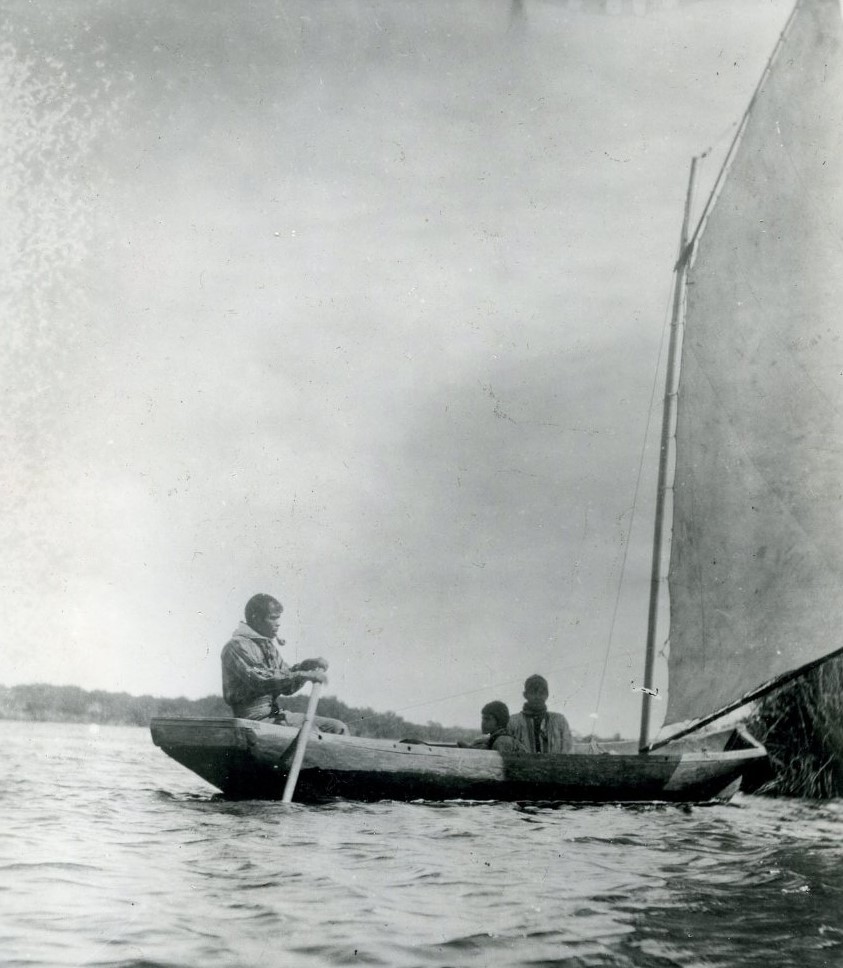
2002.166.175
Here, you can see three Seminoles in a canoe with a sail. The image dates from the early 20th century, and the sail could have been used when sailing open waters such as the ocean. In a Seminole Tribune article from 2021, canoe carver Pedro Zepeda explained that “Using a sail on a canoe was done into the 1940s. The paddle was used as a rudder. I’d like to revive it.” You can clearly see that shown here, as the man to the far left uses a paddle as a rudder.
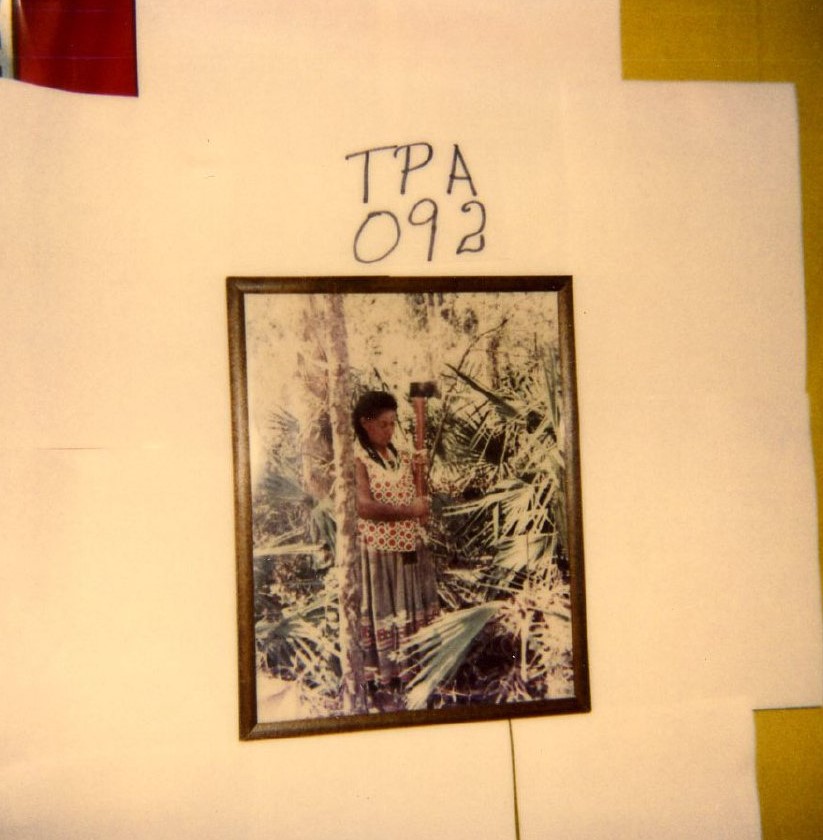
2002.166.176
A Seminole woman holds an axe to chop the palmetto in front of her. This image is as the photograph was displayed in the Museum. You can see an identification number above the image on the wall.
Patchwork, Artifacts, and More
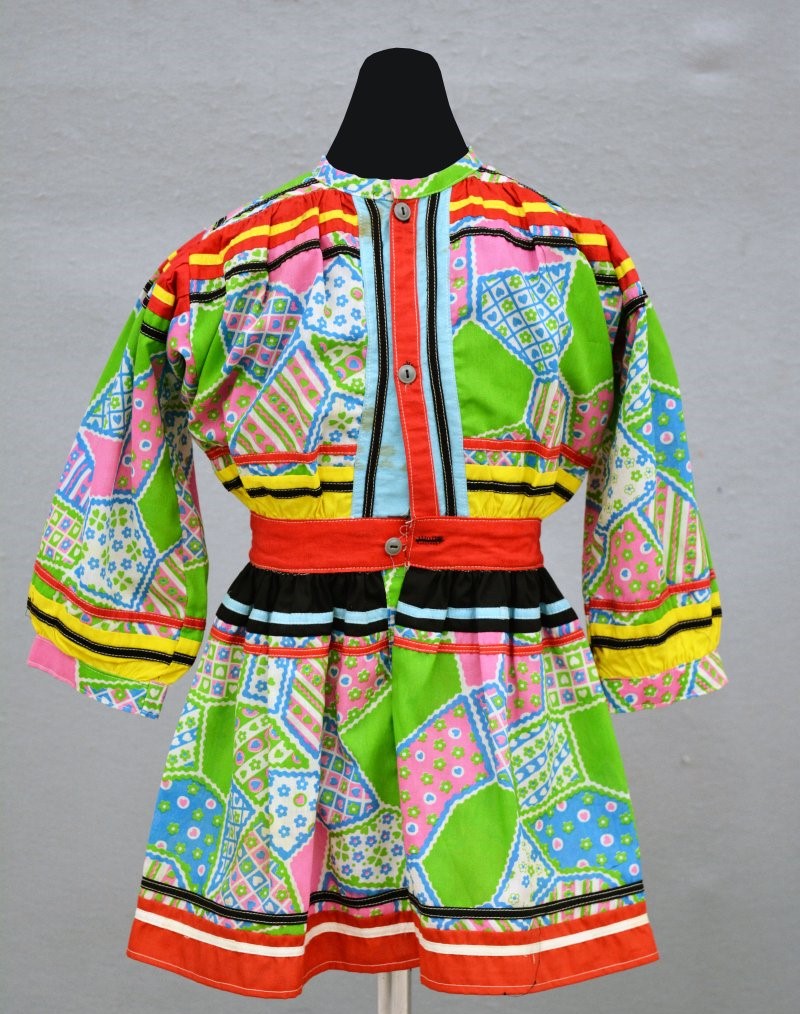
This bright, graphic boys bigshirt features no actual patchwork. Instead, it is a green and pink patch-style print, with red and yellow bands around the yoke and red, yellow, and black bands around the waist. It has three buttons. It is part of several textile and leather pieces as part of the Collection.
2002.166.69
Here, you can see a pair of turtle shell shakers. Each shaker is made from five turtle shells tied with leather thongs to a piece of leather. The leather would have been worn around the lower leg with a leather thong laced up the back. Black beads and dark colored seeds inside the turtle shells make the rattling noise.
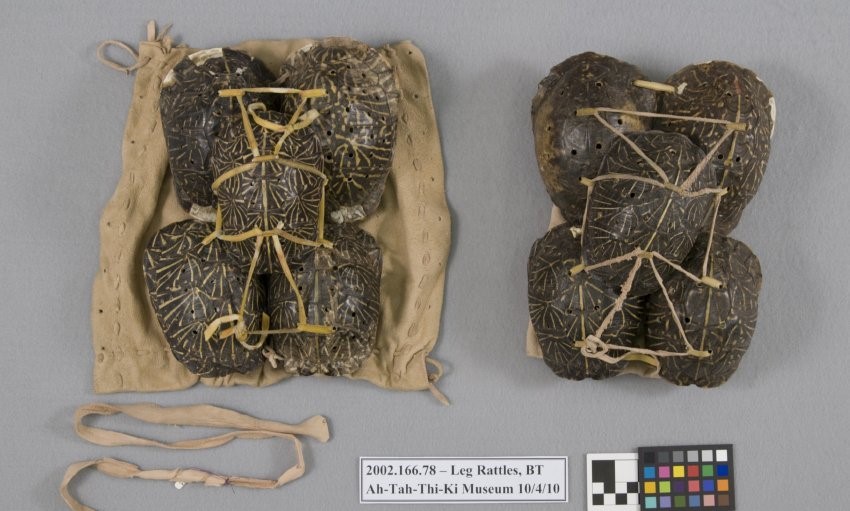
2002.155.78
Interestingly, the Coo Taun Cho Bee Collection also included several points, acquired through donation. This complete Marion point is dated from the Middle to Late Archaic period. This type is found primarily in North Florida but also in parts of Georgia and Alabama. It is one of four stemmed subtypes of Middle Archaic points, as defined by Bullen in 1975. The Collection also included examples of other point types that would have been utilized by Seminole ancestors throughout time.
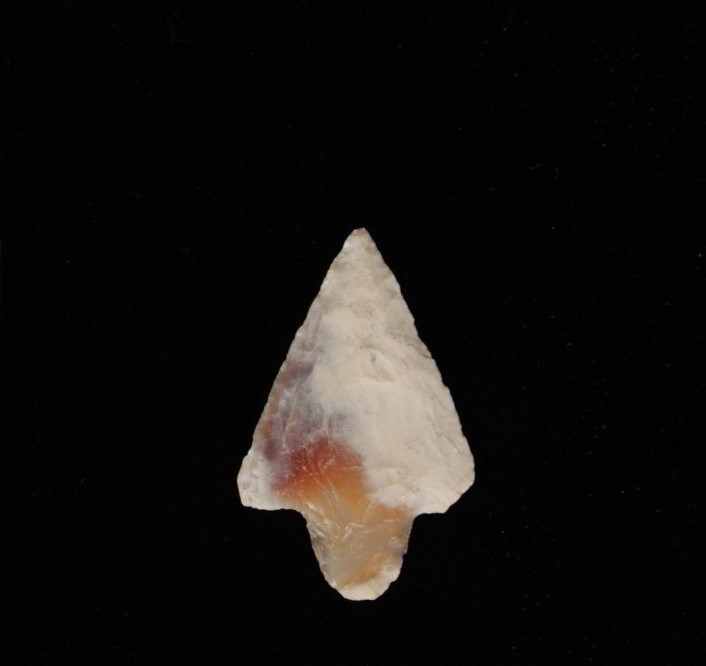
2002.166.419
This colorful black, white, blue, and red patchwork sampler hung on the wall of Coo Taun Cho Bee Museum. It was possibly used as a teaching tool or by a student mastering different patchwork patterns. You might even remember seeing it on the wall in an image from last week!
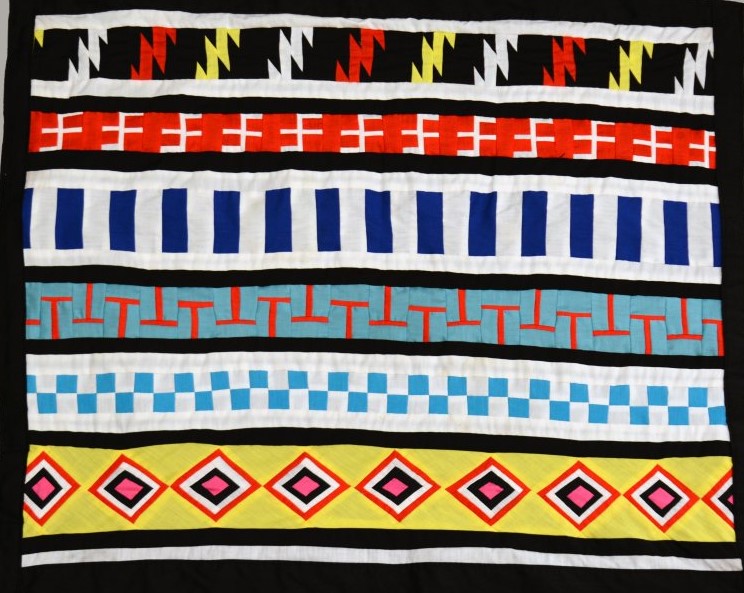
2002.166.6
Of all the things you might expect to be in the Coo Taun Cho Bee Collection, a taxidermy bear probably wasn’t on your list. Here, a taxidermized bear has been posed outside to appear natural, as if he is in a forest. But, Vlad (the bear) was in fact originally donated to the Tribe through the Tampa Reservation and was first held at the Coo Taun Cho Bee Museum. Today, it lives in the Curatorial Building at the Ah-Tah-Thi-Ki Museum. Although not officially part of the Museum Collection, Vlad is well taken care of at his Curatorial home.
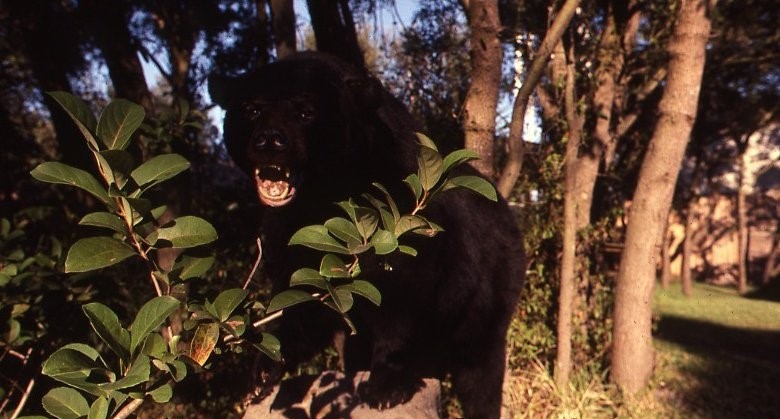
GRP1910.28
The pieces of the Collection explored in this blog post are only a small sliver of those that made up the Coo Taun Cho Bee Museum. We encourage you to explore more of this collection through the Ah-Tah-Thi-Ki Museum’s Online Collection database. Many more pieces are available for you to view, and we hope that you take this opportunity to learn more of the Seminole story!