
Shining a Spotlight on Seminole Storytelling
All of us, at some point, have listened to stories passed down through our families. Grandparents share their memories, they share the stories their own grandparents told them, and those pieces filter down to us to tell our children. But these aren’t just stories. They carry a wealth of information, generational learning, and lived experience. For the Seminole people, these stories are a connection to their history. This week, we take a spotlight to Seminole Storytelling, and how it acts as a conduit for culture, wisdom, and Seminole resilience.
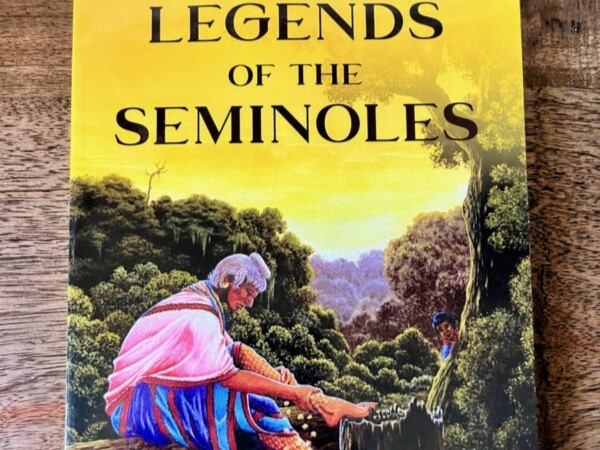
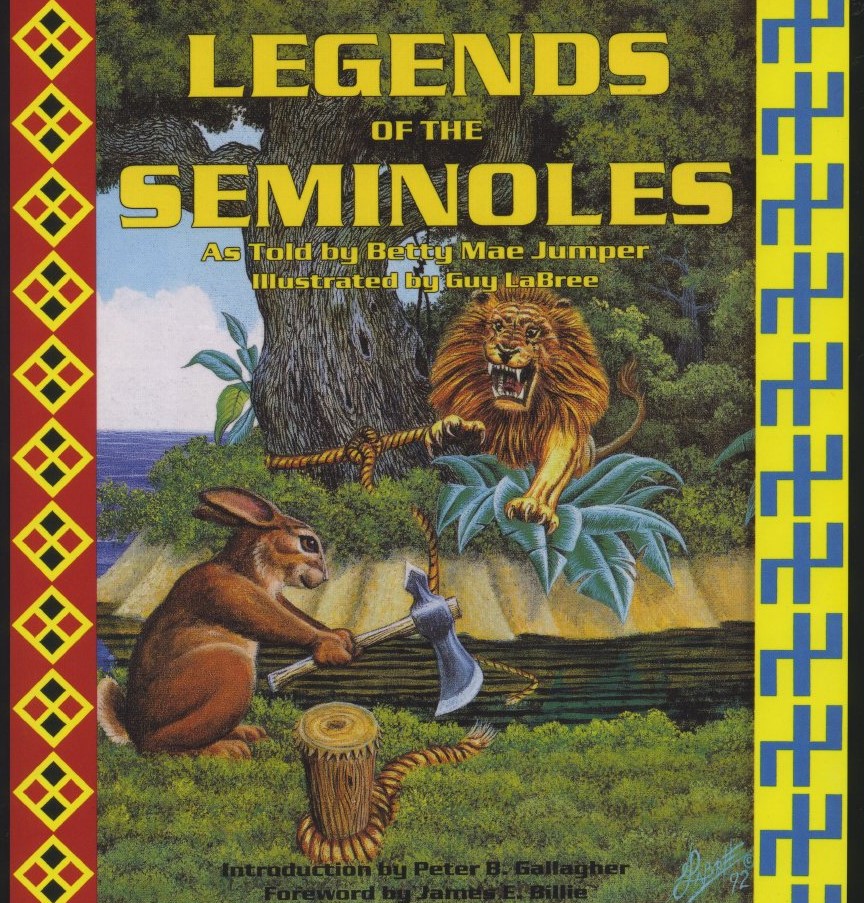
In our featured image, you can see the cover of the 2020 reprinting of Betty Mae Tiger Jumper’s “Legends of the Seminoles.” A detailed, expansive collection of Seminole legends as told by Betty Mae, the book is illustrated by none other than Guy LaBree. Beyond the stories, which are cultural treasures in themselves, the book holds the voice of Betty Mae. Growing up, Betty Mae would have heard these stories around the fire. As she grew older, she would have told these same stories around a different fire, this time as the storyteller herself. Through this book, as well as some of her articles left behind, her voice continues to pass along wisdom, learning, and care.
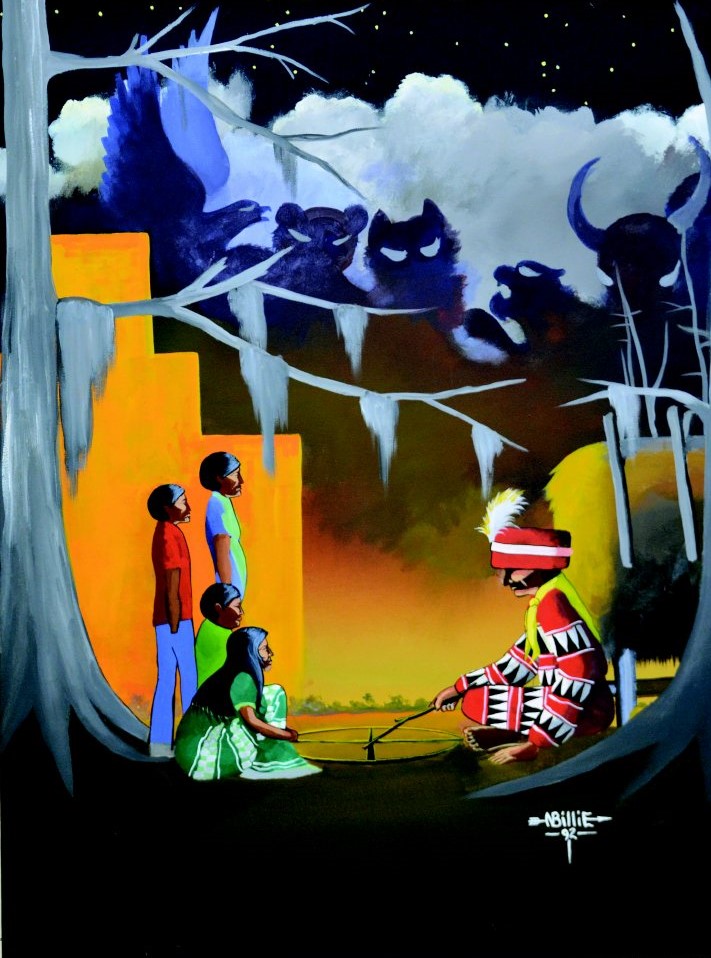
1992.4.1, ATTK Museum
Stories as Vehicles for Culture
Above, you can see a painting by Noah Billie. The painting, titled “Traditions,” shows five Seminoles sitting around a medicine wheel. To the right, a larger figure wears traditional clothing and a turban. To the left, four younger figures in more modern clothing face him, some leaned forward. The clans, shown in the sky, watch from above. This striking painting, with its bold colors and Billie’s recognizable graphic style, is an incredible representation of the power and legacy wrapped up in Seminole storytelling.
The elder, in his traditional clothing, leans over the medicine wheel. The youth, with their more modern clothing, almost lean in, as if listening to him speak. In a way, it shows the cultural transference from generations, as those who came before share knowledge, tradition, and culture to the next generation. Above, the clans watch over.
Stories for Seminoles are vehicles for culture and tradition. Children learn their history through stories, and they learn morals and teachings through legends. From the youngest children to the oldest elders, they listen again and again, learning and growing with each telling. Without these stories, they would lose so much of that cultural transference.
In Peter Gallagher’s introduction in “Legends of the Seminoles,” he quotes Betty Mae talking about the process of her beginning to write down the Seminole legends from her youth. “Betty Mae Jumper had been translating from Creek and Miccosukee and writing down, in long hand English, the legends and stories from her childhood…. She didn’t really know why she was doing it, just that it needed to be done… ‘These stories are very old, but have never been written down,’ is how Betty Mae rationalized her passion. ‘If the oldest people on the reservation were to die, without leaving them for others to learn, then our culture would die too.” (Legends of the Seminoles xviii)
Stories as Cultural Resilience
From a western viewpoint, it is easy to discount storytelling as just entertainment. Often, we don’t place value in things unless we can read them, unless they are rooted in a tangible way to some authority. But, this is an incredibly narrow, reductive viewpoint. Prior to the modern age, before stories began to be recorded and written down, they were one of the best and most effective way to pass along information.
From generation to generation, people learned stories that gave them the foundation for their lives. They also couldn’t be taken away. During the Seminole War period, entire cultures and communities were under intense pressure just to survive. They lost so much, but stories were one way that the culture was able to continue and had a chance again to flourish. As long as there were elders to share their stories, and those who listened, the culture could be kept alive.
A Seminole Tribune article from 2013 details a Seminole Storytelling program headed by now-Ah-Th-Thi-Ki Museum Director Gordon Wareham. A seasoned storyteller, he often blends his flute music with Seminole legends.
During one of his performances, he told the story of the Rabbit and the Box Turtle to a group of preschoolers. “We have some bad people in these stories to teach you kids how not to act,” Wareham said. “We are Seminoles, and that is more than our DNA. It’s about the knowledge we have, and the stories told by our grandparents and parents.” Today, storytellers like Wareham and Outreach Coordinator Van Samuels work hard to continue passing this knowledge along.
Oral Histories
Another element to Seminole storytelling that informs and upholds the Seminole story are oral histories. Today, we often hear the concept of oral history in a Museum context; elders are interviewed so their words can be recorded and passed down to those who come after. In 2023, then-Oral History Coordinator Alexander Banks wrote for the Seminole Tribune that this work was necessary to fill in the gaps of Indigenous and marginalized voices in the historic narrative. In effect, these oral history projects worked to provide not only representation, but also agency, for those whose voices had been cut out of the history books. These histories can be anything ranging from an anecdote, to a personal experience passed down, to a legend. But, all include some element of storytelling, of narration. But, what makes one thing a story, and another a history? These are, in actuality, the same thing.
Banks wrote that “When you hear the word ‘narration’ you might imagine things like works of fiction, or a story as opposed to a more straightforward list of the facts. If someone is narrating their own history or the history of their people, are they turning it into more of a story and less of a history? I think not. In fact, I would go so far as to argue that all historians funnel their findings through a storytelling, narration process to get a final product that looks less like a list of facts, and more like a novel. So why do some academics consider the story told by the historian to be more valid or historical than the narrative of the interviewee? This should be the other way around.”
Oral histories are the history of the Seminole people, as each story is passed down from person to person. Without these traditions, so much of the truth of the Seminole story and their true history would have been lost.
The Evolving Narrative
Today, storytelling is still an integral part of the Seminole Culture, and just as much as it has been in the past. Before, children would have learned stories around the campfire from their aunts, uncles, parents, and grandparents. Today, while that may still be true for some, they also learn them through Tribal schools, cultural events, the Museum, and libraries. Seminole storytelling has evolved to include recordings, books, and other ways to hold on to stories for longer. In James E. Billie’s forward to Betty Mae’s book, he talks about how legends shift and change as people tell, retell and pass them on. He also writes about preserving these stories in the modern era, and how that has preserved much of the original “voice” of many of these storytellers.
He writes “The recipient of the legend must do his or her best to retell the story, sticking as close to the original version as possible. It is a great responsibility; for this reason, the best storytellers are greatly respected among those in the tribe.
We retell the same great stories over and over, just as we have been doing since Creation. Today, however, we have the privilege of writing, recording, and videotaping these stories. This may eliminate the continuous human retelling, but at the same time there is no misinterpretation. Each word is exactly preserved. In this way, we can enjoy the original version told by the storyteller.” (Legends of the Seminoles x-xi)
The Stories Continue
Stories will always be an important part of the Seminole culture, and a true connection with those who came before. Today, there are so many ways that stories are recorded and preserved. There are even new ways, through song recordings and even film. But, at the core lies the same thread of intention; to pass down, to share, and to guide.
Storytelling has changed, but the need for it hasn’t. In the same Seminole Tribune article from 2013, Billy Walker, an alligator wrestler and storyteller, shared his take on the stories, and how sometimes you need to hear the same story over and over again.
“A long time ago we’d sit by the fire and hear the stories. Listening to the legends was our television,” he said…. Walker knows nearly 40 legends that have been passed down through generations by word of mouth. For some people, Walker said, it can take a lifetime to “get” the message.