
Spotlight on the Seminole Tribune
Over the years, the Seminole Tribune and its predecessors have immortalized the rise of the Seminole Tribe of Florida. With the first newspaper published not long after federal recognition, it has witnessed decades of Seminole history. Not only that, but the community-oriented focus has made it an archive of the triumphs of so many Tribal Members over the years. From graduations, art installations, sports achievements, first businesses, poetry contests, and more, the Tribune has reported not only on the news, but the beat of the community itself across all reservations. This week, we trace the Seminole Tribune back to its roots in the first fledgling printing of the Seminole Indian News to the Tribune of today. We also look back on the incredible archive that past Tribune articles, photographs, and other resources offer to Seminole history.
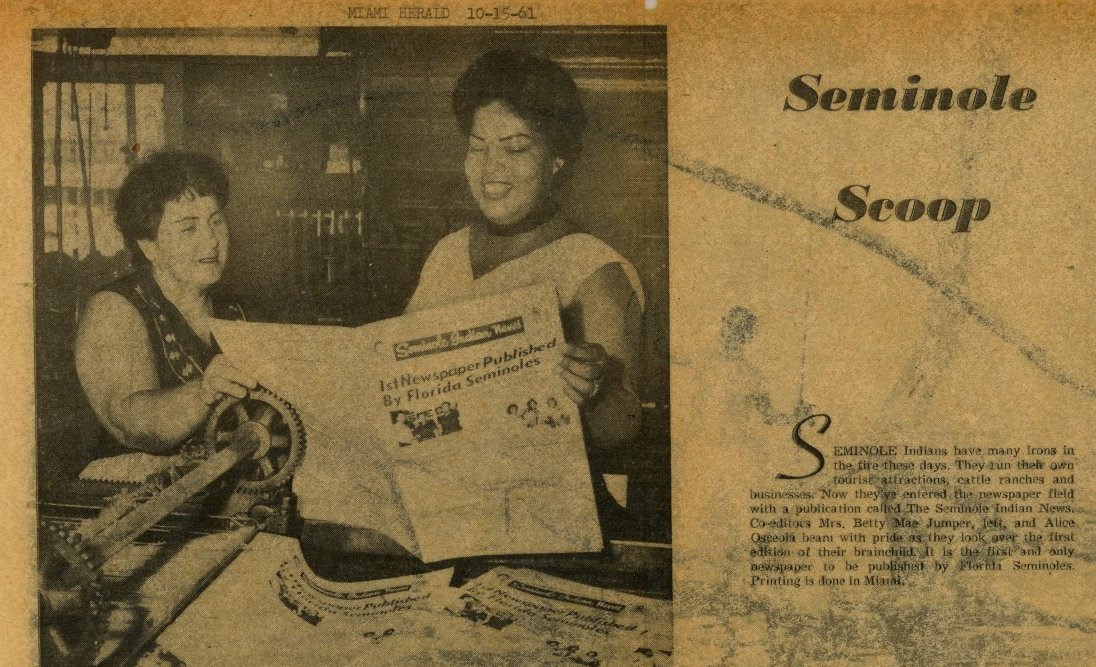
In our featured image, you can see a newspaper clipping from the Miami Herald, October 15, 1961. In it, Betty Mae Tiger Jumper (left) and Alice Osceola look at the first edition of the Seminole Indian News. Below, you can see the front page they are holding up!
Early Beginnings with the Seminole News
The first incarnation of a newspaper for the Seminole Tribe of Florida came in the late 1950s with the Seminole Indian News. Started by Betty Mae Tiger Jumper and Alice Osceola, the paper became the first official published newspaper of the Seminole Tribe. In the inaugural edition, Jumper and Osceola were profiled as co-editors. Betty Mae’s “background certainly qualifies her to be one of the first editors of the newspaper,” the paper quipped. It went on to list her achievements over the years in healthcare and dedication to the Tribe, as well as her pride in being the great-granddaughter of Coacoochee (“Wildcat”). The newspaper’s first edition also endorsed Betty Mae for the Dania Tribal Council Representative race.
Alice Osceola, co-editor, was still in high school and on track to be the first Miccosukee to graduate from high school the following year. Daughter of William McKinley Osceola, she was also the secretary of the Miccosukee Seminole Executive Council. “I want to go to college,” she shared in her profile, “I’d also like to be a Grand Ole Opry Star or a stock-car racer.” It also highlighted her likes and dislikes, including her dislike of the Jackie Kennedy hairstyle, “She…prefers the ‘bubble’ style.”
This first newspaper covered tribal news, like the crowning of Seminole Princess Josephine Huff. It also covered the upcoming tribal elections, issues with the Army Corps, and other tribal centered issues. The very back cover listed the reporters by reservation and even had a small dictionary section with Miccosukee and Muscogee words. Although the Seminole Indian News would only run for a few months, at 10 cents an issue it would set the tone for future tribal newspapers in a significant way, weaving together need-to-know current events with the news of the community itself. This first printing also put Seminole and Miccosukee news at the forefront, a stark contrast to their presence in news up to this point.
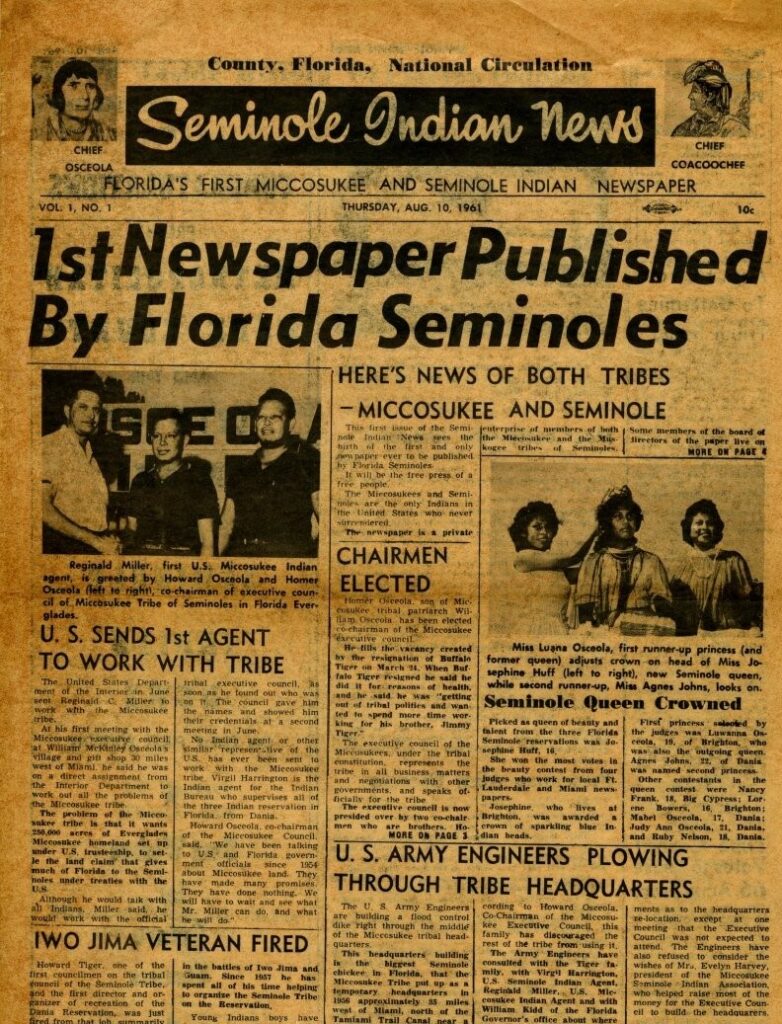
2005.1.346, ATTK Museum
The Alligator Times
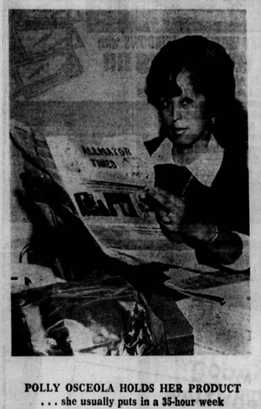
The Alligator Times would replace the Seminole news in the 1970s. Betty Mae Jumper, along with Barbara Doctor and Twila Perkins, would run this publication. Moses Jumper Jr. served as editor until around 1974. Polly Osceola, below, would also begin helping edit the Alligator Times by the end of 1972. In an interview with the Fort Lauderdale News in December 1972, Osceola shared that “People realized they needed [the newspaper] because the reservations are so far apart.” (Fort Lauderdale News, Dec 07 1972)
Organized in a more newsletter format than its predecessor the Seminole Indian News, the Alligator Times shared news from all Seminole reservations, highlighting both breaking news, culture and community stories, and upcoming and past events. All for 25 cents a copy! It was also significantly longer, with the once-monthly publication spanning 20 or more pages. Below, you can see a cover from October 1982. The paper became an archive of current events and day-to-day issues impacting the tribal community across the reservations.
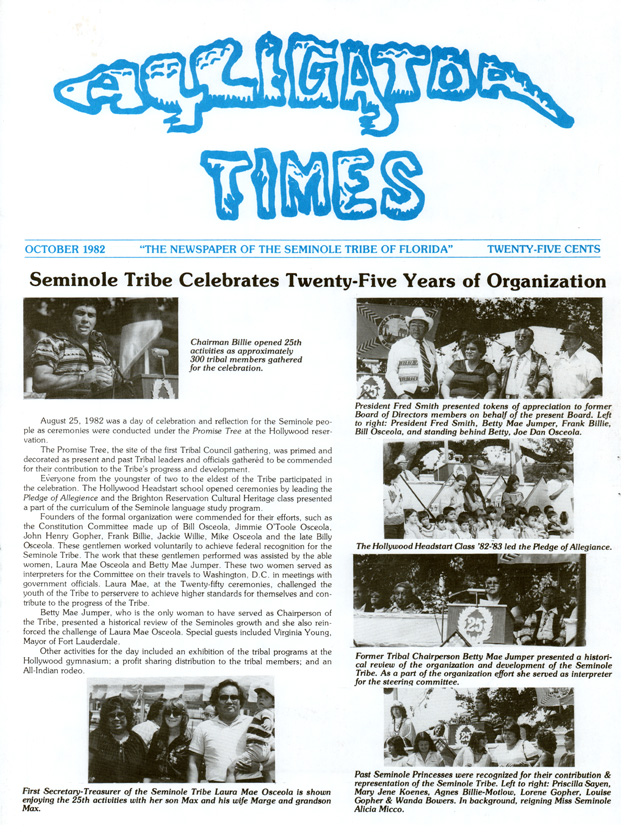
With the start of the Alligator Times, the newspaper of the Seminole Tribe of Florida was beginning to grow along with the Tribe itself. Much more detailed reporting, as well as a more staff, is apparent in this publication than the one before. It truly was beginning to become a newspaper for and by the Seminole Tribe of Florida. If you look back on the newspaper archive prior to this tribally-run paper, the presence of Seminole and Miccosukee people in the news is limited and solely from a white perspective. This newspaper put the community on the page, reporting on issues about and on the Seminole Tribe itself.
The Seminole Tribune
The Alligator Times would be renamed the Seminole Tribune in 1982 with Betty Mae Jumper as editor-in-chief. As it transitioned to the Seminole Tribune, the vision for the newspaper itself coalesced into one not only focused on tribal community news, but also one that served as an avenue for sharing stories, anecdotes, and culture. In 1989, the Seminole Tribune became the first Native newspaper to win the Robert F. Kennedy Journalism Award. That same year it was nominated for a Pulitzer Prize. A member of the Native American Journalists Association, the Seminole Tribune earned an additional five awards from them in 1997.
From the beginning, editorials by Betty Mae Jumper, James Billie, and other Tribal members were interspersed in between pieces of news. They share stories, brought attention to issues they felt were important, and shared memories. In 2017, Mary Beth Rosebrough from the Ah-Tah-Thi-Ki Museum wrote her own article in the Seminole Tribune about Betty Mae Jumper’s editorials. Rosebrough called attention to the heart in her columns, stating that “Placed within the fast-paced blur of news reports, Betty Mae Jumper’s column on life and how to live it stands as a refuge of peace and calm – and common sense.”
In addition to these editorials, interviews, Q&As, and biographies of and by Tribal Members and elders are interspersed throughout the years. The Tribune has served an important role in cataloguing and preserving the voices of so many people throughout the decades it has been running. It has also made these items more easily accessible than many newspapers would. Today, the Ah-Tah-Thi-Ki Museum cares for copies of the Seminole Tribune back through 1984, underscoring the importance of this publication as an archive of Tribal history. You can also find an online archive of all the Seminole Tribune editions dating back to 2000 on the Seminole Tribune website.
More than a Newspaper
Today’s Seminole Tribune is one that is laser focused on reporting on and for the Seminole Tribe and Indian Country. With monthly issues, it has a circulation of more than 4,000 copies. The Tribune also now has a robust online presence, including a website and social media. This allows people from across the country and beyond to not only learn about and engage with Seminole news, but also proliferate the Seminole voice, story, and culture further. Often on this blog we talk about elevating the Seminole story and perspective, when for so long it was devalued in favor of the white lens. The Seminole Tribune is one of those places where this Seminole-centered story is a reality.
The May 2026 edition is a great example, reporting on everything from the recent Festival of Indigenous Culture in Naples, an editorial on sea-level rise and community design, to featuring the second chapter of Eljin Jumper’s “Younger Otter,” an autobiographical work-in-progress. But, one article particularly underscores the long-term impact of the Tribune’s presence in cataloguing Tribal history.
In “From Prints to People: Cataloguing Community Through Tribune Photographs,” Ah-Tah-Thi-Ki Museum Cataloguing Assistant Rebecca Krest outlines the Museum’s work in accurately cataloguing and taking care of the Tribune’s photographic collection, which came to the Museum in 2015. It encompasses tens of thousands of photographs, spanning from the early 1980s through to 2015. The Museum has been working diligently to accurately identify people, places, and experiences that have been captured in this collection, guided by the community itself.
Krest stresses that it is the priority of the Museum that the Tribe be the keepers of their own history. She states “as a tribal institution the museum is in a unique position to model decolonization. For the Tribune photographs, this means cataloging the photos in a way that puts the Seminole community’s wants and needs first. This can be done in multiple ways, but the most important being that the information is directly guided by input from tribal members.”
Encompassing decades, the collection is a physical documentation of the lives many in the community. Krest writes that “This ongoing project serves as a community-wide photo album, where people now have access to unseen photos of family, friends, and even themselves. It is a joy to be able to carry on this project and help give physical memories back to the tribe.”
Are you a Tribal Member that is looking to access the Tribune collection? Please contact Rebecca Krest at rebeccakrest@semtribe.com.