
The Magic of Lantern Slides: Glass Positives Capture a Changing Florida
Welcome back to the latest in our Seminole Snapshots series. In this series, we look at the impact of photography in preserving and sharing the Seminole story. This week, we’re exploring a unique part of the Ah-Tah-Thi-Ki Museum’s photographic collection: lantern slides. These boldly colored glass slides were created using an early photographic process and viewed through a projector. They would be used for entertainment purposes, for personal use, or for lectures and presentations.
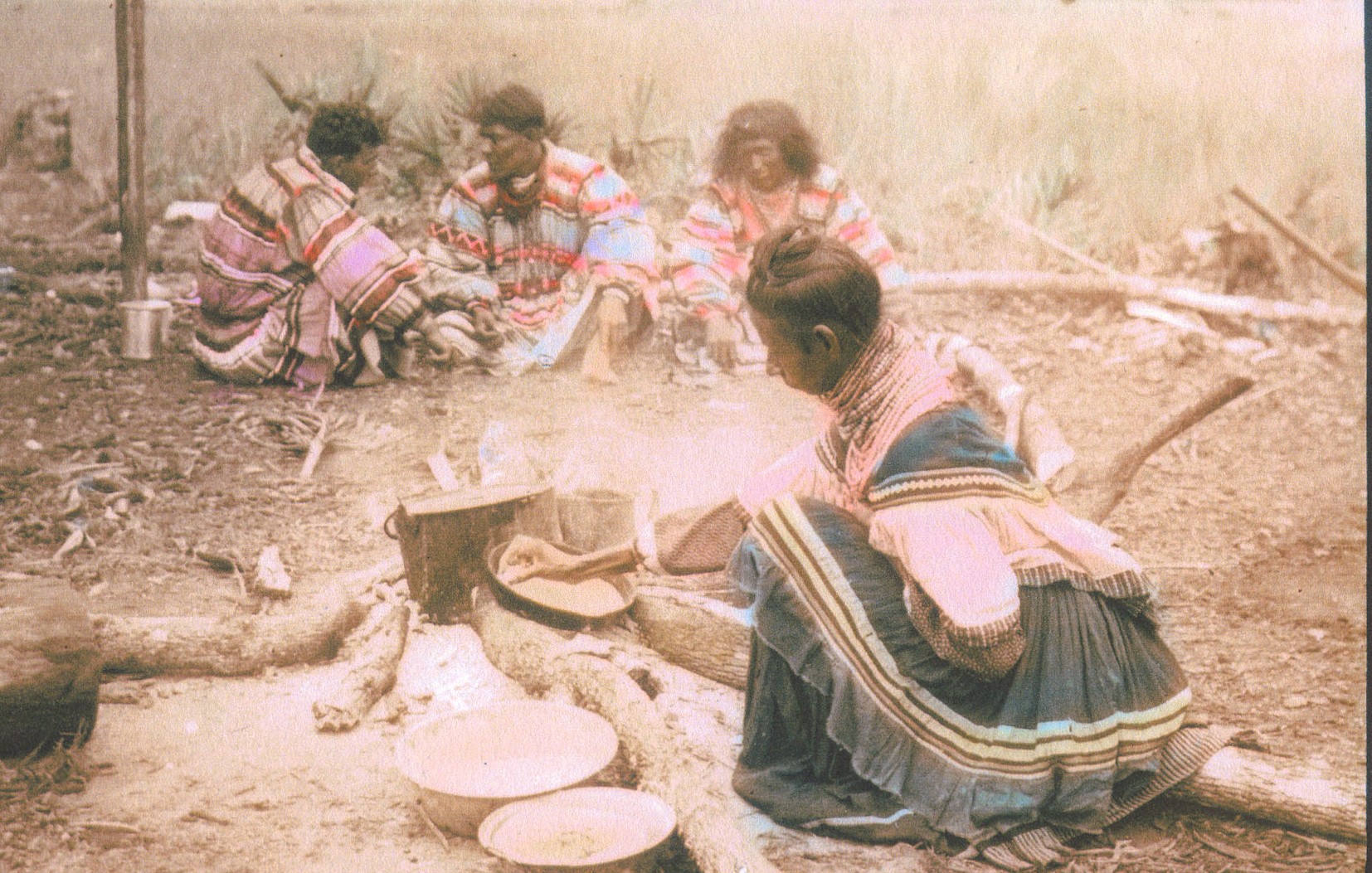
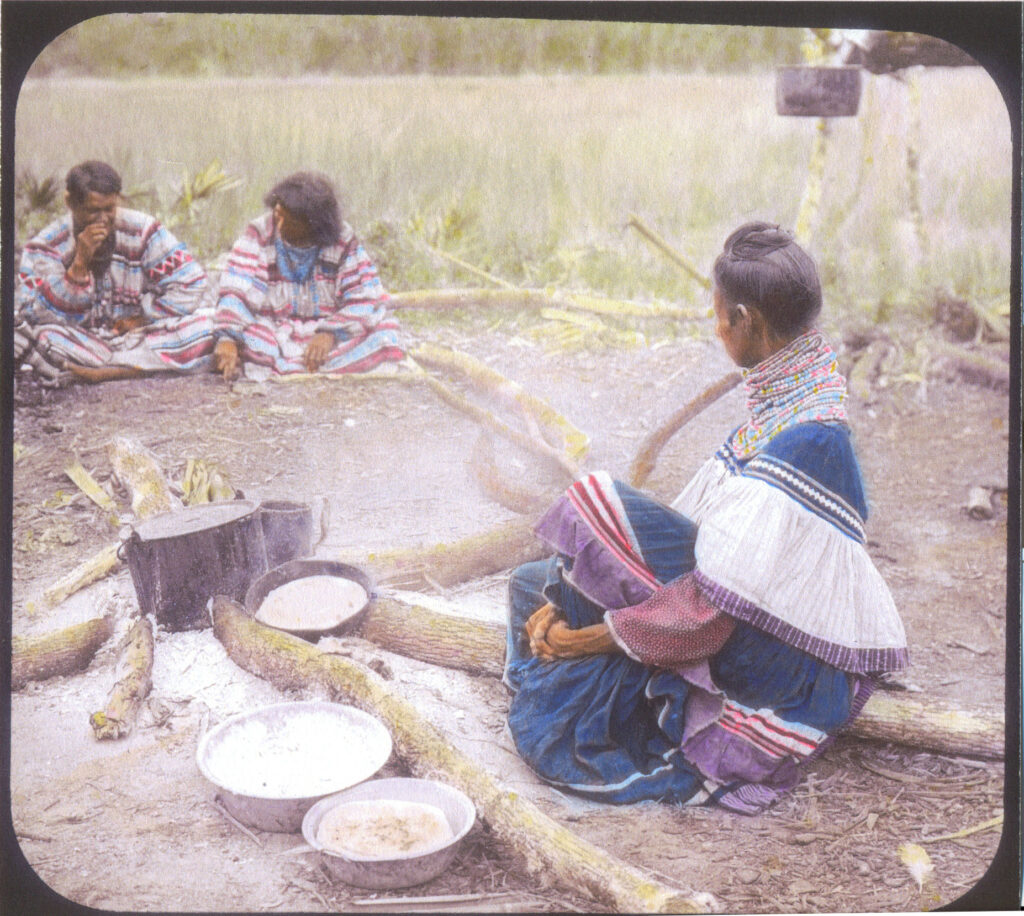
In our featured image, you can see a Seminole woman tending to a cook fire and a pan of frybread, circa 1919 (2001.3.5, ATTK Museum). You will see another shot of the same scene later on. In both images, the Seminole “star-fire” is prominently featured. This type of fire consists of logs cut and laid around the fire like spokes of a wheel. As it burns, the logs can be pushed inward to keep the fire continuously burning.
What is a Lantern Slide?
Lantern slides are a very niche and unique aspect of photographic history. Interestingly, the technology that they are based off predates photography itself! “Magic lantern slides” were made as far back as the 17th century. Pictures would be painted or printed onto glass plates, which would then be projected onto a wall with a light source such as a lantern. “Lanternists” would bring images to life with sound effects, narration, and even music. Multiple lenses projecting multiple images could give the show a 3D effect or simulate movement in the image.
Quickly, they became popular forms of entertainment. As technology progressed and photography was invented, photographs were transferred to slides. Basically, a photographic lantern slide is a positive print of an image on the glass. It would then be “matted” by a piece of opaque paper to obscure the edges and also give it the visual impact of a mounted photograph.
They could also be used to “frame” the scene or subject, by using the matting to crop people or unwanted parts of the image. Below, you can see one such example, where a man to the far right is “cropped” by the matting material. The matted image was then sandwiched between another slide and then sealed, protecting the image from scratches and damage.
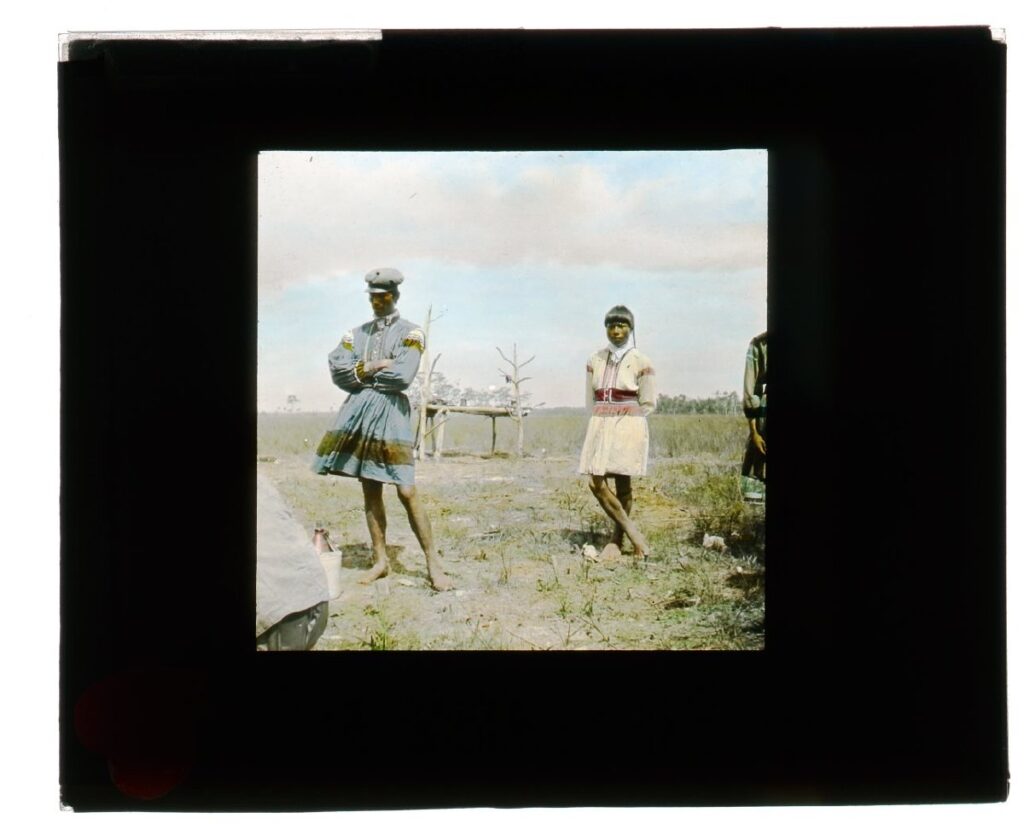
2012.3.31, ATTK Museum
By the mid-19th century more modern stereoscopes, which were handheld by viewers, could be used to view the slides. The images that we can see in this post are more modern lantern slides, dating to the beginning of the 20th century.
During their heyday in the 18th and 19th centuries, lantern slides were an incredibly popular form of entertainment. As the images were projected, they were kind of a precursor to the PowerPoint slides of today. People could even purchase souvenir slides during their travels, which would have the name of the printing or distributing house listed on the slide. Lantern-slides would begin to fall out of fashion by the 1960s and 70s, when they were replaced by more modern photographic slides and digital slide projectors.
Changing Times in Florida
These lantern slides, which fall within the timeframe for popularity of both lantern slides and major upheavals in Seminole history, are a look into a huge period of transition for both Florida and the Seminole people. Around the turn of the 20th century major drainage projects were redefining the Florida landscape. Soon, many of the ancestral canoe trails would be dry year-round, and normal subsistence patterns would be interrupted. By 1928, the Tamiami Trail would be completed, slicing through the heart of the Everglades and forever changing South Florida. The slides seen here were taken within a short 12-year period, from around 1907-1919.
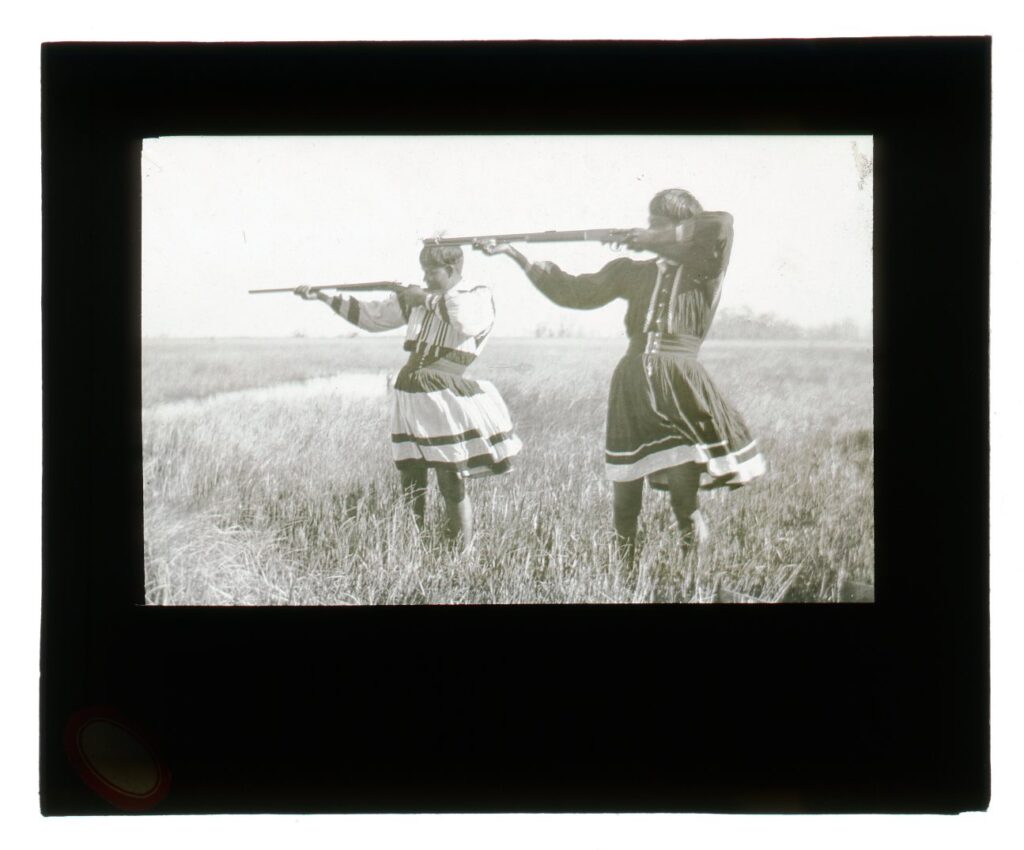
2012.3.35, ATTK Museum
Two Seminole men in bigshirts stand aiming shotguns. The man to the left is possibly Charley Tommy, the guide for the 1907 Julian Dimock exploratory trip to the Everglades.
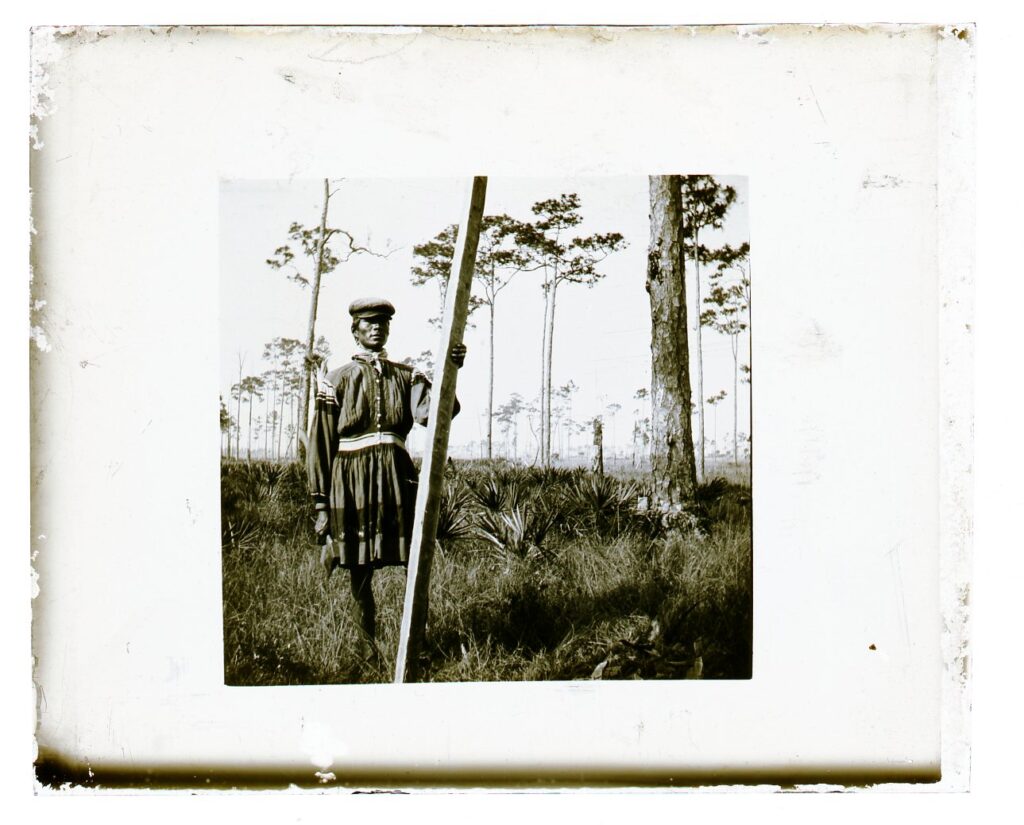
2012.3.16, ATTK Museum
You might notice a blend of Seminole and non-Seminole fashion in the images, such as in the image above. Here, a Seminole man wears a traditional bigshirt paired with a more American cap. He stands in palmetto scrub with tall thin pine trees. Facing the camera, he holds a thin wood post in left hand, and an axe in his right hand. Below, you can see a Seminole couple also wearing a mix of fashions.
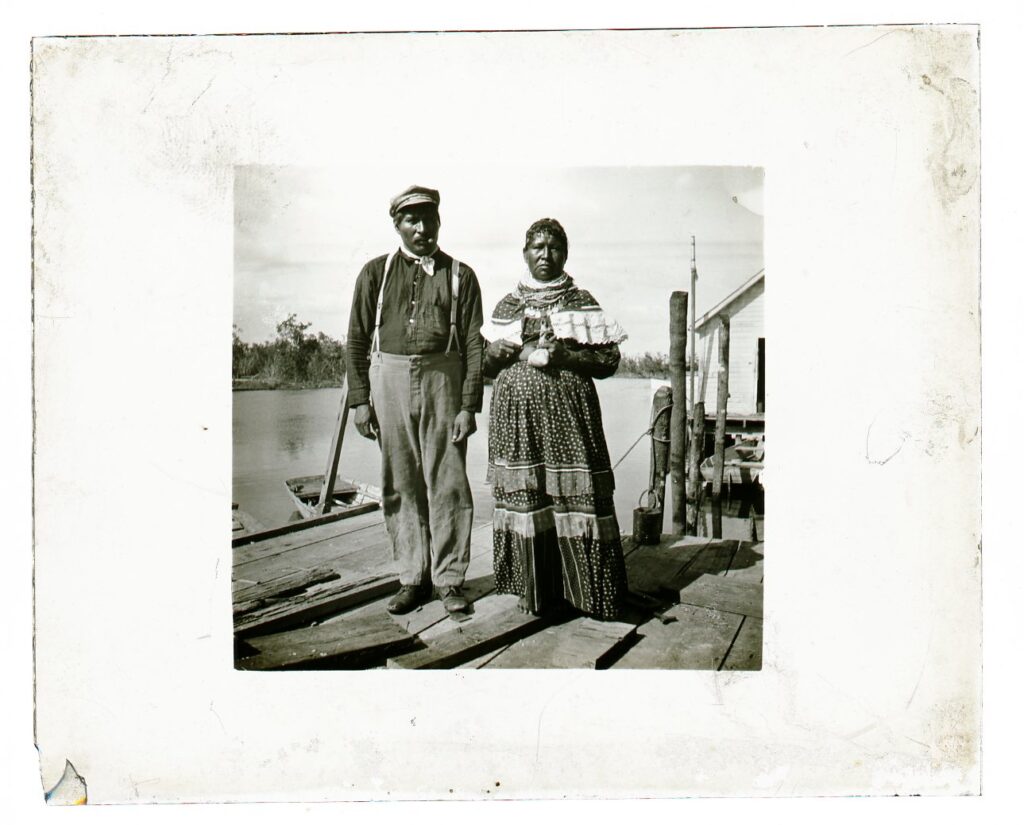
2012.3.10, ATTK Museum
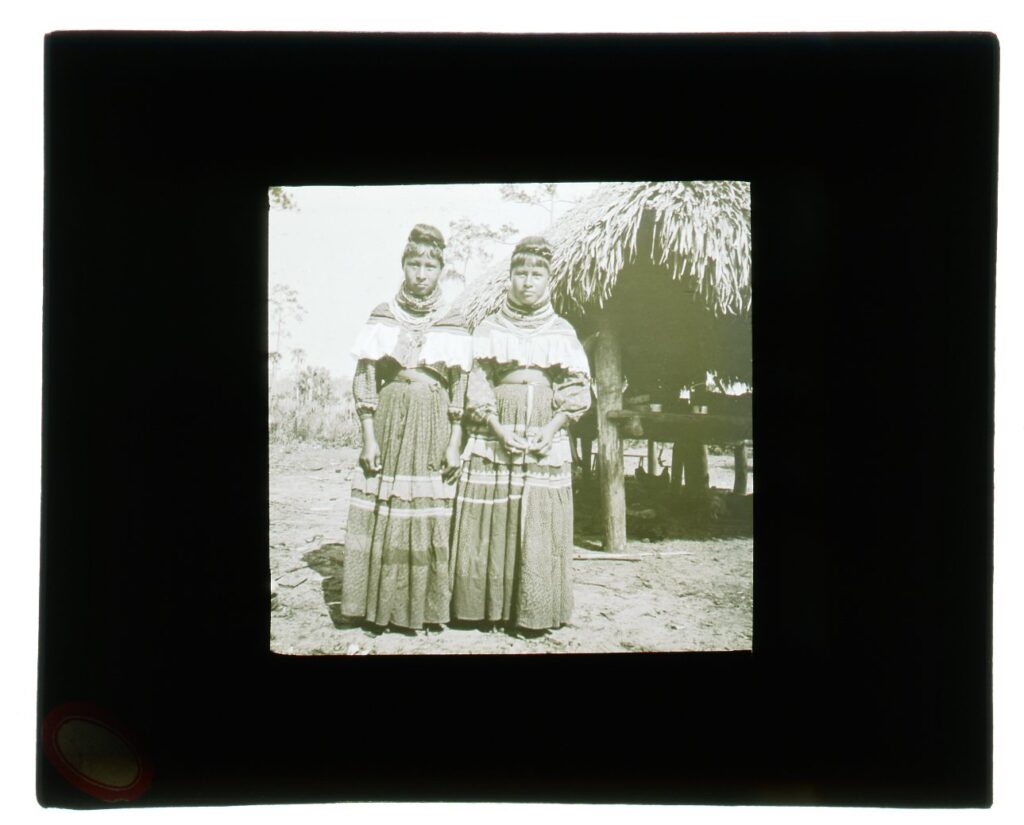
2012.3.9, ATTK Museum
Two Seminole women stand in traditional clothing including lacy capes. They also wear traditional hairstyles of the time and many beaded necklaces.
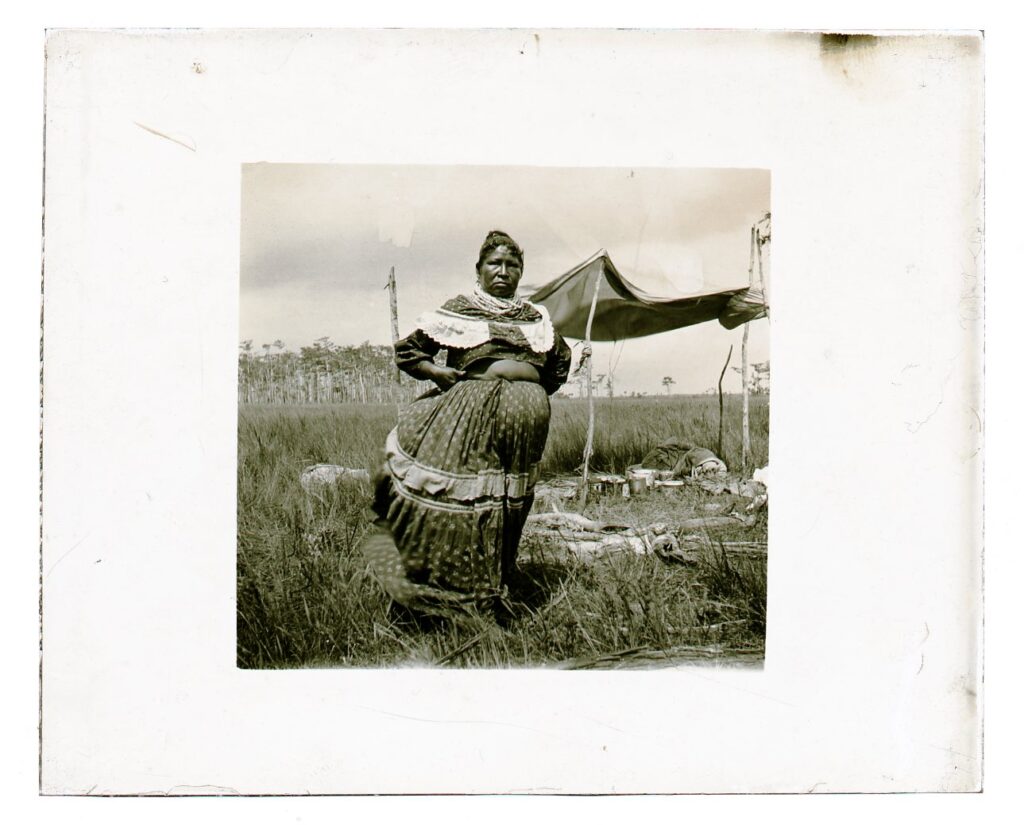
2012.3.6, ATTK Museum
A Seminole woman stands wearing traditional clothing. She faces camera and stands beside a temporary shelter in an open field with trees in the background.
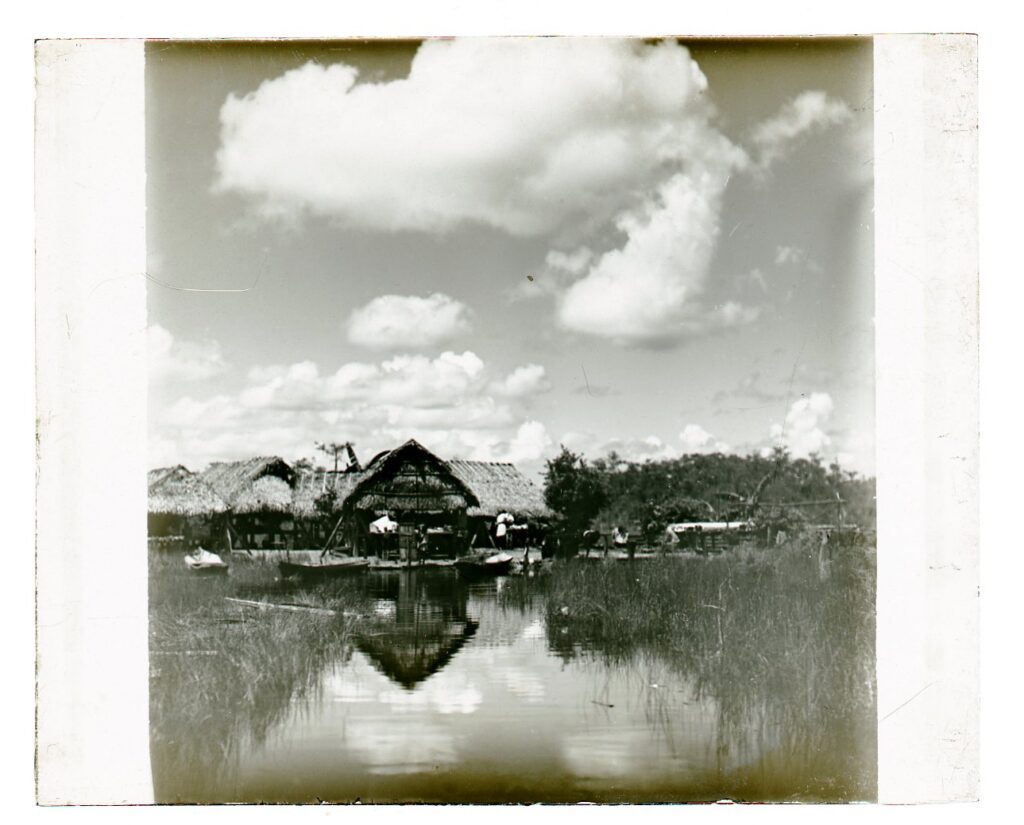
2012.3.1, ATTK Museum
Taken in 1910, the above image shows Little Billy Conapatchie’s (also known as Billy Cornpatch) camp. It was taken by Julian Dimock on an expedition with Alanson Skinner for the American Museum of Natural History.
Hand Painting, Tinting, and Coloring
Hand painted and colored lantern slides were also very popular, and in many cases souvenir slides were brightly colored to make them more appealing. They were painstakingly painted by hand to add color or hand tinted. Some of the souvenir slides (such as can be seen below) have clear indications of hand coloring, and a particular, intense style of coloring at that.
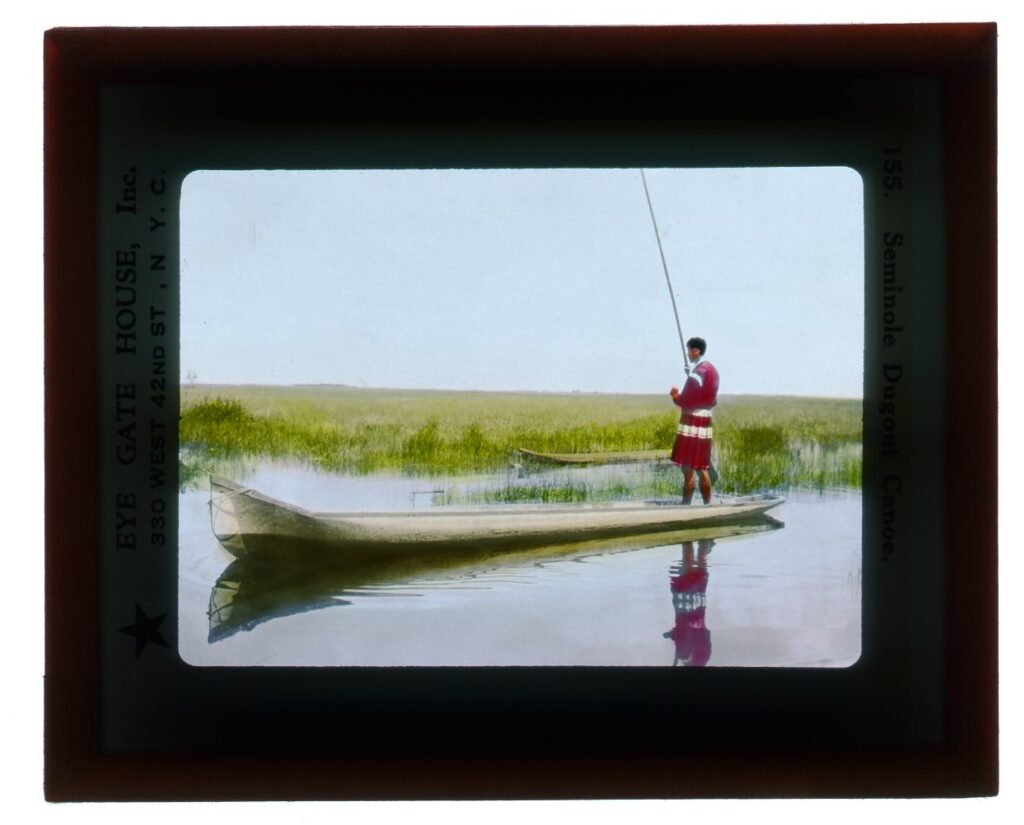
2012.3.25, ATTK Museum
Above, you can see a hand painted glass positive of a Julian Dimock photo. It has been identified as Wilson Cypress at Godden’s Landing, circa 1910.
Some slides within the Ah-Tah-Thi-Ki Collection show more natural color. You can see below a selection of lantern slides taken during around 1919. They may have been taken during a survey trip for Tamiami Trail and were hand tinted. Although not explicitly linked in the collection, the images show some of the same subjects, including possible guide Abraham Clay.
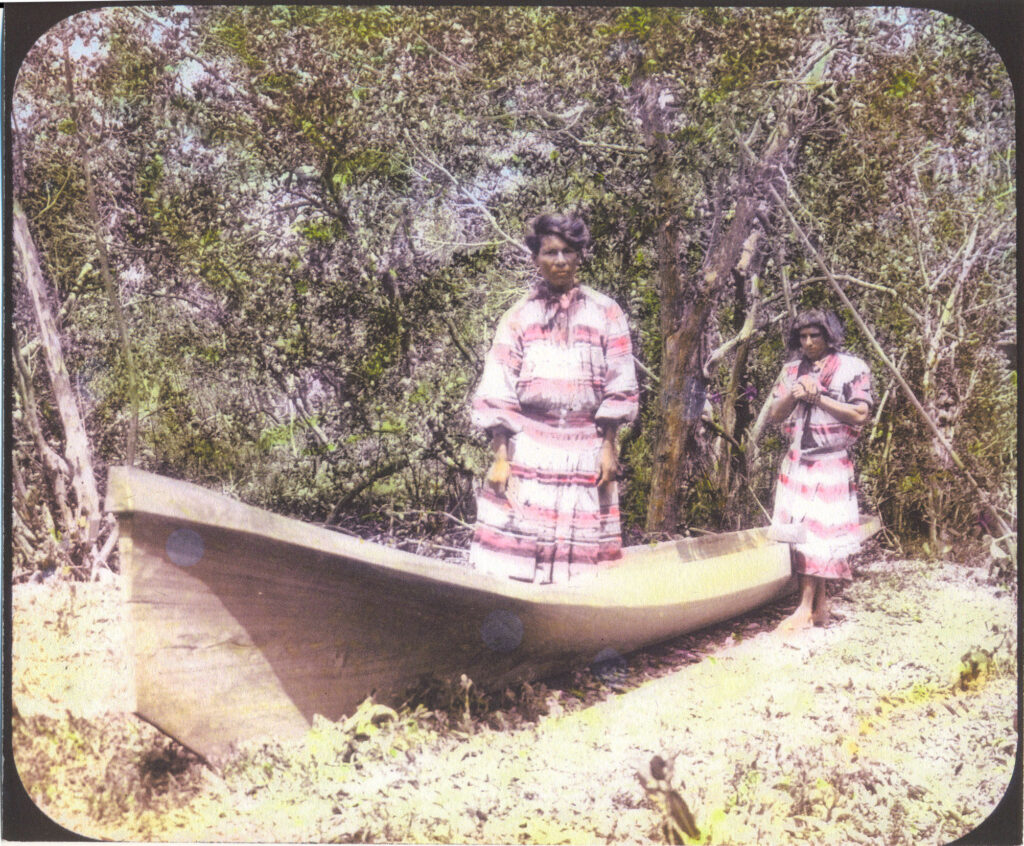
2001.3.1, ATTK Museum
Here, two men stand posing in a canoe beached on the shoreline. Note that both men are seen in the following slides as well, and it is most likely the same trip.
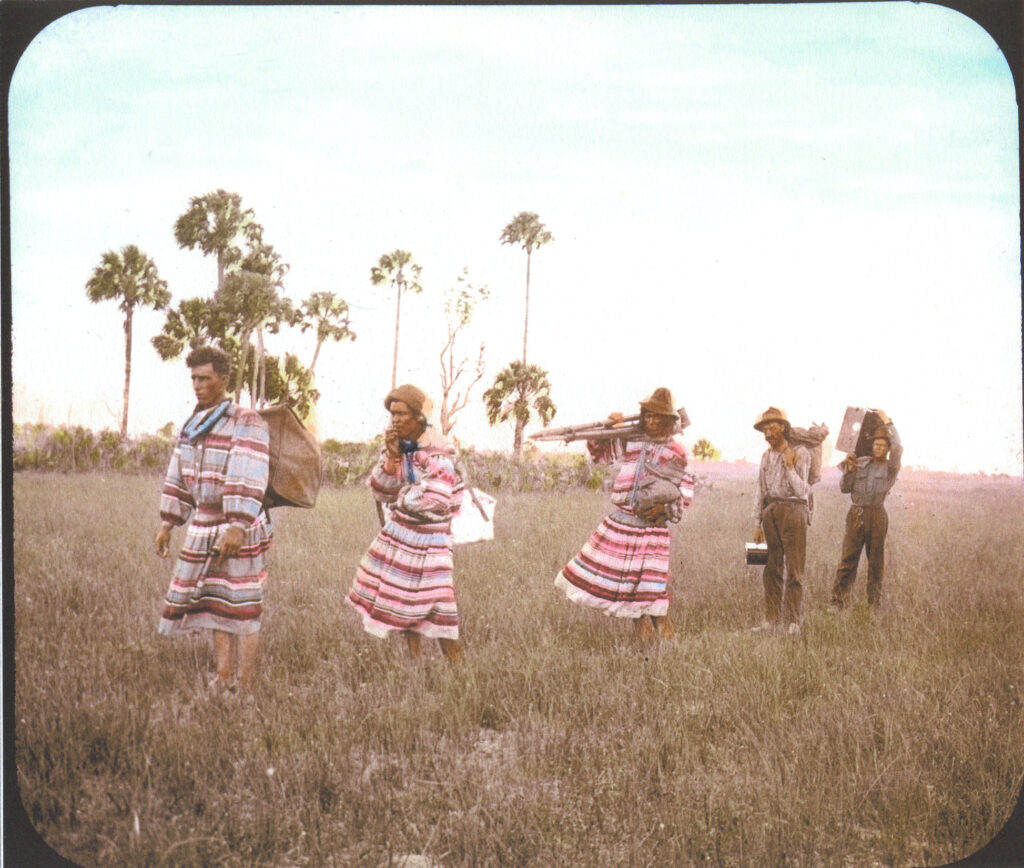
Three Seminole men carry photographic equipment through swamp with white men in the background. It is believed to be a survey group for the Tamiami Trail circa 1919, with guide Abraham Clay in the center. Two white men follow the group.
2001.3.6, ATTK Museum
A Seminole woman sits tending the fire, cooking with multiple pots. Note her necklaces. She has many, many beaded necklaces adorning her neck. She was probably the wife of the Seminole man sitting to the left in this image. In another image in the Ah-Tah-Thi-Ki Museum collection, they pose with their child.
2001.34.4, ATTK Museum
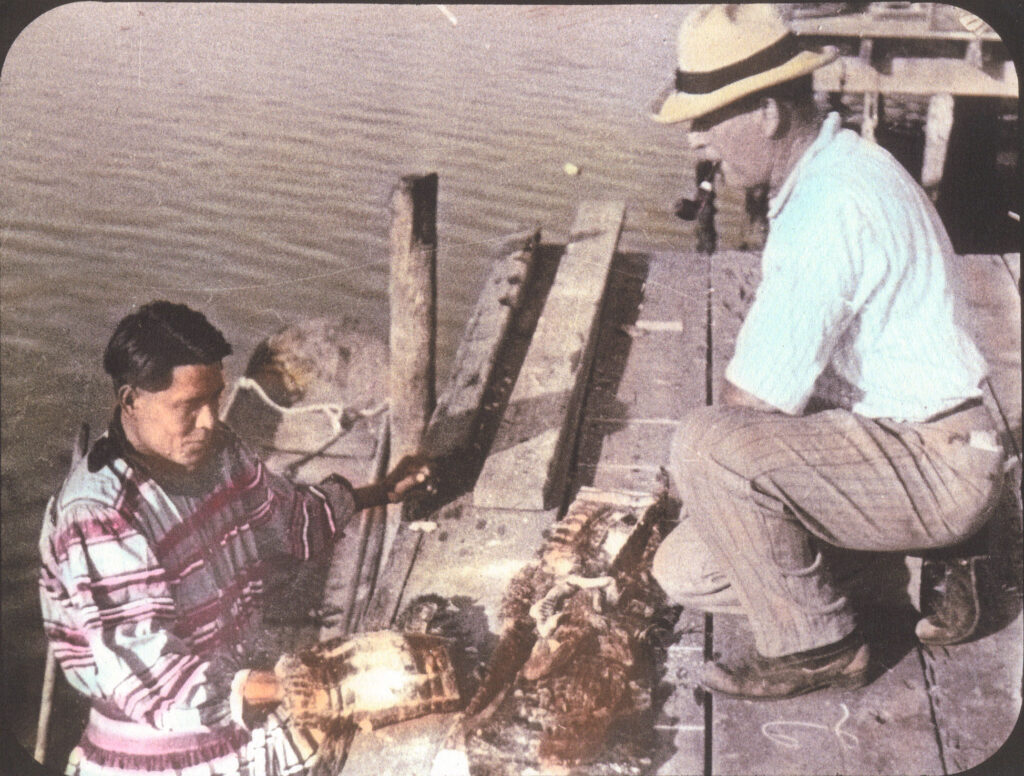
Here, a Seminole man ties up alligator hides at dock while a white man looks on. Alligators were, and still are, incredibly important culturally for Seminoles. During the Seminole War Period and beyond they were a food source. Their hides, as shown above, were also a valued trade item. With dwindling resources in the Everglades, they were no longer able to quietly live. Trade became a lifeline and resource during this transitional period, and trading posts were necessary for survival. Later, the relationship between Seminoles and alligators would grow and change, with stylized versions of their hunting techniques morphing into alligator wrestling shows.
Slides by Julian Dimock
Julian Dimock, who has been the subject of a Seminole Snapshots post once before, also has a number of lantern slides present in his photographic collection that resides with the Ah-Tah-Thi-Ki Museum. These glass-positive copies of his images would have been used to project them onto a larger screen. During his career, he took thousands of photos of South Florida, particularly during a transitional period of history for Seminoles. As the world around them changed and the Everglades shrunk, they too were forced to change and survive.
His images, which range from landscapes to people, places, and wildlife, often depicted Seminoles during a time in which they were only beginning to reconnect with the Western world. In 1920 he would donate over 4,000 glass negatives and photographs to the American Museum of Natural History, where the largest collection of Dimock images is still preserved. We encourage you to explore Dimock’s Collection, which is available online through the American Museum of Natural History.
2012.3.33, ATTK Museum
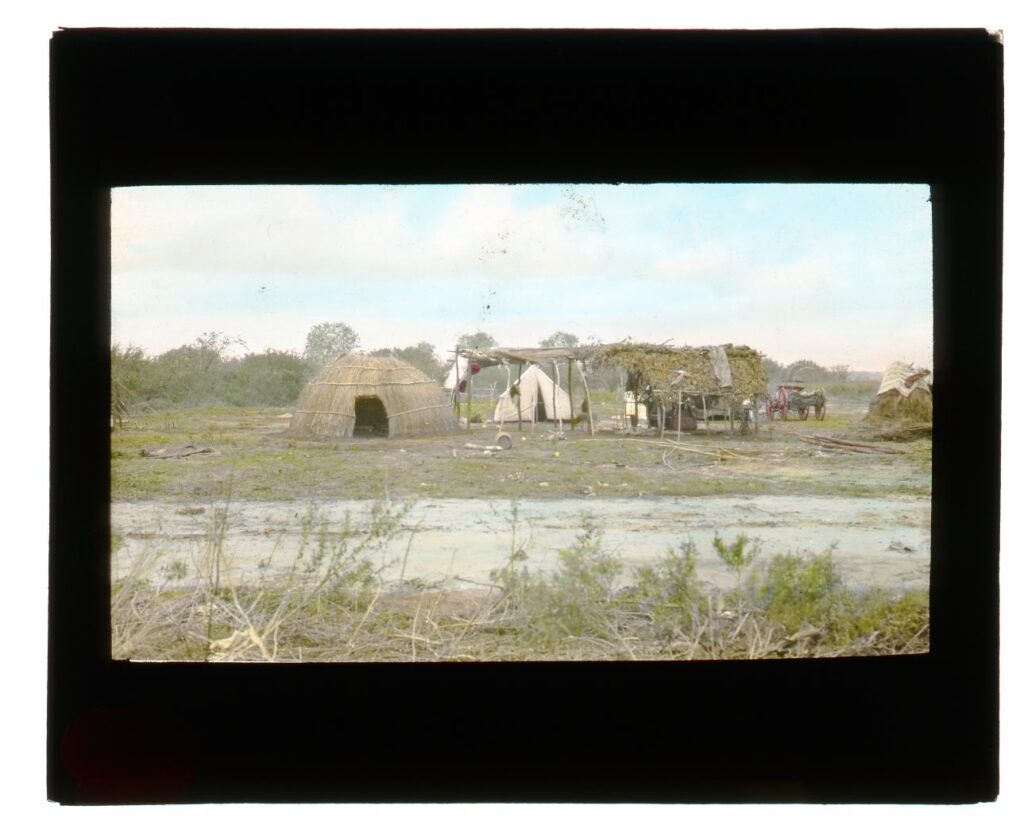
Dimock’s expeditions over the years captured Seminole life during this time of transition, possibly better than anyone. Above, you can see a temporary camp, complete with a fully enclosed structure. There is also a wagon to the far right.
2012.3.32, ATTK Museum
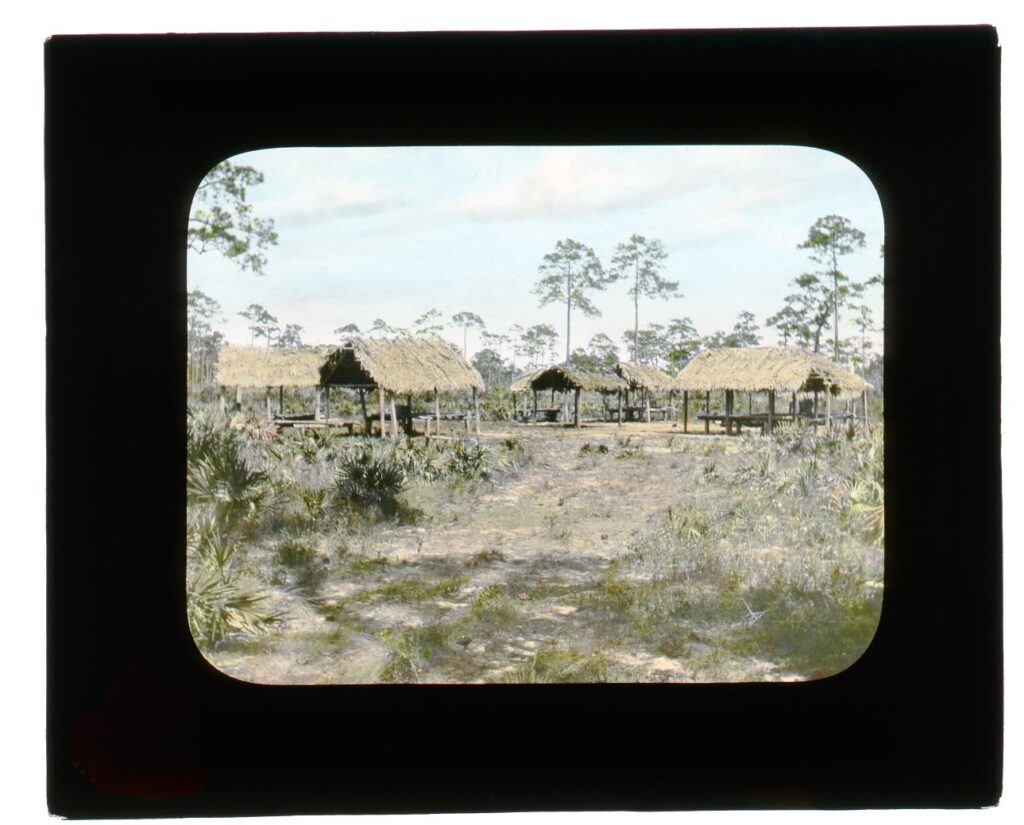
Here, you can see a group of chickees. The image has been hand-tinted.
A Moment in Time
Lantern slides now can be looked at as a bygone product of the early photographic industry. Their unique place in history would eventually be replaced, but the importance of these images can’t be overwritten. The glass-positives in the Ah-Tah-Thi-Ki Museum represent a period of huge transition for the Seminole people. This transition period also signals one of the first times Seminoles were photographed after coming back into contact with American settlers.
Following the Seminole War period, most had isolated themselves in the heart of the Everglades for safety. By the end of the 19th century Seminoles regularly traded at a number of trading posts, connected through the water of the Everglades The turn of the century would require them to adapt even more as the trading post era began to wane. Around this time, tourist camps also began to make their presence known, with Tom Tiger’s camp opening in 1904. Fighting for survival, they would adapt and change along with the world around them, while trying to keep the Seminole culture, and story, alive.