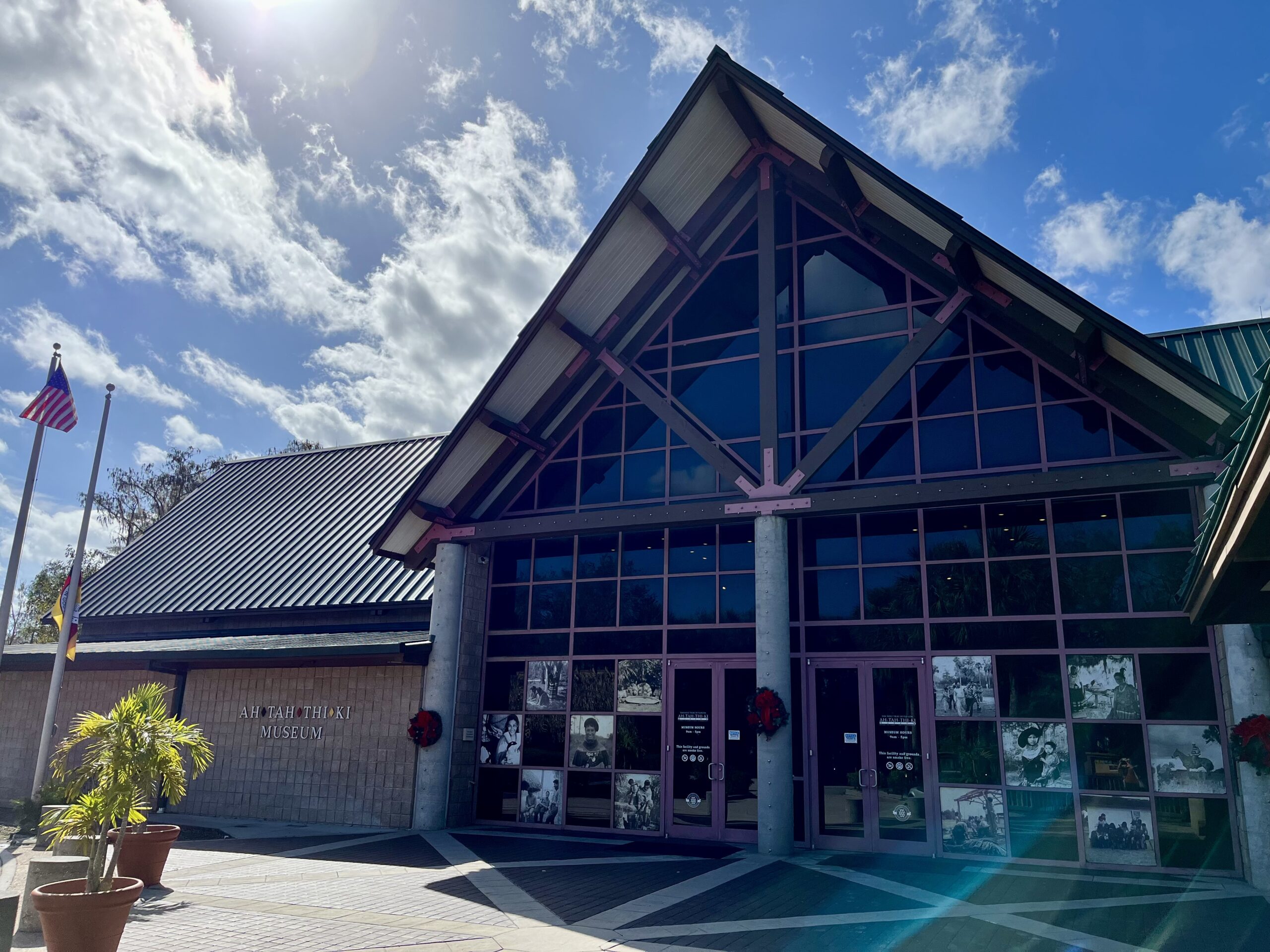

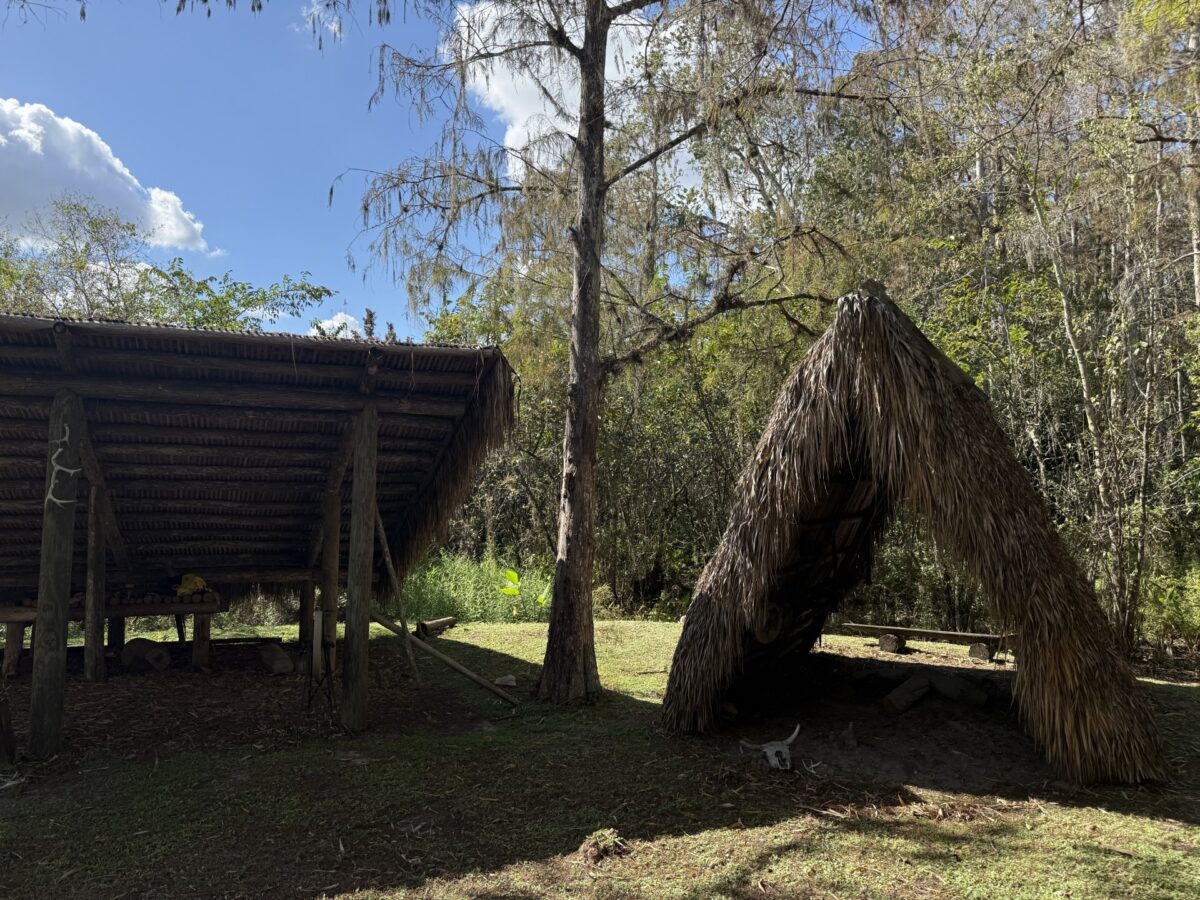
Everything You Need to Know about Taking Your Kids to the Ah-Tah-Thi-Ki Museum
Every parent knows the horror of showing up somewhere, kids in tow, and finding out that it is not kid friendly. Add in investing time, money, and labor in the travel to that destination, and many would throw in the towel. This week, we are exploring the experience of having kids along for the ride during your Ah-Tah-Thi-Ki Museum visit. Since the Museum is most likely a bit of a drive no matter your point of origin, we want to ensure you get the most out of your experience!
For the purposes of this blog post, I visited the museum with my three children, ages 5, 2, and 3 months. All my experiences at the Museum were my own, and don’t reflect the opinions of anyone but the author. For an inside look into the exhibits available right now at the Museum you can visit our last blog post! The intention of this narrative is to give people the information they need to have a successful visit, and to encourage them to experience the Ah-Tah-Thi-Ki Museum for themselves. It should be noted that while I have been to the Museum many, many times this was the first time I had brought any of my children.
We also visited during the American Indigenous Arts Celebration (AIAC), so in addition to the exhibits and boardwalk we were able to partake in the fun and festivities of that event, as well. Our visit being during AIAC meant there were more people on campus than a typical Museum visit, as well as more available to do.
Things to Consider Before the Visit
When preparing to take all three of my children to the Museum, I really considered what would be helpful and what wouldn’t when packing. Even though it is only an hour or so from a major metro area, there isn’t anywhere to buy certain things that might make the experience smoother on reservation. I encourage you to consider your specific needs when visiting and set yourself up for success. For every visitor, I would pack sturdy walking shoes, water, sunscreen and sun protecting clothing.
Parking, Snacks, and Getting Home
The Big Cypress Seminole Indian Reservation is a decent trek from any major metro area. Although there is a gas station on reservation, it is a good idea to fill your tank before you leave! If you are coming from the East coast, you also can stop at the Miccosukee Service Plaza. For those with electric cars, the Museum has four Blink Electric charging stations with J1772 type plugs in the parking lot. Free parking is available directly across from the Museum, with spacious, well-maintained bathrooms (and a water bottle filler!) available in the parking lot. Restrooms are also available inside. However, there is no dedicated nursing room for mothers.
You may be wondering, what food is available around the Museum? The Museum itself does not have a café, but right down the road there is a full-service restaurant, Swamp Water Café. With a menu that ranges from a full American-style breakfast to Indian tacos, there is something that would please even the pickiest palates. Weekly specials also keep the menu fresh, adding to the already impressive menu.
If you’re just looking for a quick snack, the Big Cypress Landing convenience store is at the edge of town. Also known as Sadie’s, it also has a kitchen that offers quick, convenient food in addition to packaged options like chips and drinks. Remember, snacks and drinks other than water are not allowed in the exhibit spaces or inside the Museum itself. But, if you would like to pack your lunch, there are picnic tables and other places to stop and eat on the Museum campus.
Our Family’s Visit
Every kid is different, but each one will find things that they love along the way. The trick is making it an experience, which is easy to do at the Ah-Tah-Thi-Ki Museum. The blend of indoor/outdoor options, exciting, colorful exhibits, and a relaxed atmosphere gives the perfect opportunity for children to explore, learn, and ask questions. For our visit, we walked through the entire exhibit space and also completed the one-mile boardwalk.
Often as parents we depend on things like strollers to move around with our kids, even indoors. While strollers may work for you inside the exhibit space, I would personally not use a stroller if you were planning on walking the boardwalk if at all possible. They do fit width wise, but often there are many people walking and enjoying the cypress dome and travelling in both directions. The boardwalk is also wheelchair accessible, and I would personally prioritize that space for wheelchairs.
With my kids, the 5- and 2-year-old walked, and I used a baby carrier for the 3-month-old. The entire boardwalk is a mile long, and my 2-year-old easily completed the whole circuit. The boardwalk is sturdy, solid, and well maintained. Mesh screens enclose all of the handrails and below, meaning you don’t have to worry about any openings that kids could slip through.
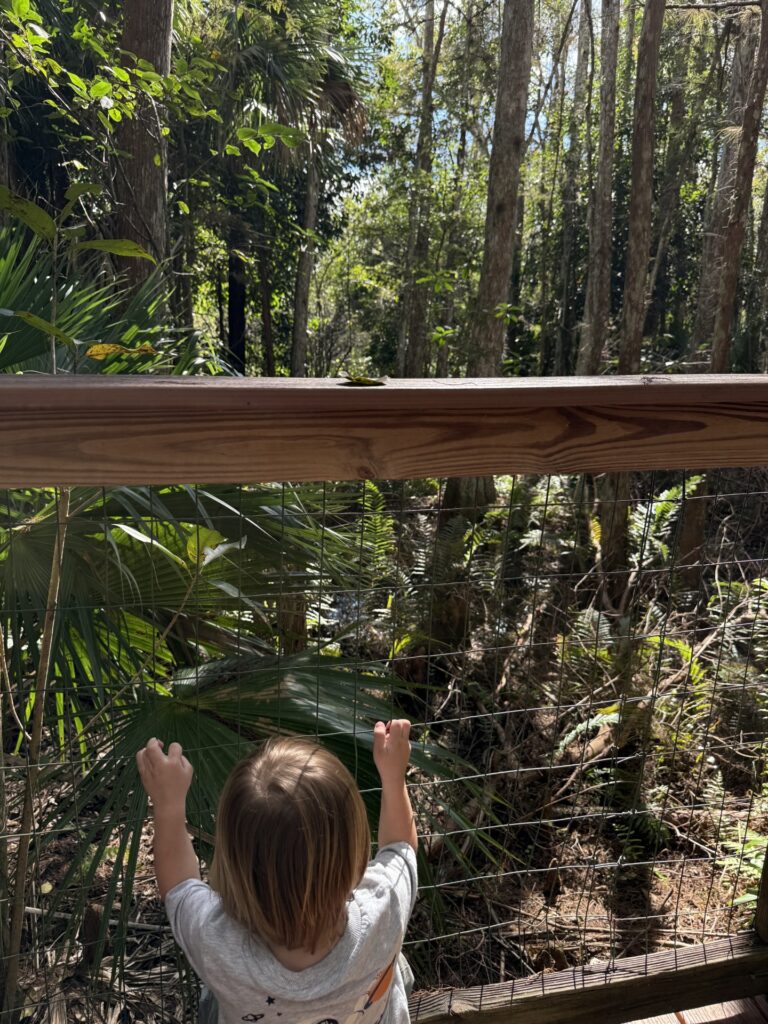
Don’t want to brave the boardwalk? Just outside the front doors of the Museum is a pathway to the Sculpture Garden. This area is perfect for younger toddlers to explore, as it is a much smaller and more intimate walking space. The pathways are even and wide, and you’ll continue your learning journey by walking through the sculptures. You can learn more about the Sculpture Garden, and the artists, here in a previous blog post.
Top Highlights
Below, I will outline the three top highlights, identified by my two older children. Honorable mentions go to the picnic chickees, Sculpture Garden, the Hunting Camp, and the Princess Photo Op inside the Seminole Princesses’ exhibit!
The Turtle
The Ah-Tah-Thi-Ki Museum boardwalk is the perfect opportunity to blend learning and fun. The boardwalk is one mile-long, and winds in a circuit through a 60-acre cypress dome. The cypress dome is teeming with plants and animals. Along the way there are helpful, informational signs that identify important plants, animals, and other interesting features.
Before we started our journey, I prepped my kids to keep their eyes open for any flora and fauna, and we had a little notebook on hand to write down our observations. I had intended to go through the winter birdwatching list, but the boardwalk was pretty busy and we didn’t see too many birds while walking. On a quieter day, the boardwalk is a prime birdwatching location, and actually part of the Florida Birding Trail.
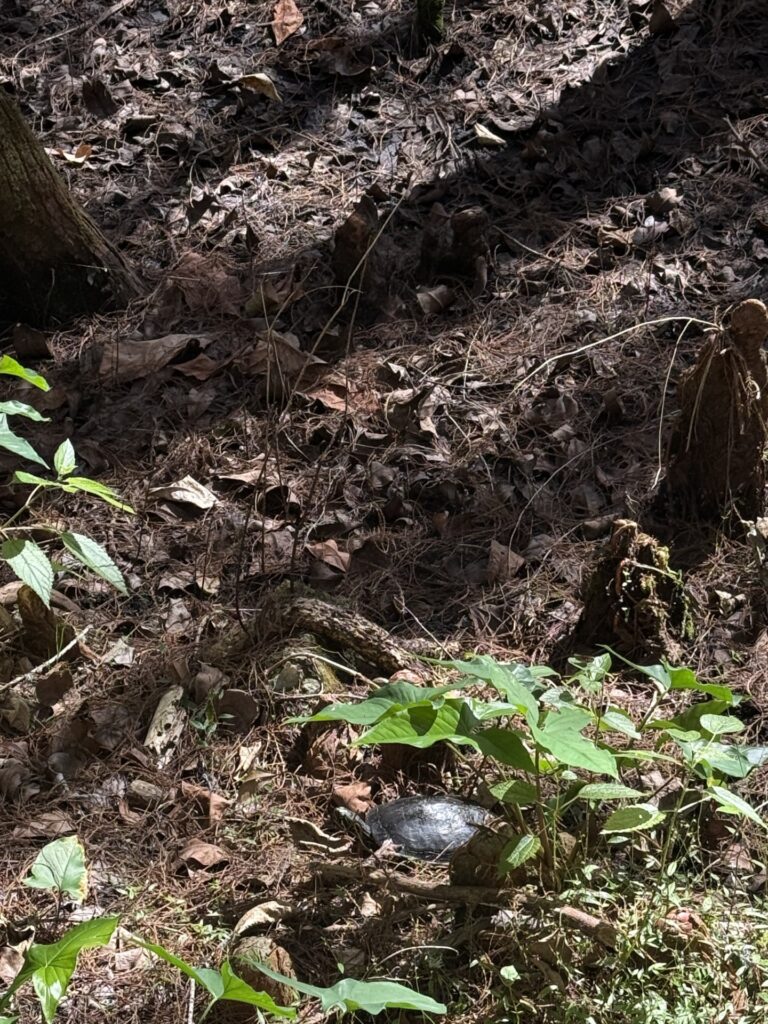
But we spotted a turtle with its head poking out! Both of my bigger children were absolutely fascinated with the turtle, and it spurred them to keep their eyes open for the rest of the loop. We also had fun trying to find the various plants identified on the boardwalk signs, as well as any plants I knew off the top of my head.
I encourage you to build this into your time at the Museum, and coach your kids in trying to spot and identify as many plants and animals as you can. Remember, do not ever leave the designated walking areas, and do not touch the plants and animals that you might come across. The cypress dome is their home, and you are a visitor.
Animal Patchwork
The second top moment for my kids inside the Museum was in the “Taweeahche: Seminole Patchwork” exhibit. It was the first one that they walked through, but also the exhibit they spent the most time in! Both older kids loved looking at all the bright colors and intricate patterns of the patchwork. One loved the patchwork flowers and butterflies, and the other was enamored with the “Ringling Dress.” But both could not stop talking about the animal patchwork. Below, you can see an image of a sample piece of animal patchwork that is part of the exhibit display. Another piece also includes animal patchwork in the garment.
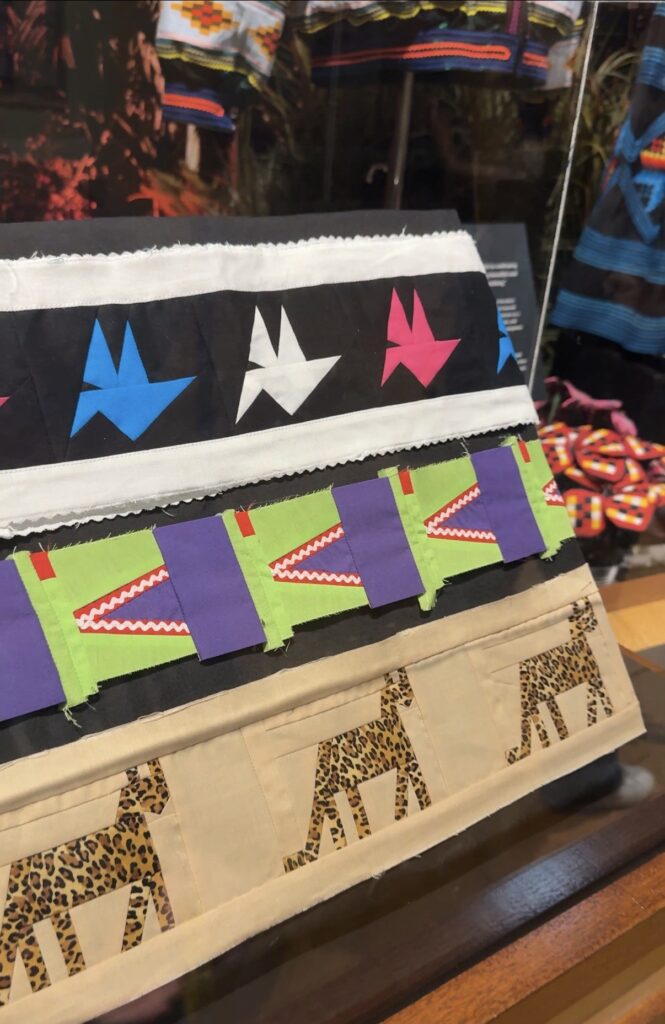
The three banded sample piece depicts birds, alligators, and big cats. A garment directly behind the sample also includes deer. The alligator heads in particular were particularly fascinating. My kids had just seen the alligator wrestling demonstration by Billy Walker at the American Indian Arts Celebration a few minutes before we came into the exhibit space.
The Fire
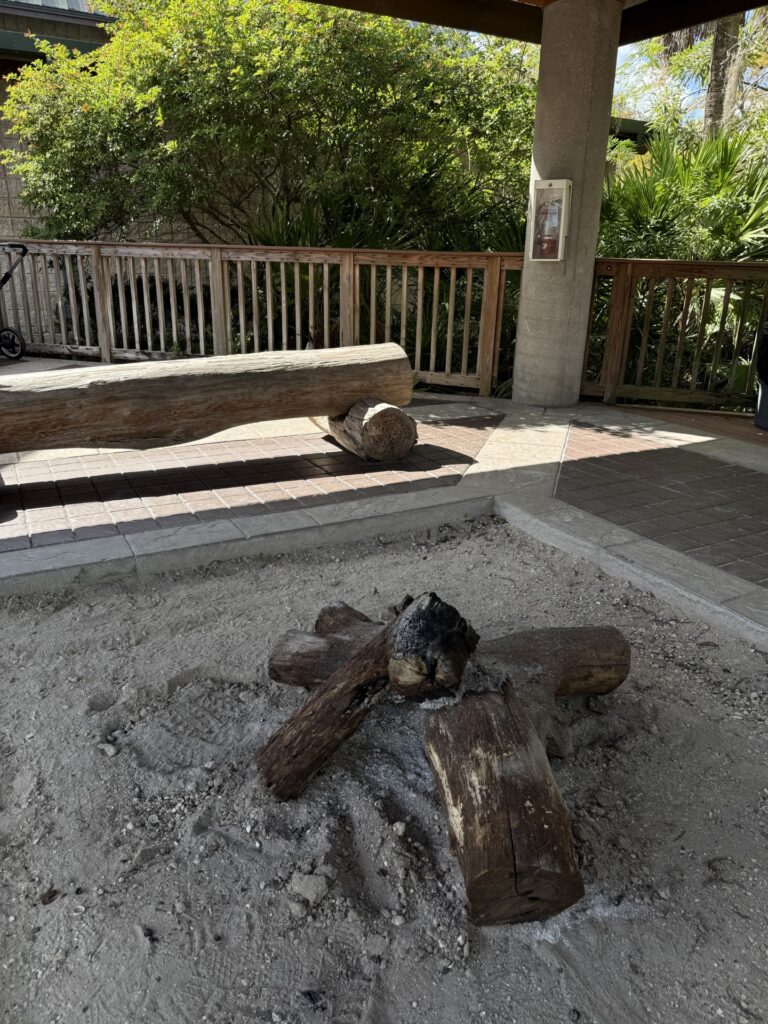
After our time inside the Museum and the Boardwalk was over, we walked back to the front entrance of the Museum. Located just outside the doors is a fire, with bench seating. This was the third and final highlight. While seated at the fire, we talked about what the two had learned during our time at the Museum, their highlights, and answered any questions they had. It was an incredibly nice moment to debrief. It also gave us a moment to rest, recharge, and drink some water before walking back across the street.
Even though I would probably say the Ah-Tah-Thi-Ki Museum is best enjoyed by kids 5+, we still had an amazing time with my younger children in tow. The 2-year-old was also able to explore the boardwalk in a safe way. Overall, it was a very successful visit, with lots of fun, learning, and positive experiences.
Tips and Rules from the Museum
- No snacks or drinks other than water inside the Museum.
- Pictures are allowed, but no flash photography!
- Do not touch the exhibits, unless they specifically have an interactive component.
- Children always need an adult to accompany them throughout the Museum campus.
- For any Museum events that include vendors, cash is encouraged!
Kid-Oriented Programming with the Ah-Tah-Thi-Ki Museum
The Ah-Tah-Thi-Ki Museum works hard to educate, enrich, and encourage all of their visitors, including children. There are numerous opportunities to come and experience the Seminole story, both at the Museum itself and beyond. We asked Abena Robinson, the Education Coordinator at the Ah-Tah-Thi-Ki Museum, to write a list of educational and kid-oriented programming for 2026. She shared the following list, as well as noting that the Ah-Tah-Thi-Ki Museum website “is filled with a plethora of information and resources about the Ah-Tah-Thi-Ki Museum as well as Seminole Arts and Culture!”
Student groups (including homeschooling groups!) are encouraged to also book field trips with the Museum. Abena notes that field trips are “geared to educate and inspire all about Seminole Life and Culture,” and that “our museum educators are experts and will give you an amazing Tour filled with aspects of Seminole life and history!” For schools that might want someone to come present on their campus, Mr. Van Samuels is the Ah-Tah-Thi-Ki Museum Outreach Specialist. His customized presentations are 45 minutes long, with a 15-minute Q&A session following. The cost for his presentations are $250, made payable to the Ah-Tah-Thi-Ki Museum.
You can find more information, as well as Abena’s contact information, here.
Four Upcoming Festivals in 2026
There are four upcoming opportunities in 2026 for you, your family, and even your school to come out and experience the Museum! All four of these include free admission to the Ah-Tah-Thi-Ki Museum.
The Indigenous Arts and Music Festival on February 5-7th, 2026 at the Junior Cypress Rodeo Grounds on the Big Cypress Seminole Indian Reservation is a wonderful event where students and teachers will gain knowledge on Seminole culture and traditions. Native food, Native contemporary Music, Native vendors and much more! Abena advises that “If you wish to bring your students to this great experience please let me know as soon as possible how many students and teachers you will bring! We have 300 students confirmed for Feb 5 and Feb 6th we have 292 students. Slots are filling up quickly!”
There are two opportunities for you to celebrate Earth Day the Native Way with the Ah-Tah-Thi-Ki Museum. The Earth Day celebration at Okalee Village in Hollywood will be April 14, 2026. Just two days later, the Ah-Tah-Thi-Ki Museum will host another event on Big Cypress April 16th. Abena shares that “Earth Day is an epic event! Native foods, Native dances! Native way of preserving the earth and community! Educational workshops and presentations! Educational Resources! If you wish to bring students to this great experience please let me know how many teachers and students you will bring, what time you will arrive and depart and how many buses you will bring!”
The next American Indigenous Arts Celebration (AIAC) will be November 2026. This annual celebration is the perfect moment to bring school groups of all sizes. Featuring Native music, food, dance, art, crafts, and so much more! Abena notes that they usually have 600-800 students attend the two-day event. “This is usually offered on a first come first serve basis!” Abena shares “Unfortunately we had turned away many schools because we were maxed! Let us know if you are available and how many students and teachers are coming ASAP!”