
What Actually Happened: No Peacetime in the Long War
Seminole history has been told from a colonialist point of view for hundreds of years. Only recently have there been concerted efforts made to highlight the Seminole voice in that history. Today, the Seminole Tribe of Florida works hard to elevate and highlight their history from their own words and perspective. This week, join us for the first installment of our new blog series: Correcting the Record. In this series, we try and uncover and correct misconceptions and mistruths around Seminole history and culture. This week, we are going to look at the lie of “peacetime” during the Seminole War period.
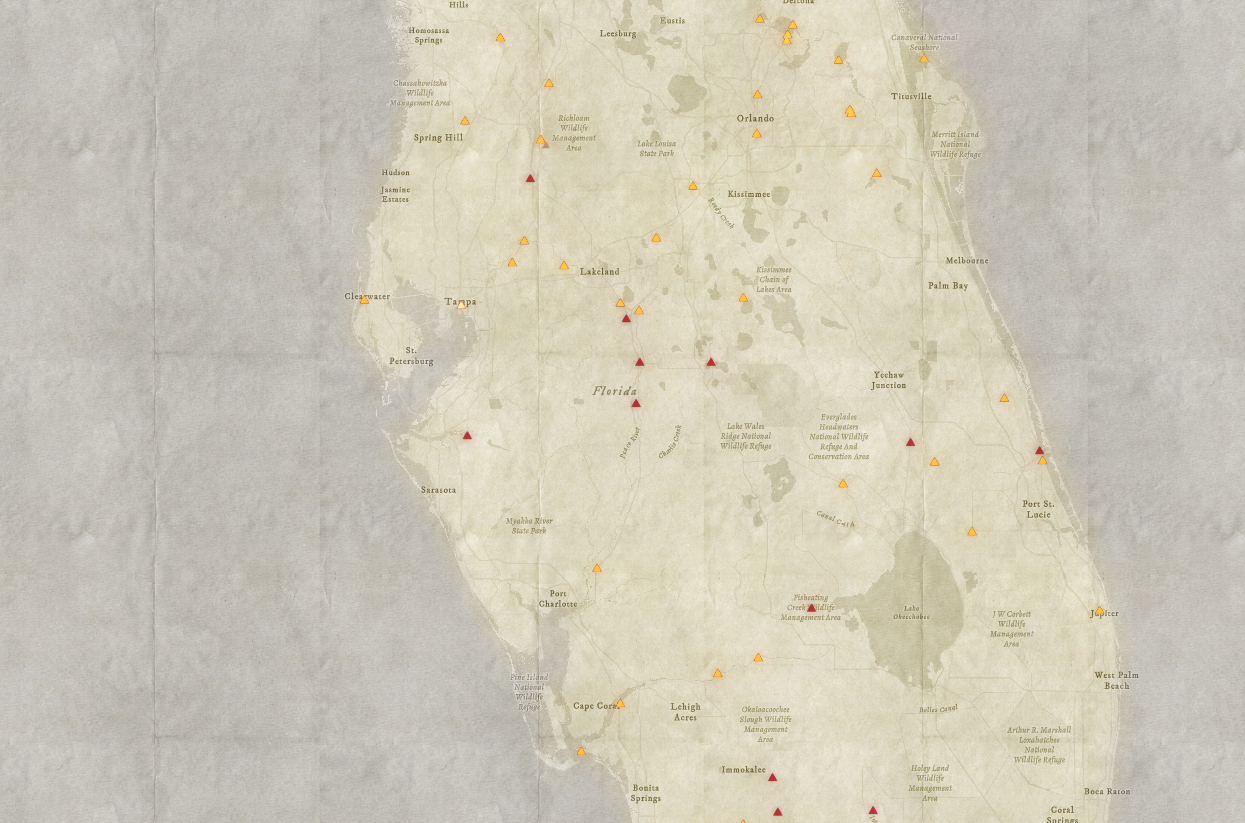
In our featured image, you can see a screenshot from the recent StoryMap shared by the Seminole Tribe of Florida Tribal Historic Preservation Office. Titled “The Indian Removal Act: The Seminole Tribe of Florida. Tracing the Trail of Tears and Triumphs” shows military forts during the Seminole War Period.
The StoryMap reads that “The forts established during the first half of the Indian Removal Act are shown in orange, illustrating how the U.S. military extended its reach across central Florida. The U.S. Army pushed further south, as shown in red, during the second half of the Act, encroaching on the Seminole’s refuge in the Everglades.” If you proceed through the StoryMap, you might notice that a significant portion of the red-tagged forts were constructed during “peacetime.”
All of Florida is Seminole
Living in the 21st century, our lens of Florida history is often skewed by colonialism. History is recorded by those in power, and for a long time that narrative was the only narrative being told about Florida’s history. We often think of Florida in a narrow scope, lasered down to a few hundred years since the Spanish stepped foot on the peninsula. Since then, the Indigenous peoples of Florida, Seminole ancestor tribes, have been whittled down, constrained, and eradicated by war, illness, and assimilation. Those who remain can be found in the Seminole Tribe of Florida, the Miccosukee, and throughout Indian Country.
While outdated and western-centered history books often state that Seminoles only came to Florida in the 1700s, this is an oversimplification that intentionally muddies the history to undermine the Seminole perspective. It is important that whenever we talk about Seminole stories, especially those that involve an intentional skewing of history to those in power, we remember that the history of Seminoles in Florida began long, long ago.
Seminole ancestor tribes have lived, travelled, and traded throughout the entire Florida peninsula and the Southeast forever. The remnants of these cultures can be found both archaeologically and in Spanish accounts, although this first contact would spell the beginning of the end. The term “Seminole” is a relatively new one and in fact, “that word would be placed on their descendants by outsiders and only came to be adopted later due to the threat of the common foe that united the Florida people.”
The Seminole War
In previous blog posts, we have emphasized that for the Seminole people, the Seminole War period was one Long War. Colonialist history remembers it as three wars, broken up over decades. The First Seminole War is listed in history from 1817-1818, with General Jackson’s campaign to invade Florida. But, from the Seminole perspective, this war began in 1812, with those first organized acts of aggression and cross-border skirmishes. These ‘defined’ histories list only the years when Congress officially declared action.
To Washington D.C., the in-between times were not war. But, to Seminoles, they continued to place their energy, actions, and laser-focused attention to resistance. For Seminoles, the entirety of these decades were wartimes, as they were distinctly and unceasingly under threat. For, “while there were negotiations and times where the Army did not directly engage them, the Seminole still faced regular aggression and violence from American settlers, militia, slave catchers, and even lawmen.”
Activity during the Seminole War period actually highlights this point. Although according to Congress the in-between periods were “peaceful,” this is explicitly not true when we look at the history. The U.S. Army would offer bounties on Seminoles even during the so-called “peaceful” periods. Pioneers would also be financially compensated for capturing or even killing Seminoles. Skirmishes between Seminoles, the United States government, and militia groups still occurred. They also still continued to push for relocation, either through force or coercion.
Military operations did not cease in these moments in-between official war being declared. Following the Second Seminole War (1835-1842), which was the costliest and deadliest of any of the Indian Wars, there continued to be a military presence throughout the state. Many Seminoles had already been forcibly relocated to Oklahoma, with the remaining few protected by the waters of the Everglades. An invisible line was drawn from Fort Brooke to Fort Pierce, along the Peace River Valley. This line separated these settlers and their homesteads, protected by the U.S. Military, from the Seminoles to the south.
A Line of Forts
In 1850, this invisible line would be further made a reality with additional forts being constructed to shore up the military presence. More forts in now-Polk County were added during this time, intended to deter Seminole presence even further. In fact, “Gen. David Twiggs envisioned a line of forts stretching across the state. They would be anchored by Fort Meade, which was being built near a destroyed village on the Peace River.”
This line of forts, which were rudimentary and rustic, was meant to deter the few remaining Seminoles from pushing their way back northward. The Second Seminole War, which “ended” in 1842, was devastating to the Seminole population. A large amount of Seminoles had succumbed to war or been forcibly relocated to Indian Country.
It is important to note that the Indian Removal Act of 1830, which outlines the United States’ justification for this forcible removal and genocide, was passed during “peacetime.” Congress would also pass the Armed Occupation Act in 1842, during “peacetime”. This “offered 160 acres of free land to settlers who agreed to farm at least five acres, live there for five years, and take up arms against the Seminoles if needed.” In effect, it created a volunteer, incentivized militia willing to crush Seminole resistance with very little effort on the part of the United States government.
Fort Meade, Fort Clinch, and Fort Arbuckle
Established in 1849 by Lt. George Gordon Meade, Fort Meade was located on the Peace River in Polk County, FL. It was intentionally placed along a new military road stretching from Fort Brooke to Fort Pierce, linking the military presence on that imaginary line. From this point, Lt. Meade would survey locations of two additional forts: Fort Clinch and Fort Arbuckle. Fort Meade was eventually abandoned in 1854, before being reoccupied in 1857. It would be occupied by Confederate forces from 1861-1864.
Fort Clinch was the next in the trio to be placed, named after General Duncan L. Clinch, who oversaw military operations in Florida from 1827-1836. The fort was located on the northern shore of now-Lake Arbuckle, outside Frostproof, FL. Only ten days later Fort Arbuckle would be erected. Established about 12 miles east of Fort Clinch on now-Lake Arbuckle, Fort Arbuckle was another in the line of forts intended to cut off Seminoles from Western settlers and monitor their actions.
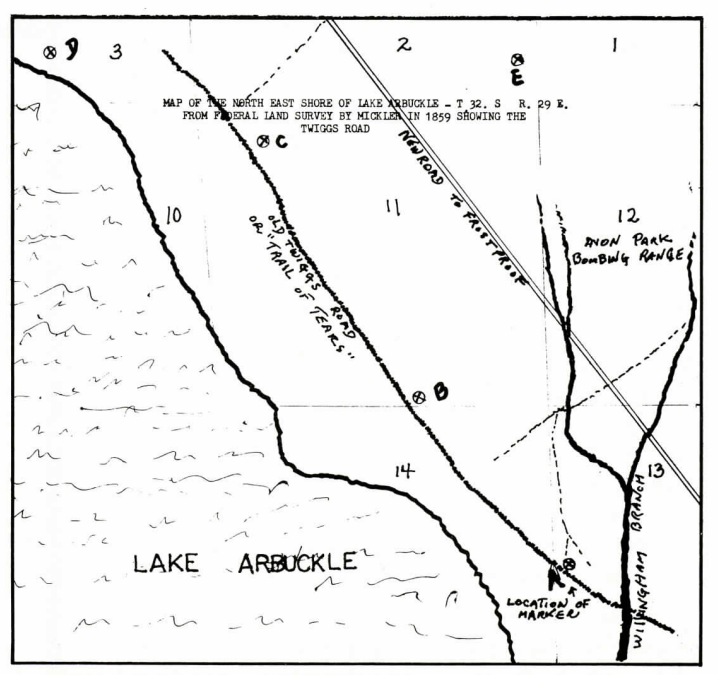
You may notice that Fort Arbuckle does not show up on the STOF-THPO’s StoryMap. The exact location of the fort has been lost to time. Shown below is an 1859 land survey map (with some modern annotations) marking the road where Fort Arbuckle once stood. Although the fort itself had already disappeared by then, its footprint lived on through the military roads built to transport troops and supplies. We do know that the fort location is within the boundaries of the Avon Park Air Force Range, as noted on the survey map.
Both these new forts were crude and remote. The U.S. government placed several companies at the forts, intending to increase pressure on Seminoles and either force or coerce them to leave Florida. Among those who were placed at the forts was one Lt. A.P. Hill. He would later become one of Robert E. Lee’s generals during the Civil War.
Hill would write to his father in May 1850 about the situation. He wrote “We have already been in Florida eight months withering it in tents, and the season for active campaign allowed to pass in inactivity. The time which should have been devoted to forcing the Indians out has been consumed in trying to talk them out, and the Indians as a matter of course have outtalked us.”
Troops were withdrawn from Fort Arbuckle by 1850, with Fort Clinch following in June.
Jacob Summerlin’s Letter
In 1852, Jacob Summerlin would write a letter to then-Governor Brown in Tallahassee. It asked for him to commission a captain to police the Seminole, so they stayed within their “boundary.” Summerlin, who grew up a Florida Cracker, was a shrewd cattleman with hundreds of head of cattle. Seminoles were a threat to not only his worldview, but also his profits. Later, he would become a prominent social and political climber, known as Florida’s Cracker King. In the letter to Governor Brown, Summerlin shared his version of pioneer justice.
In the exhibit “Struggle for Survival: 1817-1858” which exhibited at the Ah-Tah-Thi-Ki Museum in 2016, they outline that “Bounties for Seminoles made it enticing for Pioneers to seek out Seminoles for capture or death. As the letter from Florida pioneer Jacob Summerlin illustrates, not only does he shoot to kill he also tries trickery to attempt to capture Seminoles.”
Interactions like this were frequent, with the Seminoles experiencing violence not only from organized military but also encroaching settlers. In fact, as we also noted above, the government incentivized these pioneers to this violence, in a way that encouraged these clashes with pioneers. Additionally, they had no legal recourse. The Seminole had no avenue to seek justice for murder, theft, and other violence.
1993.5.1, ATTK Museum
The Continuation of the Long War
All of these actions, from verbal and physical pressure, incentivizing settlers, and displaying a show of military force by flooding Seminole lands with forts and troops, would lead to increased tension. There was no peace after the devastation of the Second Seminole War, only anxiety that would grow to a fever pitch and eventually erupt again in the Third Seminole War following the raid on Billy Bowleg’s camp. In reality, the delineation between the First, Second, and Third wars only really pointed to when the United States government would step back to regroup, unable to fully crush the Seminole opposition. No treaties were signed, and no peace was achieved.
In the end, the Third Seminole War would last, officially, from 1855-1858. But again, the cessation of the war only spoke to fatigue rather than victory. Therefore, it is necessary to shift the way we think of this period if we want to fully grasp the truth of it. The Seminoles of Florida were under concentrated attack beginning in 1812 and stretching beyond the end of the Seminole Wars in 1858. There was never truly a time of peace, as their land, families, community, and ways of life were systematically chipped away. Despite this – the full force of the United States government – the Seminoles of Florida were never conquered.