
Shining a Spotlight on Seminole Cattlewomen
March is Women’s History Month! This month on the blog, and on social media, we will shine a spotlight on just a few of the many ways that Seminole women have affected change in the Seminole Tribe of Florida and beyond. Join us as we honor the beauty, strength, and enduring spirit of Seminole women, past and present. Today, we are taking a closer look at the legacy of Seminole cattlewomen, from Ada Tiger to today.
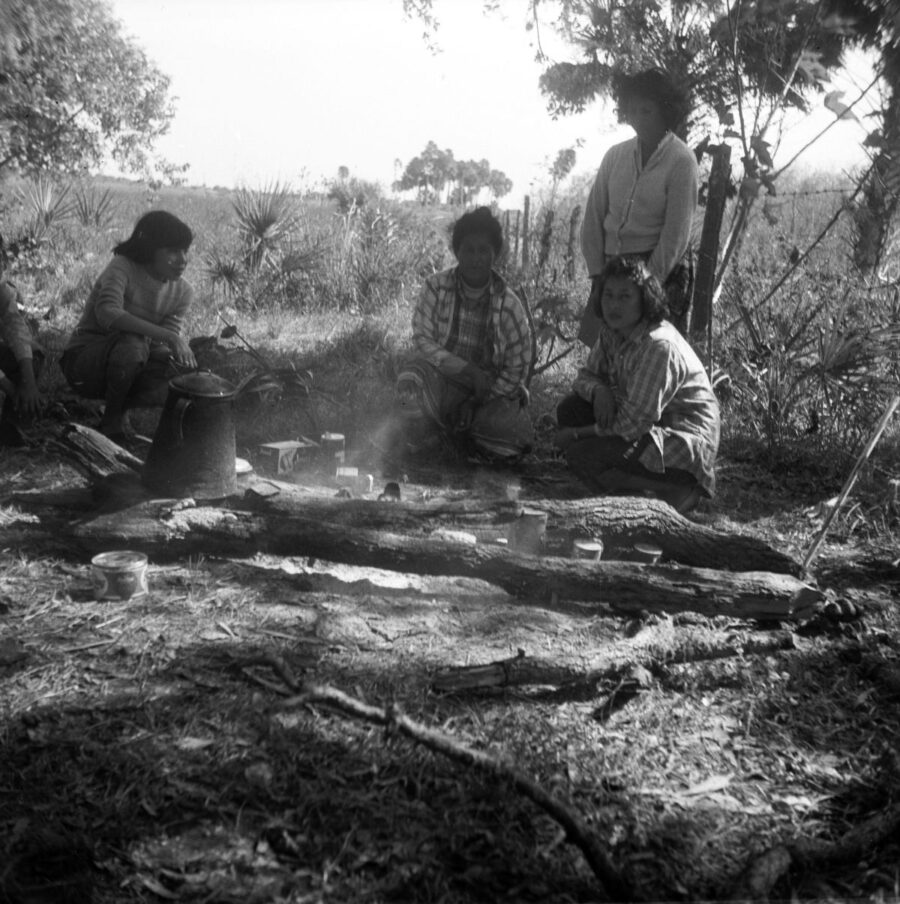
In our featured image, you can see four women gathered around a fire making coffee during a cattle roundup on the Brighton Reservation, circa the mid-1950s. They are identified from left to right as Lorene Bowers, Agnes Johns, Arlene Johns, and Susie Girtman. Agnes Johns was also a graduate of Broward Business College and worked for a time in the Credit Office of the Seminole Indian Agency where she assisted with the bookkeeping for the Cattle Program (Okeechobee News, 12 May 1961).
Cattle Come to La Florida
Seminoles have been cattle keepers since the first cattle arrived in Florida with the Spanish. In 1521, Spanish conquistadors landed on the Florida peninsula, bringing cattle in hopes of colonizing and claiming La Florida. They encountered the Calusa, ancestors of the Seminole people, who pushed the Spanish back for a time. Yet the European cattle remained, becoming the first cattle to roam Florida. Cattle keepers like Ahaya would build vast herds, supporting complex trade networks and villages.
Prior to European cattle on the peninsula, Seminole ancestor tribes in Northern Florida were part of the Mississippian culture, which dominated the southeast. Bison were found throughout this region and were an important cultural touchstone. Florida’s First People “learned to hunt them, working the land around them to draw in the bison herds (Cowkeeper’s Legacy 6).” They would process them for meat and leather. Thus, management of herds like cattle and bison are not only engrained in history, but also the culture. Cattle were an important enough resource that during the Seminole War period cattle keeping was dangerous for Seminoles, who were often targeted by both Westerners and the U.S. Army.
It is important to state that Seminole women have always been a part of that story, regardless of history’s ability to recognize their efforts. Although recent history acknowledges Ada Tiger, she, too, comes from a long history of cattle keeping spanning generations. We encourage you to keep in mind that each of these impactful women carry the history with them, passing it down again to those who will come next.
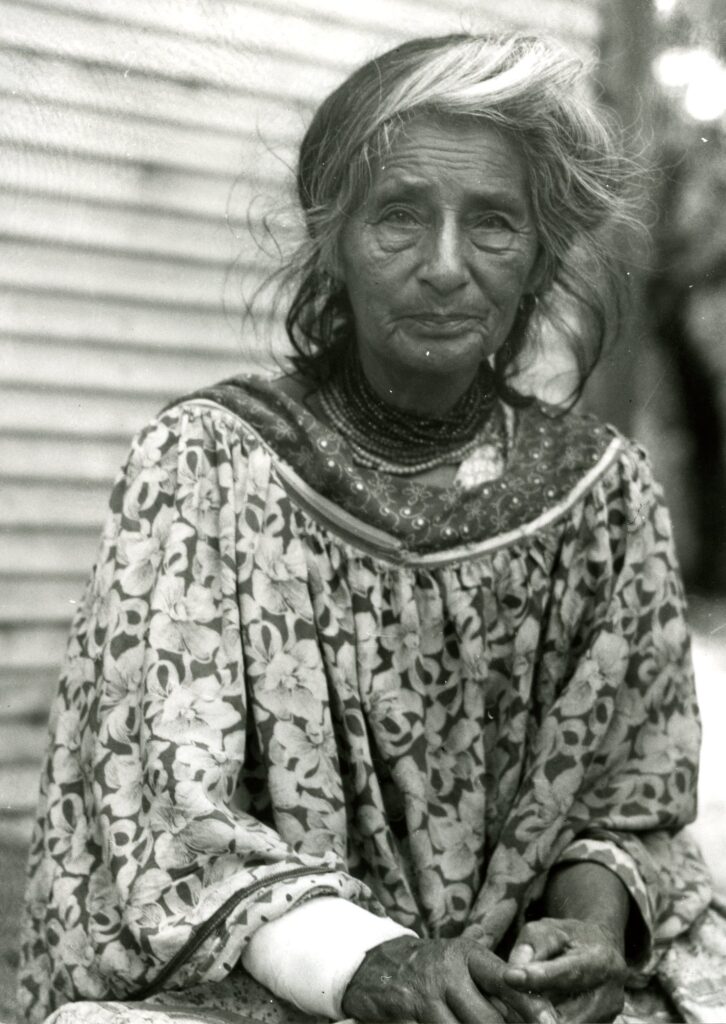
Ada Tiger (Snake Clan)
Half Creek and half Miccosukee, Ada Tiger and her family initially kept their camp around Lake Okeechobee. Tiger became a cattlewoman through necessity, becoming one of the last traditional cattle ranchers and independent Seminole cattle owners. She had inherited her herd from her three brothers, “each of whom had succumbed to tuberculosis or pneumonia within five years between 1914 and 1916 (Oct 2022, Seminole History Stories, STOF-THPO).” She took on the entire responsibility of managing stock, and by the mid-1920s her herd was the largest owned by any Seminole. Some reports placed the number in the hundreds, an incredible number for the lone cattlewoman.
Tiger maintained her herd herself, with the aid of two “cow chaser” dogs that she had raised and trained. Tiger did not use any fences or pens. Instead, “she kept them well-fed with corn grown by the family and worked the area around the camp to ensure it was a place the cattle would want to stay in (Oct 2022, Seminole History Stories, STOF-THPO).” During the 20s, Ada would make the twice-yearly ten-mile trek to Indiantown to sell cattle, treat the rest for fleas, and buy essential goods. Can you imagine herding hundreds of cattle over ten miles alone?
An impressive example of Seminole cattle keeping, unfortunately Tiger would be forced to give up her entire herd by 1928. Tiger and her family would move from Indiantown to the Dania Reservation in 1927, to protect her daughter, young Betty Mae Jumper.
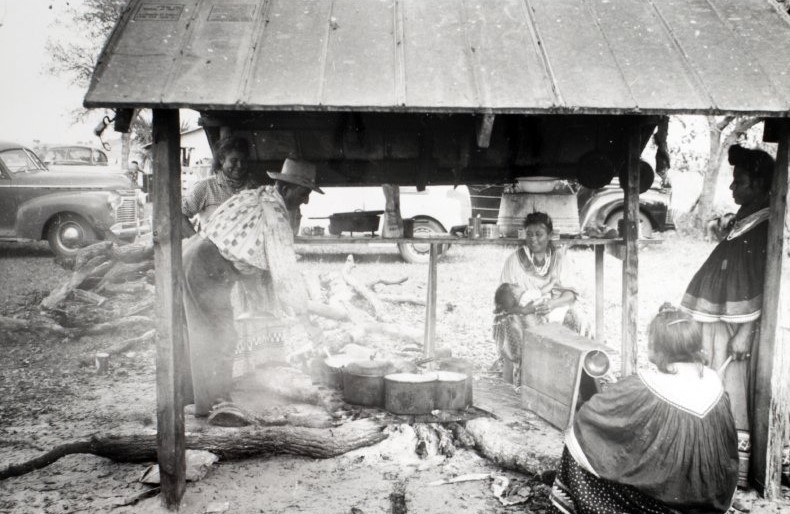
Here, you can see a shot of a meal being prepared to feed the participants of a cattle roundup on the Brighton Reservation. Identified in the photograph are Naha Tiger (stirring food), Goby Micco Tiger (with baby), and Leona Micco Smith (2009.34.1613, ATTK Museum).
The Second Generation
Following in the footsteps of Ada Tiger came a second generation of Seminole Cattlewomen recorded by history. The “Seminole People have always worked cattle in their way, in line with their values. The Tribe, and their ancestors, have a matrilineal and clan-based culture, and so Seminole women have always held important roles in cattle ranching (Cowkeeper’s Legacy 18).” In the 1930s, Seminoles would gain control over just a few hundred head of broken down, dust-bowl cattle from the United States government. Less than a decade later, they would be on track to building one of the most impressive and impactful cattle outfits around.
In 1954, Seminoles would organize a formal cattle association in Brighton and Big Cypress. Cattle keeping was modernizing, forcing Seminoles to adapt to government enforced tick eradication and fence programs. Creative breeding programs and inventive methods would help the Seminole Tribe of Florida’s cattle programs flourish. Although women owners weren’t the norm, a select few Seminole cattlewomen led by those such as Ada Pearce, Lena Gopher, Arlene Johns, and Ada Tiger’s daughter Betty Mae Tiger Jumper took the reins.
For some, they had inherited stock from brothers, fathers, and husbands. Others with pioneering minds “applied for grazing leases and purchased their own herds (Cowkeeper’s Legacy 18).” In an era that did not make space for female independence, Seminole women seized it.
“These women were equals in a time when that equality was rare in the United States. They owned their own herds and took care of all the responsibilities necessary to maintain them, from buying feed to working the trail.” – Lucy Bowers (Snake Clan) in Cowkeeper’s Legacy, page 19.
Florida Seminole CattleWomen Inc.
The legacy of Seminole cattlewomen is not only felt today, but it is still being built. In the 1950s there were a handful of Seminole cattlewomen working independently in control of their own herds. As of 2023 twenty eight of the sixty-two Seminole cattle owners are women. They maintain over 6,000 head of cattle. Some took over herds left to them by male relatives who had passed away. In 2009, the Seminole Cattlewomen’s Association would be created with about 20 women. In a 2013 Seminole Tribune article then-President Emma Jane Urbina talked about how she credits cattlewomen such as “Polly Hayes, Beulah Gopher, Reina Micco and Louise Gopher for meeting first to glean ideas from Sarah Childs, membership chairwoman of Florida CattleWomen Inc., a statewide, all-female organization dedicated to promoting the beef industry.” It started as a way for these women to support each other, to learn, and help make themselves better. They would reform in 2018 as Florida Seminole CattleWomen, Inc., and are still going today.
In a 2019 Seminole Tribune article about the reforming of the chapter, many of the Seminole cattlewomen were asked about their experiences with cattle, and the importance of continuing to be a presence in Seminole cattle.
“I feel it is time to let the world know that empowered women own and operate a cattle business just like the men do,” said Larissa Tucker, who manages her father Alex Tucker’s herd in Brighton. “I am the third generation; my grandfather Johnny Tucker got his cattle in 1952. My kids will be the fourth generation.”
“When I was old enough, my father put me on a horse,” Janice Osceola said. “I’ve been working cows ever since.”
“I respect the tradition,” said Carla Gopher Rodriguez. “We used to have nothing, just the cattle.”
“It’s humbling,” Tucker added. “You work hard for it; it’s your land, your power. You maintain the land; God’s not making any more of it.”
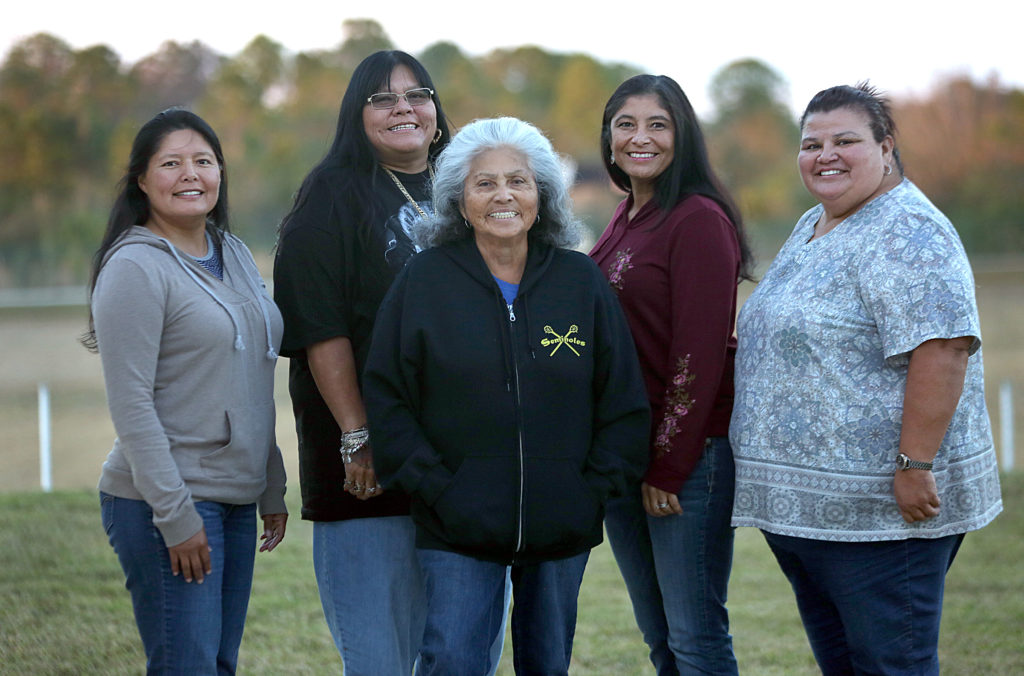
Members of the Seminole Cattlewomen’s Association gather for a portrait before a meeting Jan. 15 2019 in Brighton. From left, Treasurer Carla Gopher Rodriguez, President Emma Urbina, member Martha Jones, Vice President Wendi Riley and Secretary Lucy M. Bowers. Via the Seminole Tribune.
Building the Future of Seminole Cattle
Florida Seminole CattleWomen Inc. is part of the future of Seminole cattle. This chapter “serves as a vital voice for Seminole women in the beef cattle industry. Together the Seminole CattleWomen work to educate, involve, and support each other in building and maintaining the herds. It is a lifestyle and a heritage that has been passed down, from mother to daughter, through the generations (Cowkeeper’s Legacy 19).” As of 2023, the current president of Florida Seminole CattleWomen Inc. is Pauletta Bowers, with Billie Tiger serving as Vice President and Linda Spurlock as the Treasurer/Secretary. In 2024 Pauletta Bowers was featured in a documentary “Women of the Watershed” which addressed the issues of water management and pollution in the Everglades, and how it impacts cattle ranching.
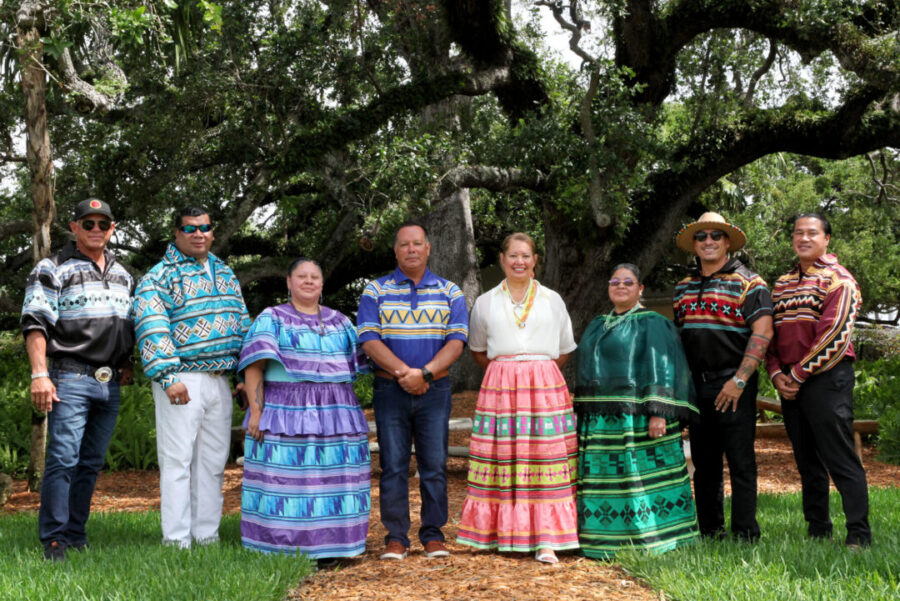
Lucy Bowers, who this year serves as the President of the Florida Cattlewomen’s Association, is the granddaughter of Annie Pearce Bowers, sister of Ada Pearce. Ada Pearce, who is mentioned briefly above, was one of the first Seminole women to own cattle in the 1950s. Lucy’s mother, Elsie Bowers, also inherited her father Andrew Jordan Bower Sr.’s herd in the 1970s, along with her siblings Mildred Bowers, Martha Jones, Gladys Bratcher, Lorene Gopher and Andrew J. Bowers, Jr. Today, Lucy Bowers maintains her family herd with her brother, Marvin. Lucy was instrumental in the revival of the chapter in 2018. Bowers started her journey with FWC in 2022, when she was installed as Parliamentarian. She is the very first Seminole woman to serve on the FWC executive board. You can see a snapshot, below, from her installation as Parliamentarian in 2022.
There are many accomplished, talented, and wonderful Seminole Cattlewomen who were not mentioned here. We encourage you to seek out and support Florida Seminole CattleWomen Inc., as well as Florida CattleWomen Inc. They work hard to support and encourage cattlewomen in the Seminole Tribe of Florida community and beyond. They host meetings that are open to all women, tribal and non-tribal, who live in the vicinity of the Seminole Tribe of Florida. Their contact information can be found on Facebook.